
Christina Evangelin Ebinezer
Marketing Associate



All products don’t fit into all outlets.
One of the common pitfalls for FMCG and CPG brands is forcing the same SKU mix across all outlets. Consumers served by a metropolitan supermarket, a local kirana store, and even a pharmacy may differ greatly in their behavior and preferences.
What is important is not to offer more but to offer the right goods in the right place.
Here comes the importance of Product Assortment Optimization. With an optimal product mix, it is easier for companies to ensure good availability, boost sales, minimize surplus stock, and optimize the use of the available shelf space.
This article will cover product assortment optimization, its significance, problems, and approaches for creating a winning SKU mix in outlets.
Product Assortment Optimization is the process of determining the ideal SKU mix and product assortment strategy for each outlet, channel, or market based on demand, sales performance, consumer preferences, and outlet characteristics.
The goal is to ensure that every outlet stocks the products most relevant to its shoppers while avoiding unnecessary inventory and slow-moving SKUs.
Two key variables determine the type of assortment:
Product assortment optimization is no longer just a category management exercise. It directly impacts sales performance, inventory efficiency, retailer relationships, and profitability across the FMCG distribution network.
Shelf space is limited, particularly for GT, where a retailer can have a limited number of SKUs on his shelf. All products require the same amount of shelf space, focus, and inventory investments. Optimization allows for allocating shelf space to the SKUs with the greatest impact.
Different markets show different consumption patterns, so the same product portfolio is unlikely to perform as well in other places. Product assortment optimization will help to adjust the SKU portfolio to suit local preferences.
Consumers usually go for a competing brand rather than wait until the desired product comes to the perfect store. Proper product assortment helps to minimize out-of-stock situations.
Effective SKU Rationalisation in FMCG helps brand in inventory complexity, operational costs, and working capital requirements. Product assortment optimization helps focus resources on the products that deliver the most value.
Too many slow-moving SKUs can increase inventory cost, create risks of stock aging, and utilize working capital of the distributor for other purposes. Assortment optimization assists brands in concentrating on their productive SKUs.
With proper product assortment strategy, the brand will be able to offer the right products to the correct outlets which increase outlet productivity, strengthen relations with retail partners, and assist in managing inventory efficiently.
When there is an informed and data-driven assortment approach, demand forecasts are made easier. By knowing which products should be offered to which outlets, it becomes easier to forecast demand and plan accordingly.
As product portfolios continue to grow and consumer preferences evolve, product assortment optimization is becoming a critical capability for brands looking to improve sales performance, reduce complexity, and drive profitable growth
Prior to implementing an optimization solution, it is vital to determine what type of assortment model is being used by the brand at present. There are four main types of assortment strategies, and most FMCG brands typically use a combination of all four strategies in different sales channels:
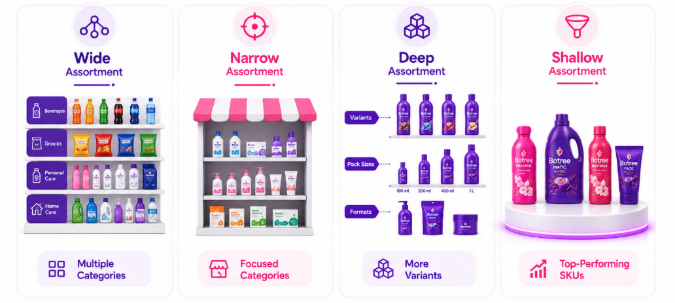
Wide assortments consist of many product categories but a lesser number of SKUs in each. Such assortments are common in supermarkets and large format retail outlets where people prefer having a large variety of products at one place.
In case of a narrow assortment, there will be a few product categories that offer only the most important SKUs. Narrow assortments are suited for speciality outlets like chemists, HoReCa trade channel, or small retail shops.
In a deep assortment, various SKUs, pack sizes and formats of certain categories will be available. Such assortments are commonly seen in categories that require variety of SKUs and give brands room for flexibility.
The assortment that includes high performing SKUs in a lesser quantity belongs to a shallow assortment. This assortment is suited for those retail outlets that have less shelf space.
Even brands with large portfolios and strong distribution networks can struggle with assortment optimization. The challenge is often not a lack of data, but the wrong assortment decisions being made.
Effective product assortment optimization starts with understanding that different outlets require different SKU mixes. The goal is to match the right products to the right outlets based on demand, outlet characteristics, and sales potential.
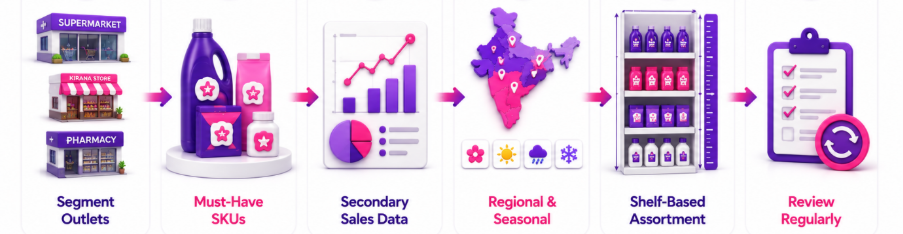
Brands that build assortments around outlet-level demand rather than broad channel assumptions are better positioned to improve product availability, reduce inventory inefficiencies, and drive stronger sales performance.
Manual assortment planning often relies on historical sales reports, assumptions, and individual experience. Modern technology enables brands to make faster, more accurate assortment decisions using real-time data and AI-driven insights.
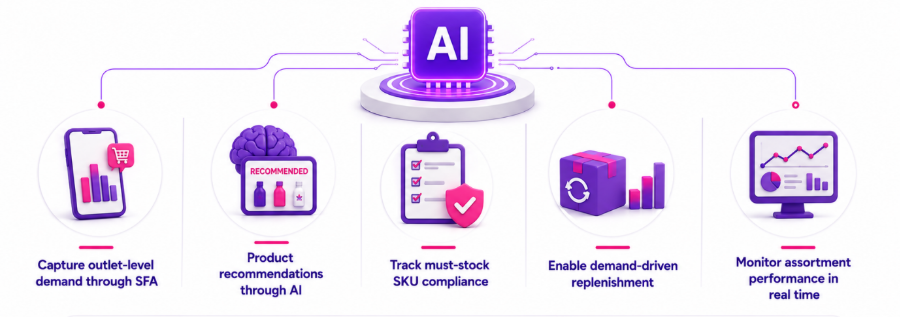
Botree SFA and DMS platforms help brands make smarter assortment decisions through AI, secondary sales visibility, and real-time execution insights.
By combining AI, secondary sales visibility, and field execution insights, Botree helps brands deliver the right SKU mix to every outlet.
Real-World Use Case: How Nabati Improved Product Assortment Decisions
As Nabati expanded its direct distribution network across India, the company needed greater visibility into SKU-level performance and a smarter way to recommend products to retailers.
Using Botree SFA and DMS, Nabati gained access to outlet-level sales insights, SKU-level performance data, and AI-powered product recommendations. Botree AI powered Product Recommender helped sales representatives identify the most relevant SKUs for each retailer based on purchase history and buying patterns.
This enabled Nabati to:
According to Nabati’s sales leadership, Botree’s Product Recommender helped sales teams spend less time taking orders and more time introducing new product ranges, creating a more personalized retailer experience while improving assortment effectiveness.
This demonstrates how data-driven assortment planning can help FMCG brands move beyond intuition and build outlet-specific SKU strategies at scale.
It is important to note that Product Assortment Optimization is not about portfolios. This is all about effective distribution execution. Not the brands with the most SKUs or the bravest launch schedule will succeed at product assortment optimization. Rather, those who know precisely what SKUs should be stocked where and who have the necessary infrastructure to execute this knowledge on each visit.
Secondary sales data for outlets on the ground, AI-based product recommendations, and must-stock compliance tracking have created this opportunity for precision and actionable insight. With such capabilities, brands build an advantage that accumulates over time — a better rate of sales, higher profit margins, better relationship with distributors, increased availability, and lower number of returned goods.
Placing the right SKU in the right outlet at the right time is not a logistical issue anymore. Instead, it is about gathering and using the proper data and executing your plan.
With software solutions such as Botree SFA and DMS, brands have the ability to take advantage of AI-based recommendations, secondary sales tracking, and other tools to optimize their product assortment and increase their profits.

Marketing Associate
Meet Christina Evangelin Ebinezer, our dynamic marketing associate at Botree Software. With a background in HR and marketing, and prior experience as a content writer, Christina brings a sharp eye for storytelling and a knack for crafting engaging blogs and marketing content. She’s passionate about turning ideas into words that drive impact. Outside of work, Christina finds joy behind the piano keys or the wheel—whether she’s playing a soulful tune or cruising down open roads.
What is Product Assortment Optimization in FMCG?
What is the difference between assortment width and assortment depth?
What are the main types of Product Assortment strategies?
What is SKU Rationalization and how is it different from Product Assortment Optimization?
How do Secondary Sales, Sales Analytics, and SFA data improve assortment decisions?
How do Demand Forecasting and Retail Execution support assortment optimization?






Stay updated with the latest trends and insights.