
Christina Evangelin Ebinezer
Marketing Associate



There are plenty of data for FMCG brands to work with.
From field visitations to distributor reports on secondary sales, order placements from retailers to photos uploaded by auditors, dashboard reporting and analysis from management teams – the list of daily data inputs is long. However, despite having all this information available, the vast majority of FMCG brands still cannot answer one very important question:
Several industry studies indicate that organizations leverage less than half the collected data. It is not the process of collecting data which is an issue. What organizations need to do is to turn collected data into insights and insights into actions.
And here is where Retail Intelligence comes into play. Retail Intelligence allows FMCG brands to convert their retail data into valuable insights and drive improvement in availability, retail execution, shelf presence, and sales effectiveness. Rather than acting based on delayed reports and assumptions, brands obtain a timely insight into what happens in their entire network and react accordingly.
Let’s discuss what Retail Intelligence is, its importance, methods of collection and utilization by successful FMCG brands.
Retail Intelligence is the practice of gathering, analyzing, and implementing retail intelligence to boost the efficiency of sales operations, retail execution, and decision making throughout the distribution chain.
In FMCG, Retail Intelligence refers to combining data from various sources such as secondary sales, product availability, shelf presence, pricing accuracy, audit, field execution, and competition. This is meant to give a comprehensive view of the situation in retail shops and take necessary action.
Retail Intelligence platform is frequently used interchangeably with market research and sales reporting, although all three have different functions:
Retail Intelligence is not built from a single data source. It is a combination of multiple data streams that help brands understand what is happening across outlets, territories, and channels.
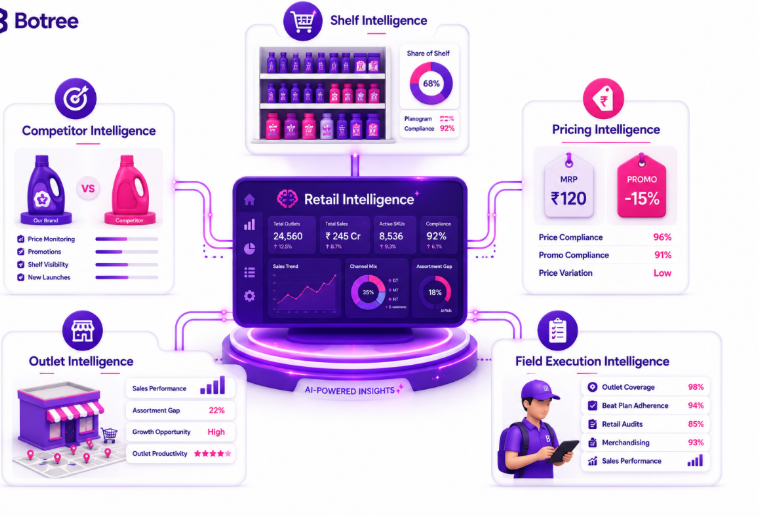
Shelf Intelligence assists brands in getting clarity about their product visibility on shelf. Metrics include share of shelf, shelf positioning, facings, planogram compliance, and stocking. Insights enable brands to detect gaps in their visibility and improve their in-store execution.
Competitor intelligence is vital in highly competitive FMCG categories. Competitor Intelligence assists brands in monitoring competitor pricing, promotions, product launches, shelf visibility, and retail execution. Brands get alerted about threats and opportunities.
Pricing is critical in driving sales. However, even minor pricing issues can lead to major losses in sales and erode retailer trust. Pricing Intelligence enables brands to monitor compliance of prices, promotions and pricing variations across outlets/territories.
Different outlets will perform differently. Outlet Intelligence allows brands to have insight into the sales performance, buying behavior, assortment gaps, growth opportunities and productivity of each outlet.
Field teams translate the brand strategy into reality. Field Execution Intelligence gives brands visibility into coverage of outlets, adherence to beat plans, retail audit activities, merchandising activities, and sales performance.
Retail Intelligence is only as effective as the quality of the data behind it. Modern FMCG brands gather retail intelligence from multiple sources across the distribution network to build a complete view of market execution and performance.
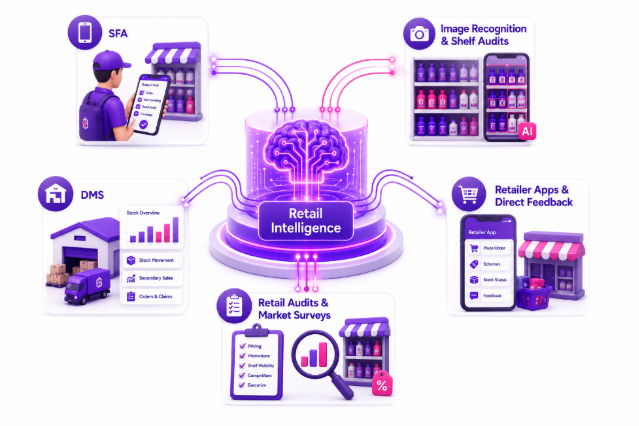
Sales Force Automation (SFA) is one of the key data sources for gaining retail insights. All the activities carried out at each outlet visit including orders placed, merchandising performed, retail audits, and coverage reports provide valuable insights on the performance of the brand in the retail environment and the retail execution.
The use of image recognition technology to analyze images taken during outlet visits allows understanding share of shelf, planogram compliance, product availability and competitor penetration without need to conduct manual audits.
Distribution Management Systems (DMS) tools provide visibility on the stock held by distributors, their secondary sales, movement of stocks, claims, and order placement. Such data helps to better understand real demand dynamics and supply gaps across territories.
Feedback from retailers can be obtained through the use of retailer applications that allow understanding retailer ordering habits, product demand, stock levels, and participation in schemes.
Retail audits allow gathering relevant data on pricing, promotion, competitor dynamics, shelf visibility, and effectiveness of execution at retailers.
When combined, these data sources create a comprehensive retail intelligence ecosystem that enables FMCG brands to make faster, smarter, and more accurate decisions at the point of sale.
Collecting retail data is valuable only if it leads to better decisions. Retail Intelligence helps FMCG brands move beyond reporting and use real-time insights to improve execution, availability, and sales performance at the point of sale.
Retail Intelligence allows brands to monitor field performance using parameters such as TC, PC, strike rate, and outlet reach. The analysis is used by brands to determine where coverage improvements are needed, make routes more efficient, and guide field teams to concentrate on impactful outlets.
Brands can leverage information from secondary sources on sales, inventory levels, and consumer demand at an individual outlet level and use it to predict product shortages and better manage replenishments.
Retail Intelligence allows brands to understand if products are being sold at the right price and whether promotional efforts were properly executed. Monitoring compliance ensures the uniformity of brand representation at retail level.
Competitive intelligence gathered from retail audits and visits provides important insight into competitor activity in terms of pricing, distribution, promotions, and launch of new SKUs.
Not all outlets are created equal. Retail Intelligence can help identify high-potential outlets based on their sales performance, shopping habits, product assortment, and growth potential.
Sales and purchasing information from individual outlets enable companies to know which products sell well within outlets. This will facilitate good product selections as well as improve range sales performance.
Many FMCG brands collect large volumes of retail data but struggle to convert it into actionable insights.
Retail Intelligence has traditionally focused on understanding what happened in the market. AI is changing that by helping brands predict what is likely to happen next and recommend the best course of action.
As AI technology continues to advance, the role of retail intelligence has shifted from descriptive reporting to predictive and prescriptive decision-making.
Botree Software helps FMCG and CPG brands transform retail data into actionable insights by connecting field execution, secondary sales, inventory, and analytics within a single ecosystem.
By combining visibility, analytics, and AI-driven recommendations, Botree helps brands make faster decisions and improve execution at the point of sale.
In today’s highly competitive FMCG space, retail intelligence is no longer an optional asset. It has become a must-have tool. Increasing distribution network, expanding product lines, and complicated execution processes demand more than reports and historic data. Retail brands need a way to see what’s going on right now and react to this information effectively.
While the companies which accumulate most data may claim success, the best performing FMCG brands are those which utilize retail intelligence to drive product availability, enhance retail execution, react faster, and make more effective decisions in their day-by-day routine.
With AI technologies advancing rapidly, image recognition becoming increasingly sophisticated, secondary sales data and advanced predictive analytics tools emerging, retail intelligence will continue evolving from a reporting feature into a growth driver.
Those who will leverage this capability in their companies today will be able to use it for execution enhancement, retailer relationships improvement, and market share acquisition tomorrow.
Botree RTM platform allows FMCG brands to achieve exactly that by providing real-time data and insights to be used for making more informed decisions and taking the necessary actions.

Marketing Associate
Meet Christina Evangelin Ebinezer, our dynamic marketing associate at Botree Software. With a background in HR and marketing, and prior experience as a content writer, Christina brings a sharp eye for storytelling and a knack for crafting engaging blogs and marketing content. She’s passionate about turning ideas into words that drive impact. Outside of work, Christina finds joy behind the piano keys or the wheel—whether she’s playing a soulful tune or cruising down open roads.
What is Retail Intelligence in FMCG?
What is the difference between Retail Intelligence and Retail Analytics?
How does Retail Intelligence improve Retail Execution?
What role do Secondary Sales and Sales Analytics play in Retail Intelligence?
How do Retail Audits and Share of Shelf contribute to Retail Intelligence?
How can Retail Intelligence Software help FMCG brands?
Stay updated with the latest trends and insights.