
Christina Evangelin Ebinezer
Marketing Associate



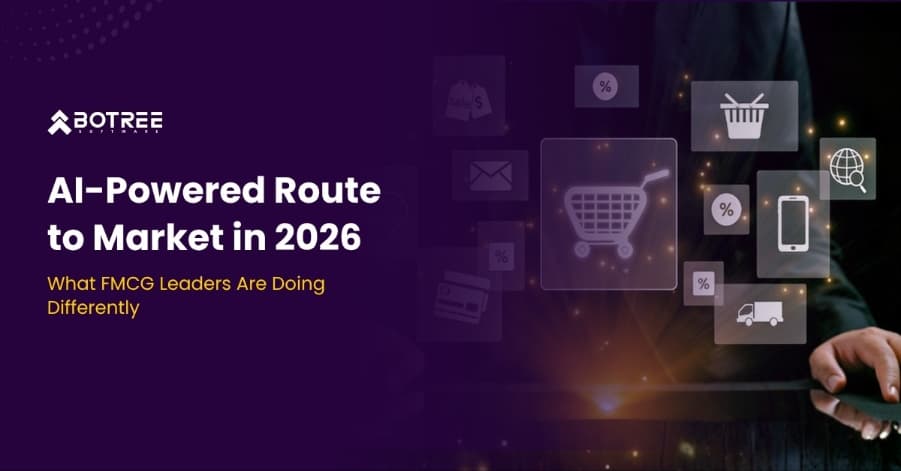
The future of Route to Market is not determined solely by distribution scope anymore. It is shaped by intelligence, velocity, and execution precision.
For companies active within FMCG, CPG, and pharma sectors, gaining visibility on sales, inventories, outlet performance, and distribution logistics in real time is essential for competitiveness.
AI-powered RTM solutions assist businesses in overcoming limitations of legacy approaches to sales execution and integration issues through advanced route management, outlet segmentation, retail execution monitoring, demand forecasting, and distribution intelligence.
With the development of AI becoming an inseparable part of sales and distribution practices, Route to Market transforms from a purely reporting system to a live execution tool.
This blog post discusses the key trends behind the development of AI-powered RTM in 2026 and how top organizations create intelligent distribution ecosystems.
India’s FMCG market grew 12.9% in value and 5.4% in volume in Q2 FY26, with rural demand pacing urban for the eighth straight quarter. Quick commerce now contributes over three-fourths of e-commerce FMCG sales. AI-driven forecasting, when applied to supply chain management, can reduce errors by 20–50% and cut lost sales from product unavailability by up to 65%
Route to Market (RTM) is the strategy and infrastructure a company uses to take its products from production to the end consumer. In FMCG, RTM is the full system that connects a brand’s factory to a Kirana shelf, a modern trade aisle, or a quick-commerce dark store including the distributors, wholesalers, salespeople, retailers, and digital platforms in between.
A complete RTM strategy answers five core questions for any FMCG brand:
In FMCG, CPG, and pharma, growth does not depend just on the products but on how well these products get distributed in the market. For that, businesses need to have a good RTM strategy.
An RTM strategy means determining how goods travel from manufacturers through distributors, retail locations, pharmacies, and to end customers. The process consists of many elements including distributor management, outlet coverage, orders collecting, inventory management, retail execution, and replenishment planning.
A successful RTM approach will ensure consistent delivery of products in thousands of retail outlets providing speed, visibility, and execution of processes in the market where shelf space, relationship with retailers, and availability significantly affect the sale rate of products.
In the pharma industry, RTM is also crucial because medicines should be constantly available, replenished in time, delivered accurately, and comply with the established regulations. Any delays in distribution affect delivery rates and patient access to medicines.
As distribution ecosystems become more complex, traditional RTM models are no longer enough. Businesses today require real-time visibility, faster decision-making, AI-driven planning, and connected execution across the entire distribution network.
That shift is driving the evolution from traditional RTM models to digital RTM ecosystems.
Sales Channel, Distribution, and Route to Market (RTM) are often treated as the same thing in FMCG, but they are different.
With evolving FMCG and CPG distribution ecosystems becoming increasingly intricate, it becomes difficult for numerous businesses to ensure transparency, execution, and operational excellence throughout their networks.
Below are some of the most prevalent Route to Market issues that influence sales and distribution efficacy.
A considerable number of FMCG businesses lack secondary sales visibility as soon as the product is dispatched past its primary point.
Without accurate secondary sales visibility, tracking outlet-level demand, tracing stock movements, and react swiftly to any changes in the marketplace becomes risky.
The distribution management process can turn out to be exceedingly difficult when handling several distributors within various territories.
Without an interconnected distributor management solution, it is challenging to track inventories, analyse schemes, manage replenishment cycles, and coordinate operations.
Difficulties with inventory visibility and replenishment planning, resulting in frequent stockouts and excessive inventories.
Without automated replenishment solutions and AI-driven demand forecasting tools, it is hard to optimize inventories across several distributors and retail channels.
Inefficient routing and Poor beat planning hinder field efficiency and travel times.
The sales team may allocate too much time at low-value outlets while overlooking potential high-value outlets in the market. AI-driven route optimization ensures that there is efficient outlet coverage and priority visits.
Most RTM processes still rely on spreadsheets, delayed reporting, and inefficient collaboration between sales and logistics teams. These practices limit responsiveness, agility, and visibility of field performance.
The lack of visibility into execution activities may affect the availability of products in the shelves, planograms, promotions, and retail performance.
The absence of retail execution and audit processes through image recognition hampers execution uniformity in the retail environment.
Most Route to Market challenges in FMCG are no longer caused by lack of distribution reach. They are increasingly driven by limited visibility, disconnected systems, and slower execution across the sales and distribution ecosystem.
AI is fundamentally changing how FMCG companies manage sales and distribution operations. Traditional RTM models relied heavily on manual planning, delayed reporting, and reactive decision-making. Today, AI-powered RTM systems help organizations respond faster to market changes with real-time intelligence and automated execution support.
Here’s how AI is transforming:
AI-driven route optimization helps sales teams maximize outlet coverage while reducing travel inefficiencies. Dynamic beating planning allows salesperson to visit outlets that match their sales potential and market activity.
With AI-based RTM systems, businesses can monitor secondary sales visibility, distributor inventory levels, movements and sales performance at an outlet level. It helps to adapt to the changes in demand and plan replenishment processes efficiently.
AI-driven demand forecasting takes into consideration historical sales data, seasons, outlet performance and channel behavior, which makes it possible to estimate the future demand.
AI-based image recognition assists businesses in achieving better shelf presence, adhering to planogram rules, measuring shelf share, and enhancing retail execution performance consistency at all locations.
With AI-based analytics, decision-makers can detect risks sooner, take action faster, and make better distribution and sales decisions.
FMCG distribution and sales execution are shifting from manual, reactive processes to AI-powered, real-time execution models. Here are the major transformations redefining Route to Market in 2026.
| FMCG Leaders Shifted From | FMCG Leaders Are Shifting To |
|---|---|
| Fixed Beat Planning | AI-Driven Visit Prioritization based on outlet potential, sales trends, and market activity |
| Manual Order Taking | AI-Powered Selling with intelligent order recommendations and basket suggestions |
| Manual Retail Audits | Intelligent Retail Execution using image recognition and real-time shelf visibility |
| Static Forecasting | Live Demand Sensing powered by real-time sales and channel signals |
| Limited Distributor Visibility | Connected Distribution Intelligence across secondary sales, inventory, and stock movement |
| Push-Based Distribution | Demand-Led Distribution driven by outlet and consumer demand patterns |
| Reporting Dashboards | AI-Powered Decision-Making with intelligent alerts and automated recommendations |
As FMCG distribution becomes more dynamic and data-driven, organizations need more than disconnected sales and distribution tools. They need a connected RTM ecosystem that improves visibility, execution, and decision-making across the market.
Botree software helps FMCG, CPG, and pharma organizations transition from traditional RTM operations to AI-powered sales and distribution execution.
With Botree’s integrated platform, brands can:
Rather than dealing with separate processes and lagging reports, businesses can achieve a unified view of sales, distribution, inventory, and execution activities within their RTM ecosystems.
“With seamless stock reporting, data-driven analytics and comprehensive visibility of our sales distribution across multiple channels, Botree DMS & SFA streamlined our operations, boosting order fulfillment and retailer satisfaction, thus driving strategic business growth”
Aritra Chakraborty
Digital Technologies Lead Royal Canin India
In addition to being more efficient, the adoption of AI-based RTM is also transforming FMCG, CPG, and pharmaceutical companies when it comes to decision-making for distributing their products.
Whereas organizations were forced to react to market trends after the changes happened, they now can identify potential risks before they occur, execute faster, and even be able to cope with changes in demand almost instantly.
Understanding market characteristics such as outlets, consumer behavior, competitors, and available channels.
Segmenting markets and distributors on the basis of sales potential and geographical proximity, among other considerations.
Creating an appropriate mix of GT, MT, digital commerce, quick commerce, direct-to-consumer, and rural channels.
Planning for efficient territories and beats to optimize field force effectiveness.
Using solutions like SFA, DMS, analytics, and AI to enhance visibility and control.
Tracking performance metrics, analysing gaps in execution, and fine-tuning the strategy continuously.
It is no longer simply about distribution coverage and sales coverage alone when it comes to the future of the route to market. The future depends on intelligence, speed, visibility, and precision in execution.
Fast-moving consumer goods, consumer packaged goods, and pharmaceutical companies must operate in environments where market demands change rapidly, channels become dynamic, and execution gaps influence growth. This has been difficult for traditional route to market frameworks that depend on delayed reports and manual coordination.
The organizations that will set the benchmark for route to market transformation in 2026 are leveraging AI and visibility, along with an execution framework that is interconnected.
As such, it is no longer a matter of debate regarding whether FMCG, CPG, or pharma should be digitizing their distribution operations. The actual issue is one of intelligent execution in the market.

Marketing Associate
Meet Christina Evangelin Ebinezer, our dynamic marketing associate at Botree Software. With a background in HR and marketing, and prior experience as a content writer, Christina brings a sharp eye for storytelling and a knack for crafting engaging blogs and marketing content. She’s passionate about turning ideas into words that drive impact. Outside of work, Christina finds joy behind the piano keys or the wheel—whether she’s playing a soulful tune or cruising down open roads.
What is Route to Market (RTM) in FMCG?
Why is Route to Market important for FMCG companies?
How is AI transforming Route to Market in FMCG?
What are the common challenges in traditional RTM models?
What is digital RTM?
How does AI improve demand forecasting in FMCG distribution?
What are the key components of an AI-powered RTM strategy?
How do SFA and DMS improve Route to Market execution?
Stay updated with the latest trends and insights.