
Christina Evangelin Ebinezer
Marketing Associate



When it comes to FMCG distribution, any delivery delay or error means reduced product availability, customer satisfaction, and revenues. In light of growing customer demands and increased complexity of distribution channels, companies are now unable to meet their demands via manual processes and fragmented data availability.
The higher FMCG order fulfillment rate guarantees accurate, timely, and proper volume deliveries, which will help businesses avoid stockouts, promote second-selling, and develop better relationships with customers. Additionally, it provides an opportunity for distributors, field sales, and supply chain teams to collaborate more effectively at all stages of the route-to-market channel.
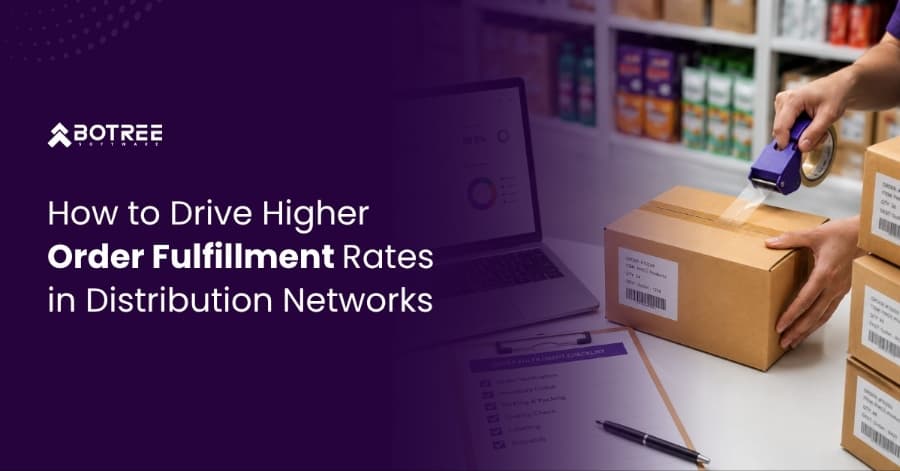
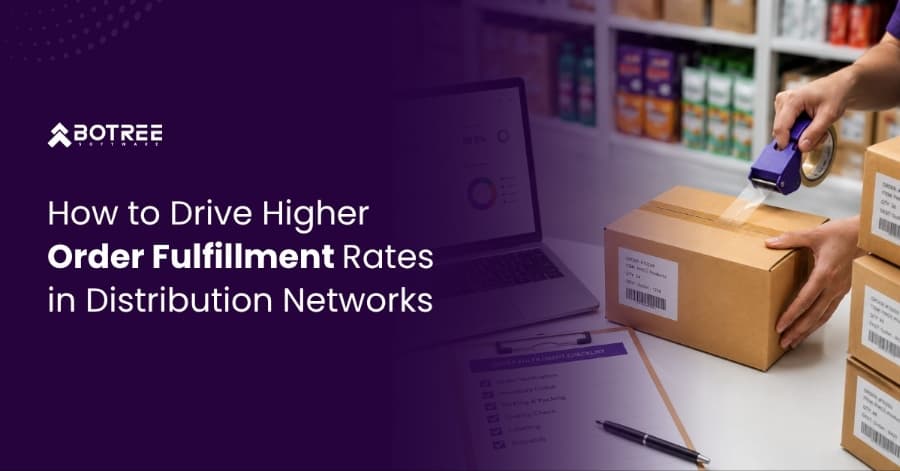
In this blog, we will discuss what order fulfillment is in FMCG distribution, why it is important, common issues that impact order fulfillment rates negatively, ways to increase order fulfillment, and the role of AI in the process.
Fulfillment rate of orders is the rate at which the orders of the retailer are fulfilled on time and in the correct quantity and quality. It is an indication of whether the right product quantities are supplied to the retailer in the promised delivery schedule.
For fast-moving consumer goods (FMCG), consumer packaged goods (CPG), and FMCD companies, the order fulfillment rate must be calculated from the distributor level to the retailer level because it gives an exact picture of product availability, distributor performance, and retailer performance.
A typical FMCG order fulfillment process includes:
Order fulfillment is often viewed as an operational KPI, but its impact extends far beyond warehouses and logistics. For FMCG, CPG, and FMCD businesses, every complete and on-time delivery strengthens retailer confidence, improves secondary sales, and builds long-term market competitiveness.
Retailers require distributors who always provide them with the right quantity and quality of goods on time. Fulfillment builds retailer confidence and makes them return to the same company with their orders in the future.
Delayed, incomplete, or inaccurate deliveries often force retailers to source products from competing distributors or brands, reducing secondary sales and slowing sales velocity.
Customers feel more confident placing larger orders and joining the promotional programs, if they know that their orders will be fulfilled properly.
Fulfillment helps distributors obtain successful outcomes of their promotions since it allows to fulfill higher order volumes in the promotion period.
Order fulfillment helps to improve distributors’ performance by providing high-level service to customers and ensuring that there will be no disputes with delivery, returns, etc.
For competitive FMCG markets order fulfillment is an important factor which allows companies to develop greater customer loyalty and take a leading position against competitors.
Order fulfillment in FMCG distribution involves multiple stakeholders from brands and distributors to field sales teams and retailers. A delay or error at any stage can result in incomplete deliveries, stock-outs, and lost sales opportunities.
Inappropriate and outdated records of stock levels cause a situation where products are assumed to be in stock but are not available for delivery, resulting in orders not being fulfilled and causing dissatisfied retailers.
Delays in the replenishment process due to inadequate manual approvals or lack of stock allocation causes distributors to be left with inadequate inventory to meet retailer requirements.
Orders that have been collected through the manual ordering process such as the use of papers, calls, and WhatsApp increase chances of delays in billing and dispatching.
Orders are either delayed or blocked due to last minute issues such as insufficient credits, price differences, or approval issues which have not been captured during the time of order booking.
Poor delivery scheduling and FMCG routing planning causes late delivery of orders leading to inability to meet retailer promises and fulfilling orders during high demand periods.
Incorrect picking process in the warehouse leads to sending wrong products, wrong quantities, or even non-delivery of items, thereby causing return shipments.
Many individuals use order fulfillment rate and fill rate as one and the same thing since they both have something to do with order fulfillment. The truth is that there is no similarity between them whatsoever. While fill rate tells us about the availability of stock items to fulfill orders, order fulfillment rate tells us whether the retailer receives orders correctly and on time. It is important for businesses to recognize the difference because even when a company has a high fill rate, it may still experience poor order fulfillment.
| Order Fulfillment Rate | Fill Rate |
|---|---|
| Measures the percentage of orders delivered completely, accurately, and on time. | Measures the percentage of ordered products that can be fulfilled from available inventory. |
| Evaluates the entire order-to-delivery process. | Evaluates inventory availability at the time of order booking. |
| Includes delivery delays, picking errors, incorrect SKUs, billing issues, and dispatch efficiency. | Considers only whether enough stock is available to fulfill the order. |
| Reflects the retailer’s delivery experience. | Reflects warehouse or distributor stock readiness. |
| A low fulfillment rate usually indicates execution problems such as dispatch delays, route planning issues, or delivery errors. | A low fill rate usually indicates inventory problems such as stock shortages or poor replenishment planning. |
| Helps improve retailer satisfaction, service levels, and distribution performance. | Helps optimize inventory planning and stock availability. |
Example
A retailer orders 100 units of a product.
Order fulfillment rate is one of the most important distributions KPIs, but it doesn’t tell the complete story. To understand where fulfillment breaks down, FMCG, CPG, and FMCD businesses should track it alongside other key performance indicators that measure inventory availability, delivery efficiency, and order accuracy.
Tracking these KPIs together provides a complete view of fulfillment performance, helping businesses identify whether issues stem from inventory shortages, operational delays, warehouse execution, or last-mile delivery.
Improving order fulfillment rates requires more than faster deliveries. FMCG, CPG, and FMCD businesses need connected inventory, order management, distributor operations, and logistics to ensure every retailer order is fulfilled accurately and on time.
Ensure that field sales teams and distributors have access to real time inventory information when they place orders. Having real time inventory visibility ensures that orders are never placed based on unavailable inventory and helps avoid stock out situations.
Enable digitization of the order booking process where orders are validated for price, trade schemes, credit limits, and available stock before placing them in the system. This avoids manual delays in the order process and minimizes any billing mistakes.
Go beyond just replenishment based on primary sales. Ensure replenishment of SKUs is based on the real time secondary sales figures to help distributors keep ideal inventory.
Enable efficient management of warehouses through digitized picking lists and barcode validations. Add to this effective dispatch and delivery route planning.
Integrate SFA, DMS, inventory management, billing, and warehousing processes into one connected system to gain visibility across order entry to delivery, thereby allowing you to diagnose and overcome fulfillment challenges more quickly.
Track metrics like order fulfillment ratio, fill rate, on-time delivery, order accuracy, and perfect order rate using real-time dashboards. Monitoring your fulfillment process will help you identify your operational weaknesses and enhance the service levels at retail stores.
By integrating automation, real-time visibility, intelligent replenishment, and connected distribution processes, FMCG companies can enhance their order fulfillment ratios, build retailer relationships, and boost secondary sales.
AI is transforming order fulfillment by helping businesses predict demand, optimize inventory management, and resolve fulfillment issues before they impact retailers. Instead of reacting to stock shortages and delivery delays, FMCG, CPG, and FMCD businesses can use AI to improve fulfillment accuracy, reduce operational inefficiencies, and deliver a better retailer experience.
AI considers secondary sales performance, inventory position, seasonal demand patterns, and geographic buying trends to advise on the best distribution of inventory stocks to avoid stock-outs.
AI constantly learns from historical sales information, market trends, and other demand signals to provide more precise demand forecasts that will help to plan replenishment effectively and avoid disruption in fulfillment.
AI builds delivery routes taking into account priorities of orders, delivery promises, traffic situation, and vehicles’ capacity to improve on-time deliveries by distributors and minimize transportation delays.
AI determines the orders which are risky due to inventory problems, credit problems, late dispatch, and delivery restrictions to alert the staff in time and take preventive actions.
In contrast to replenishment when the inventory is already low, AI-powered auto replenishment considering secondary sales performance and demand forecasts to maintain optimal inventory level.
With the use of intelligent dashboards, there is constant tracking of fulfillment operations to determine areas of improvement that can help improve order fulfillment and retail services levels.
The Botree route-to-market solution powered by AI helps FMCG, CPG, and FMCD companies increase their order fulfillment rate through integration of field sales, distribution, inventory management, billing, and delivery in a single platform. By using this platform to achieve real-time inventory visibility, automate order validation, process digital orders, and manage automatic inventory replenishment, businesses can reduce delays, avoid stock-outs, and fulfill retailer orders quicker and more precisely.
Botree DMS allows to create orders based on live inventory available at distributors, validate pricing, schemes, and credit limits automatically, and provide end-to-end visibility right from booking an order to delivery confirmation. Through the use of analytics powered by AI, continuous monitoring of order fulfillment KPIs such as order fulfillment rate, fill rate, on-time delivery, and order accuracy becomes easy for businesses. This way they can find out bottlenecks in processes, improve the performance of their distributors, and make sure their products are delivered to retailers completely, accurately, and in time.
Order fulfillment goes beyond being an operational metric as it has an impact on retailer trust, availability of products, and revenue growth. Any order fulfilled entirely, accurately, and on time helps build retailer trust, boosts secondary sales, and enhances the distribution network’s reliability.
With FMCG, CPG, and FMCD companies struggling with ever-growing complexity in their distribution networks, order fulfillment improvement involves more than just ensuring that the company has enough inventory. It includes integration of sales, inventory, distribution, and delivery processes enabled by visibility, automation, and AI decision-making.
Companies that invest in increasing order fulfillment rates can expect to be able to avoid stock outs, boost retailer trust, optimize their distribution process, and gain a competitive advantage in the marketplace.

Marketing Associate
Meet Christina Evangelin Ebinezer, our dynamic marketing associate at Botree Software. With a background in HR and marketing, and prior experience as a content writer, Christina brings a sharp eye for storytelling and a knack for crafting engaging blogs and marketing content. She’s passionate about turning ideas into words that drive impact. Outside of work, Christina finds joy behind the piano keys or the wheel—whether she’s playing a soulful tune or cruising down open roads.
How do you calculate order fulfillment rate?
What is a good order fulfillment rate for FMCG businesses?
What is a perfect order rate?
How can distributors improve order fulfillment performance?
What is the difference between order fulfillment and order management?
How does inventory visibility improve order fulfillment?
Why is on-time delivery important in FMCG distribution?
How does AI improve order fulfillment in distribution networks?
How does a Distributor Management System (DMS) improve order fulfillment?
Which KPIs should businesses track to improve order fulfillment?
Stay updated with the latest trends and insights.