
Christina Evangelin Ebinezer
Marketing Associate



It is Monday at 9:00 AM. A national sales manager is checking the weekend fill rate dashboard for a popular brand. Two high volume SKUs of the brand, which have promotions running, were completely out of stock in nearly 40% of the distributor base during the weekend.
There was enough stock available in the factory. There was enough stock available in the warehouse. But replenishment had failed to deliver on time.
This problem is one of the most common issues in FMCG distribution today. Out-of-stocks rarely occur due to the absence of goods. They occur when replenishment decisions are made too late.
With increasing SKU volumes, distributor network complexity, and retail channel complexity, traditional manual inventory management and replenishment policies are failing to cope with dynamic demand patterns.
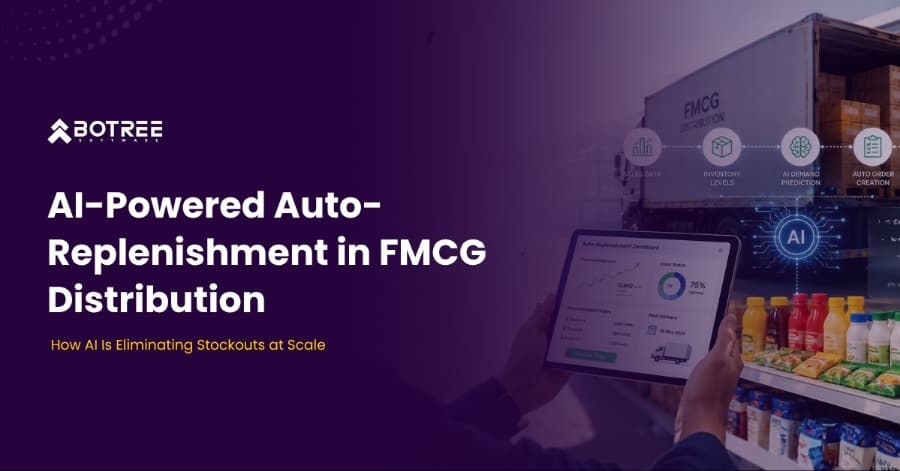
This is where AI-powered automatic replenishment is transforming FMCG distribution. Contemporary AI-based replenishment solutions can anticipate changes in demand trends, track sec ondary sales and distributor inventories, and generate automatic replenishment decisions before any stock gaps impact market availability.
In 2026, AI is not only enhancing replenishment operations but is becoming the operational model of FMCG distribution.
Auto-replenishment is a data-driven inventory replenishment system that decides, automatically, what to reorder, when to reorder it, and how much to reorder, without manual intervention. It connects real-time secondary sales data, current stock levels, lead times and demand patterns to generate replenishment orders across the distribution network: brand warehouse, CFA, super stockist, distributor and retailer.
In simple terms, manual ordering reacts to a stockout. Auto-replenishment prevents it. AI-driven auto-replenishment goes one step further: it anticipates it before any human in the chain notices.
The traditional replenishment system was designed in an era of a much simpler distribution scenario – less SKU’s, steady consumption cycle, and slow-moving markets.
However, FMCG distribution by 2026 will be a whole new ballgame.
Current business conditions include:
In such a case, traditional inventory management and replenishment rules find themselves inadequate.
| FMCG Distribution Reality in 2026 | Why Manual or Rules-Based Replenishment Fails |
|---|---|
| 200–600 active SKUs per distributor | Static reorder rules become difficult to manage accurately |
| Promotional demand spikes | Fixed thresholds fail to adapt to sudden demand surges |
| GT, MT, Q-commerce, and D2C channels | Rules-based systems cannot balance multi-channel demand velocity |
| Rurban and multi-company distributor models | Inventory visibility becomes fragmented across networks |
| Inventory visibility becomes fragmented across networks | Manual planning reacts too slowly |
| Delayed secondary sales visibility | Replenishment decisions happen after stock gaps occur |
| Distributor dependency on manual ordering | Human-driven replenishment creates inconsistencies |
The challenge is no longer just inventory automation.
The real challenge is making replenishment decisions fast enough to match how modern FMCG demand behaves.
This is where AI-powered auto-replenishment is changing the equation.
FMCG brands can lose 5–10% of revenue due to delayed replenishment cycles and stockouts.
Before automated replenishment system the sales team had to follow up manually on stock availability, replenishment depended on delayed stock checks, and distributors maintained excess stock levels but were unable to avoid stockouts. After AI-based auto-replenishment allows companies to plan their replenishment activities based on real-time inventory monitoring, demand forecasting, and optimal inventory balancing.
| Before AI Auto-Replenishment | After AI Auto-Replenishment |
|---|---|
| Sales teams manually follow up for stock availability | AI-driven replenishment recommendations and automated refill planning |
| Frequent out-of-stock complaints from distributors and retailers | Improved fill rates and faster stock availability |
| High safety stock maintained across distributors | Optimized inventory balancing across the network |
| Reactive replenishment based on delayed stock reviews | Real-time replenishment based on live inventory movement |
| Excess inventory and slow-moving stock buildup | Better inventory turnover and reduced dead stock |
| Emergency dispatches and urgent stock transfers | Smarter replenishment prioritization and lower logistics costs |
| Manual spreadsheet-based inventory planning | Continuous AI-driven inventory planning and SOQ generation |
| Static reorder thresholds for all distributors | Dynamic reorder logic based on demand patterns and SKU velocity |
For FMCG, CPG and OTC pharma, automatic reordering has gone beyond automating inventory restocking activities. Automatic reordering is emerging as a critical business competency that enhances inventory visibility, improves replenishment efficiency, and enhances route-to-market performance.
With the growing application of AI in distribution, organizations have started experiencing concrete benefits.
Ensuring that fast-moving products are available remains the greatest challenge in FMCG distribution.
By analyzing the demand pattern, secondary sales trend, and distributor stock levels using AI, it is possible to spot potential stockouts early and address the issue of stock shortages before the problem becomes visible to consumers.
Improving Demand Forecasting Accuracy
Traditional forecasting models often struggle during:
AI-powered inventory planning systems continuously adapt to changing demand behavior, helping businesses improve forecasting accuracy and replenishment planning across markets.
Many businesses still maintain high inventory buffers to avoid stockouts, which often leads to:
AI-driven inventory optimization helps businesses balance stock availability more efficiently across distributors and warehouses while reducing excess inventory buildup.
Late decision-making and inadequate inventory visibility might adversely impact the fill rates of distributors and service provision at retailers.
The AI-driven replenishment solution will help improve the balancing of stocks and speed up replenishment, thus ensuring that companies achieve higher fill rates and emergency stock transfers.
Many FMCG companies have replenishment procedures where distributors manually order goods, and replenishment happens late due to stock analysis.
This helps automate replenishment processes and improve inventory visibility instantly.
Inventory shortages and late replenishment might impact the relationship with the distributors and regular servicing of the retailers.
Better replenishment planning will help enhance inventory reliability, distributor management, and servicing of retailers.
Many businesses still struggle with fragmented visibility into inventory movement across warehouses, distributors, and retail channels.
AI-powered replenishment systems help businesses improve visibility into:
allowing supply chain and sales teams to make faster operational decisions.
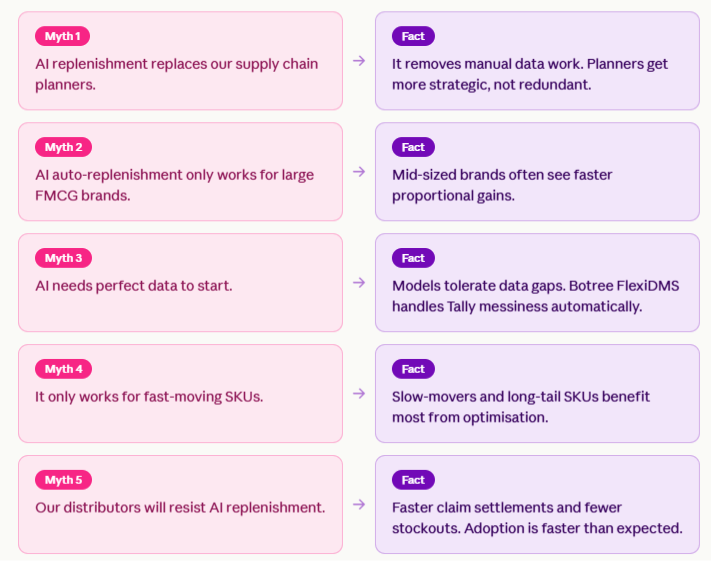
As AI-powered auto-replenishment becomes more common across FMCG distribution, many businesses still assume it is difficult to implement, too complex for distributors, or only suitable for large enterprises.
In reality, modern AI-powered replenishment systems are designed to improve operational flexibility, reduce manual workload, and adapt to real-world distribution complexity.
The traditional replenishment systems were designed to automate the process of FMCG inventory management. This is far from being sufficient in the modern FMCG distribution.
When networks grow larger and inventory flows get more complex, companies need replenishment solutions which will be capable of constant demand analysis, higher transparency of inventory, improved cooperation between distributors, and quick reactions to changes in the marketplace.
And here Botree enters the stage of auto-replenishment powered by artificial intelligence.
Botree provides the following services:
With Botree Software, you can increase replenishment responsiveness, avoid stockouts, optimize distributor inventory, and enhance operational control of your route-to-market network.
The following solutions are offered by such Botree platforms as Botree DMS, FlexiDMS, and AI-powered Product Recommender with SOQ.
FMCG distribution networks are becoming too complex for manual and static replenishment systems to manage efficiently.
FMCGRising SKU volumes, fragmented retail channels, faster replenishment expectations, and increasing pressure on inventory efficiency are pushing businesses toward AI-powered auto-replenishment.
FMCGModern AI-driven replenishment systems can now predict demand shifts, improve distributor inventory visibility, automate replenishment workflows, and reduce stockouts in real time across large distribution networks.
FMCGIn 2026, AI-powered replenishment is no longer becoming just an operational advantage.
FMCGIt is becoming a necessity for modern FMCG distribution.
Stockouts in FMCG distribution hardly ever occur due to lack of availability of goods. Stockouts occur due to delayed decision-making when it comes to product replenishment.
As the size of distributor networks grows, SKU flow becomes faster, and retail channels become more fragmented, it is becoming increasingly difficult for traditional replenishment tools to operate successfully in modern FMCG conditions.
That is where auto-replenishment enabled by artificial intelligence is transforming modern distribution.
From predictive demand sensing to intelligent creation of stock-out quantity (SOQ), from improved inventory visibility to automated replenishment processes, AI helps companies streamline their inventory management and improve their distributor coordination.
The change is not from manual replenishment to automated replenishment.
The change is from reactive replenishment to intelligent replenishment driven by artificial intelligence.
Platforms like Botree are helping FMCG and OTC pharma businesses build that future with connected AI-powered inventory and distribution ecosystems.

Marketing Associate
Meet Christina Evangelin Ebinezer, our dynamic marketing associate at Botree Software. With a background in HR and marketing, and prior experience as a content writer, Christina brings a sharp eye for storytelling and a knack for crafting engaging blogs and marketing content. She’s passionate about turning ideas into words that drive impact. Outside of work, Christina finds joy behind the piano keys or the wheel—whether she’s playing a soulful tune or cruising down open roads.
What is auto-replenishment in FMCG distribution?
How does AI-powered auto-replenishment work?
How is AI auto-replenishment different from traditional inventory replenishment software?
How does auto-replenishment help reduce stockouts in FMCG distribution?
What is Suggested Order Quantity (SOQ) in inventory replenishment?
Can AI-powered auto-replenishment integrate with Tally and Busy?
Why are FMCG businesses adopting AI-powered inventory replenishment in 2026?
Stay updated with the latest trends and insights.