
Christina Evangelin Ebinezer
Marketing Associate



The FMCG, CPG, and OTC Pharma industry is experiencing a major shift. Distribution today is faster, more digital, and much more complex than in the past.
E-commerce and quick commerce are driving this change. Quick commerce now accounts up 70 to 75% of e-grocery orders in India, up from 35% in 2022. This growth is pushing brands to adopt real-time, digital-first operations.
However, many distributors still work with limited visibility, inconsistent inventory, and manual processes. This affects product availability, sales, and overall supply chain efficiency.
This is precisely where FMCG distribution software – specifically a Distributor Management System, becomes essential. It connects distributors, field teams, and brands on a single platform, delivering real-time visibility, automation, and control across the entire secondary distribution layer.
The shift is already happening. The question is: are your systems set up for how distribution works today?
Let’s begin by understanding what a Distributor Management System really is.
At its core, a Distributor Management System (DMS) is a software platform that helps FMCG, CPG, and OTC Pharma companies manage, monitor, and streamline every aspect of their distribution operations – from order placement to secondary sales tracking, inventory management, scheme execution, and claim settlements.
Think of it as the central nervous system of your distribution network. It connects manufacturers, distributors, field teams, and retailers onto a single platform – giving every stakeholder real-time visibility into what’s moving, what’s stocked, and what’s selling.
A modern DMS streamlines all distribution workflows, improves supply chain efficiency, eliminates stockouts and overstocking, and allows companies to access real-time data from distributors.
Now that we have a clear picture of what a Distributor Management System is, let’s address a question that often causes confusion – is a Distributor Management System and a Distribution Management System the same thing? Not quite. Here’s how they differ.
If you’ve ever searched “Distributor Management System vs Distribution Management System” and walked away more confused than before, here’s a simple way to understand the difference.
Distributor Management System: “Are my distributors doing their job?”
Distribution Management System: “Is my product reaching the shop properly?”
One focuses on managing the people and operations within your distribution layer – billing, stock, claims, secondary sales. The other takes a wider lens, tracking the entire product journey from factory floor to retailer shelf.
| Aspect | Distributor Management System | Distribution Management System |
|---|---|---|
| Focus | Tracks and manages secondary sales, what moves from distributor to retailer | Covers the full sales cycle, primary sales from brand to distributor and secondary sales from distributor to retailer |
| Scope | Operates at a single tier, the distributor level | Spans multiple tiers, manufacturer, distributor, sub-distributor, and retailer |
| View | Limited visibility, you can see what’s happening at the distributor level only | Complete network visibility – every stock movement, order, and sale across the entire distribution chain |
| Goal | Operational tracking and control – ensuring distributors are billing correctly, managing stock, settling claims, and applying schemes | Network-wide growth and optimization – improving fill rates, reducing distribution costs, and driving route-to-market efficiency |
Now that the distinction is clear, let’s look at what breaks in real-world distribution operations and why most systems fail to keep up.
This is the question that causes the most confusion at the buying stage – and the most expensive mistakes when answered incorrectly. Here’s a clear breakdown of how these three systems differ, and why you typically need all three working together.
| System | What it manages | Where it operates | Typical blind spot |
|---|---|---|---|
| ERP (e.g., SAP, Oracle) | Finance, primary sales, procurement, manufacturing | Internal operations — factory to distributor | Lacks visibility into secondary sales and distributor-level execution |
| SFA (Sales Force Automation) | Field force activity, outlet visits, order capture | On-ground execution — sales rep to retailer | Limited visibility into distributor billing, inventory, and claims |
| DMS (Distributor Management System) | Distributor billing, secondary sales, inventory, schemes, claims | Distributor to retailer operations | Does not cover upstream processes like manufacturing and financials (handled by ERP) |
Leading brands don’t treat distribution challenges as isolated problems. They recognise that issues like poor secondary sales visibility, inventory management gaps, manual processes, and claim delays all stem from one root cause – a disconnected distribution ecosystem.
Instead of fixing processes one by one, they build a connected, real-time distribution backbone powered by a modern Distributor Management System (DMS).
Platforms like Botree Software are purpose-built to enable exactly this transformation – at scale, across distribution networks.
Let’s connect each challenge to how leading brands solve it with Botree DMS.
1. Dependence on Manual Claim Management
In most Indian FMCG distribution networks, claims for trade schemes, returns, and price differences are still handled manually. Distributors rely on spreadsheets, paper forms, or scattered emails, and brands validate claims in batches. With hundreds of distributors, thousands of SKUs, and multiple concurrent schemes, this creates a slow, error-prone process. Delays in settlements tie up distributor working capital, create disputes, and reduce confidence in the brand, ultimately lowering the ROI of trade promotions.
How Botree DMS solves this:
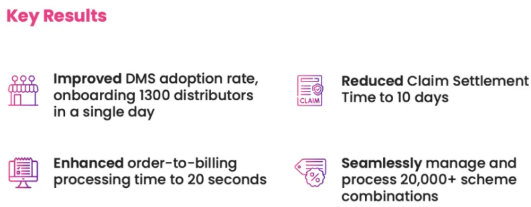
FMCG distribution software with claim management like Botree DMS automates the entire claim management lifecycle — from submission to validation and settlement. Claims are checked against scheme rules at the point of billing, eliminating manual errors and disputes. Settlement timelines shrink from months to under 10 days, improving distributor cash flow and restoring trust in the brand while maximizing trade promotion ROI.
2. No Visibility on Expired and Aging Inventory
Distributors often lack batch-level tracking, leaving them unable to distinguish between sellable stock and near-expiry or expired products. Legacy systems count everything as “available,” which inflates inventory numbers and skews demand forecasts. Retailers may receive products that cannot be sold, leading to write-offs, compliance risks, and lost revenue. In a fast-moving market like India, with thousands of SKUs and multiple sales channels, these gaps significantly disrupt secondary sales visibility and operational efficiency.
How Botree DMS solves this:
Botree DMS tracks inventory at the batch level, flags near-expiry and expired products, and ensures only sellable stock is considered for allocation. This FMCG distribution software feature improves forecasting, prevents revenue loss, and ensures operational efficiency across channels, while enhancing secondary sales tracking accuracy.
3. Stock Allocation Confusion
Distributors often cannot clearly differentiate available stock, ordered stock, and billed stock, especially when multiple channels and ongoing schemes are in play. Without a real-time view, stock is over-committed, deliveries are partial, and retailers get frustrated. Multi-tier distribution networks make this even more complicated, slowing order-to-cash cycles and impacting the accuracy of secondary sales tracking and inventory planning.
How Botree DMS solves this:
Botree DMS provides a clear, real-time view of available, ordered, and billed stock. This eliminates confusion, enables accurate fulfilment decisions, and strengthens distributor-retailer relationships. Integrated distributor billing software ensures smooth order-to-cash execution and accurate reporting across the network.
4. Inflexible Distributor Segmentation
Many legacy systems restrict how distributor segments can be updated, forcing brands to apply uniform strategies across distributors. Geography, channel, or performance differences are ignored, leading to misaligned trade scheme management, wasted promotional spend, and under-optimized sales. Without dynamic segmentation, brands struggle to target the right distributors with the right schemes, which affects trade ROI and overall route-to-market efficiency.
How Botree DMS solves this:
Botree DMS enables flexible segmentation based on geography, channel, or distributor performance. Schemes and policies automatically align to updated segments, ensuring promotions reach the right distributors. This improves trade ROI, enhances route-to-market execution, and makes sales planning more agile.
5. No Distributor Location Tracking in Browser Usage
When distributors log into DMS platforms via web browsers, location data is often not captured. This leaves brands blind to territory compliance, regional sales performance, and outlet coverage. Without this visibility, brands cannot accurately monitor distributor activity or ensure proper execution in the field, weakening the effectiveness of route-to-market strategies and limiting actionable insights from secondary sales data.
How Botree DMS solves this:
Botree DMS captures distributor location data at login, enabling brands to monitor territory adherence and link sales activity to geographic performance. Integration with ERP and SFA systems ensures that field-to-distributor data is seamless, providing actionable insights for operational planning and improved execution across channels.
Industry experience suggests that a significant percentage of DMS implementations do not achieve their intended adoption targets within the first year. The failure is rarely the software. It is almost always one of the following:
1.The DMS is imposed on distributors, not adopted with them
Brands that mandate a DMS without involving distributors in the selection and onboarding process encounter immediate resistance. Distributors who do not understand the benefit to them – faster claim settlement, fewer billing disputes, cleaner inventory – will find ways to work around the system.
Fix: Run a pilot with 20 to 30 distributors who are advocates. Document their wins. Let peer-to-peer learning drive the broader rollout.
2. The implementation timeline is underestimated
Migrating a distributor network from manual processes to a DMS involves data migration, training, parallel-run periods, and integration work with existing ERPs and SFA tools. Brands that rush this process encounter data quality problems that undermine trust in the new system from day one.
Fix: Budget a minimum of 8 to 12 weeks for a meaningful pilot, and 4 to 6 months for a full network rollout of scale.
3. The DMS is treated as an IT project, not a business transformation
When DMS implementation is owned by the IT team without active sponsorship from the sales or commercial leadership, adoption stalls. Distributors respond to their relationship managers – not to IT notifications.
Fix: Assign a business owner to the DMS implementation. Tie adoption metrics to sales leadership KPIs. Make DMS compliance a condition for scheme eligibility.
4. Integration is an afterthought
A DMS that does not connect to the brand’s ERP produces double-entry work. A DMS that does not connect to the SFA creates a data gap between field activity and distributor billing. These disconnects erode the system’s value and create work rather than removing it.
Fix: Define integration requirements with ERP and SFA systems before signing a DMS contract – not after.
While solving operational challenges is critical, the real value of a Distributor Management System lies in the long-term business impact it creates.
A well-implemented DMS doesn’t just fix inefficiencies – it transforms how distribution performs at scale.
Here are a few key benefits of DMS:
The Distributor Management System (DMS) market has evolved rapidly. Today, most distributor management software solutions offer core capabilities such as billing, secondary sales tracking, and basic inventory management.
However, in 2026, the real differentiation lies in execution depth, real-time capabilities, and India-specific operational readiness.
For FMCG, CPG, and OTC Pharma brands, selecting the right DMS software means evaluating two layers of capabilities – foundational features that are non-negotiable, and advanced capabilities that drive competitive advantage.
Non-negotiable capabilities
Emerging capabilities that separate leading platforms
Distribution has entered a phase where speed, accuracy, and visibility are no longer differentiators – they are baseline expectations.
What makes 2026 different is the convergence of three shifts:
Operating without a modern Distributor Management System in this environment isn’t a manageable inefficiency – it’s a structural limitation. And as leading FMCG and CPG brands continue to standardise real-time, data-driven distribution models, that gap will only widen.
In 2026, adopting a DMS is not about improving operations – it is about keeping pace with how distribution itself now functions.
Selecting a DMS is not just a technology decision – it is a long-term strategic investment.
The wrong system can:
The right DMS aligns with your operational needs, integrates seamlessly, and scales with your business growth.
Distributors and FMCG brands choose Botree DMS because it is built specifically for the realities of complex distribution networks.
Founded in 1983, Jyothy Labs Ltd. is an established FMCG company offering a wide range of products for home and personal care – with popular brands like Ujala, Henko, Pril, Exo, Maxo, Margo, and others as part of their portfolio.
While they started digitizing their distribution operations in 2016, they wanted a more scalable solution to support their 2700+ distributor network. They adopted Botree DMS in 2021.
They hosted on the AWS platform Jyothy Labs was able to effortlessly scale their business, provide timely support, and offer a streamlined experience to users across multiple locations.
Here’s what Ravi Razdan, Jyothy Lab Ltd’s Director (IT and HR) has to say –
“Now, with more than 2700 distributors onboard, our DMS boasts 100% coverage, delivering invaluable data insights and visibility that are driving nationwide sales.”
Discover How Jyothy Labs Ltd. Enhanced Operational Efficiency
Read Success Story
Distribution is entering a phase where consistency, adaptability, and execution speed define long-term success. As networks expand and channel dynamics evolve, the ability to operate with clarity and control becomes a critical advantage.
A well-implemented Distributor Management System enables this shift – bringing structure to complexity and enabling more predictable, scalable performance across the network.
Solutions like Botree DMS are designed to support this transition, helping businesses move toward more connected, responsive, and resilient distribution operations.
The opportunity ahead is not just to improve systems, but to build a distribution model that is ready for what comes next.

Marketing Associate
Meet Christina Evangelin Ebinezer, our dynamic marketing associate at Botree Software. With a background in HR and marketing, and prior experience as a content writer, Christina brings a sharp eye for storytelling and a knack for crafting engaging blogs and marketing content. She’s passionate about turning ideas into words that drive impact. Outside of work, Christina finds joy behind the piano keys or the wheel—whether she’s playing a soulful tune or cruising down open roads.
What is a Distributor Management System (DMS)?
What is secondary sales tracking software?
How does a DMS help with claim settlement automation in FMCG?
What is scheme management software in FMCG?
How is a DMS different from an ERP or SFA?
How long does DMS implementation take?
What should I look for in distributor management software in India?
Can a DMS manage multiple sales channels?

Stay updated with the latest trends and insights.