
Christina Evangelin Ebinezer
Marketing Associate



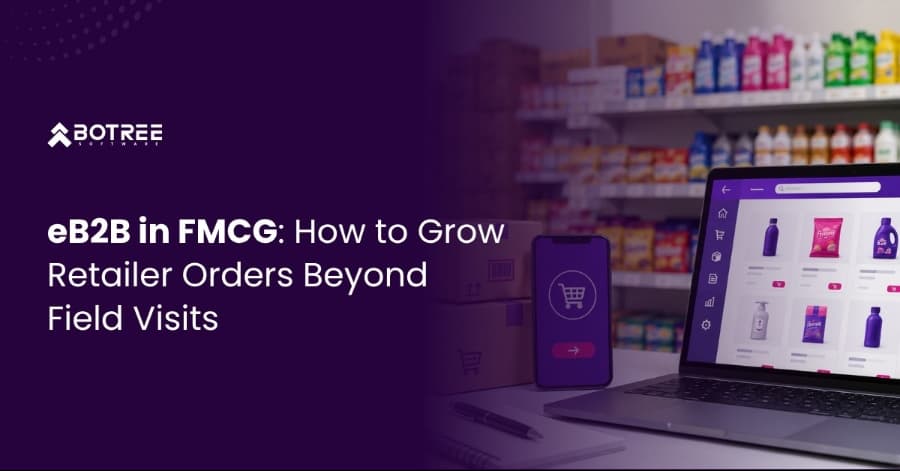
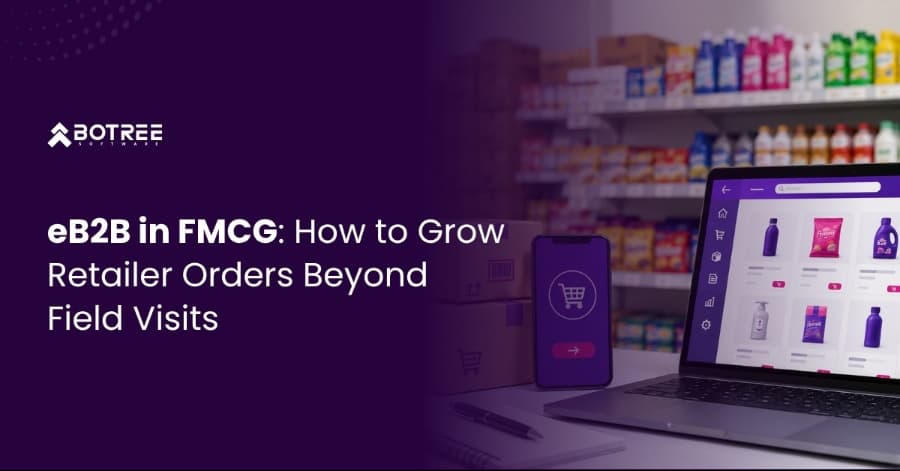
Retailers are now expecting the same convenience when purchasing their goods B2B as consumers have when buying their items online. This means that instead of waiting for the next visit by a sales representative, retailers should be allowed the option to purchase their items at any time whenever they need them.
Such changes have made eB2B (Electronic Business-to-Business) one of the fastest growing routes to market within FMCG distribution. E-B2B allows for placing orders for products offered by distributors or brands via a digital application and thus provides an instant and always available ordering option.
FMCG and CPG brands can get a lot out of eB2B solutions besides simply being able to order products. It can help brands to increase order frequency from retailers, secondary sales visibility, engagement, and reduce dependency on planned field visits as distribution channels get increasingly extended. In the modern world, eB2B solutions become an integral part of a route to market strategy.
In this blog, you will learn more about eB2B solution – its definition, functionality, importance for FMCG brands and growth strategies beyond field sales.
The Electronic B2B or eB2B for FMCG &CPG is an online trading platform where retailers can place orders for products from distributors and brands via mobile or web portal. The technology digitizes the process of placing orders traditionally done by contacting a salesperson from the company and allows to look through the products, check the prices and place orders at any time.
Unlike traditional approaches of sales and distribution which require visiting the fields, the electronic B2B solution gives retailers an opportunity to have 24/7 access to product catalogues, special offers and orders placed. Thus, placing orders becomes quicker and easier without the need for manual intervention.
From the perspective of FMCG brands, the electronic B2B solution does not only allow making orders in digital way but provides an opportunity for connecting to the retailers, improved visibility of secondary sales, more frequent orders, retailer engagement and scale up the distribution.
For decades, FMCG retailer ordering has relied on field sales representatives. A salesperson visits the retailer on a scheduled beat, collects the order, and passes it to the distributor for fulfilment. If the retailer needs stock before the next visit, they usually call the salesperson or send a WhatsApp message.
While this model has supported FMCG distribution for years, it becomes increasingly difficult to manage as retailer networks expand and expectations for faster service continue to grow.
These difficulties have rendered the conventional order method highly ineffective for FMCGs. To cater to their increased range of outlets, firms require an online order system that allows retailers to make orders at any time while also providing brands with visibility about demand and engagement of retailers.
During the growing trend of digital commerce, there are two avenues available to FMCG brands to get into touch with the retailers. Either they could do it through the third party B2B marketplaces or create their own eB2B portal. As much as marketplaces help in expanding the network, there is an increasing trend among the leading FMCG brands to invest in their own eB2B portals.
Owning the eB2B platform gives brands direct communication with retailers through individual catalogs, trade schemes, loyalty programs, and product recommendations. Each order, each campaign, and each notification builds a brand-retailer relationship rather than loyalty to the marketplace.
Ordering data from retailers is the most valuable information that any FMCG company could have. Owning the eB2B channel provides visibility into purchase behavior, favorite SKUs, order patterns, and active schemes. All of this data can help to improve forecasting and planning as well as make smarter commercial decisions.
With an eB2B solution in place, brands will be able to run their own trade campaigns, personalized pricing, and retailer-exclusive offers without intermediaries. It gives full control over the performance of trade schemes and prices.
The ownership of a proprietary eB2B channel allows brands to have full control over the catalog, content, pricing, communications, and retailer interactions. It enables a consistent shopping experience as well as builds trust and encourages repeat shopping.
While in the marketplace platforms retailers engage mostly with the platform, in the owned eB2B channel, it is a sustainable digital asset for the brand. With increasing retailer adoption, it can be developed into a sustainable sales channel which helps increase order frequency, secondary sales visibility, etc.
While owning an eB2B channel is a smart long-term strategy, building the technology from scratch doesn’t always create the greatest business value. Many FMCG brands underestimate the effort required to build, integrate, and continuously evolve an enterprise-grade retailer ordering platform.
One of the biggest concerns when introducing an eB2B platform is whether retailers will stop interacting with field sales teams. In reality, eB2B doesn’t replace salesperson – it eliminates routine order-taking so they can focus on activities that create greater business value.
Rather than wasting their time on order collections during their visits, the sales reps can focus on range selling, cross-selling, upselling, and launching new products that will help boost the sales of the outlets.
As the repetitive process of placing orders is taken care of by the app, the field team members can utilize their time to enhance shelf visibility, check on the planogram, run promotions, and make sure that all the SKUs are available at each outlet.
The salesperson can invest more time into identifying new outlets and bringing them onboard instead of making repeat visits for placing orders to the existing outlets.
The sales force is no longer just the order collectors; rather, they are business partners who help the retailer in improving their assortments, guide them about the right products, solve problems, and grow their businesses.
Many companies think that deploying an eB2B platform is all they need for digitalizing their distribution. Although an eB2B platform helps retailers place orders easily, it is just one component of the route-to-market system. An eB2B platform is nothing but a channel to order if there are no Distributor Management System (DMS) and Sales Force Automation (SFA).
All three have their own significance in making the distribution process perfect:
The retailer app helps retailers explore products, discover price and trade schemes, make orders at any time, and monitor deliveries. It provides a convenient self-service ordering facility.
After placing an order, the Distributor Management System manages all processes related to inventory management, pricing, billing, order processing, trade schemes, and distributor operations. As a result, each retailer order will be processed and fulfilled properly.
Sales Force Automation provides field reps with all necessary information to perform better in terms of outlet coverage, range selling, merchandising, retail audit, and opening new outlets. Instead of wasting time making repeat orders, salesperson concentrate on tasks that drive secondary sales.
The combined use of eB2B, DMS, and SFA helps retailers to make orders any time, makes it possible for distributors to process orders properly, and makes it possible for field teams to execute their tasks with more transparency.
Botree Retailer App facilitates the creation of an eB2B channel by connecting FMCG and CPG brands to retailers, where retailers can place orders at any time while maintaining connections between distributors, field force, and brands through a single route-to-market solution. Integrated with Botree Distributor Management System and Sales Force Automation (DMS and SFA) platforms, Botree Retailer App provides retailers the opportunity to access personalized product catalogs, pricing, trade schemes, order history, loyalty programs, and order tracking through a single solution. Each order is processed automatically to the Distributor Management System where it undergoes the process of inventory validation, invoicing, scheme implementation, and fulfillment; while the sales force can view each retailer order, purchase history, and scheme status in real time through the Botree SFA platform.
The evolution of eB2B from a simple ordering system into a sophisticated channel of FMCG distribution brings numerous benefits to both sides. First, eB2B helps retailers to order products at any time of the day and gives them the opportunity to use personalized pricing and trade schemes. In addition, through the use of eB2B, FMCG companies can communicate with retailers at any time without waiting for their scheduled field visits. As a result, using eB2B, FMCG companies can increase order frequency and secondary sales.
But the real benefits will come once it is not used as a stand-alone application but is connected to other systems. When connected to a Distributor Management System (DMS) and Sales Force Automation (SFA), eB2B creates a connected route-to-market, making retailer ordering, distributor fulfillment, and field execution more efficient and helping to engage retailers better and provide them with more products.

Marketing Associate
Meet Christina Evangelin Ebinezer, our dynamic marketing associate at Botree Software. With a background in HR and marketing, and prior experience as a content writer, Christina brings a sharp eye for storytelling and a knack for crafting engaging blogs and marketing content. She’s passionate about turning ideas into words that drive impact. Outside of work, Christina finds joy behind the piano keys or the wheel—whether she’s playing a soulful tune or cruising down open roads.
How does a Retailer App improve digital ordering for FMCG brands?
Can an eB2B platform support multiple distributors?
How does AI improve an eB2B platform?
How does eB2B improve trade promotion management?
Why is DMS integration important for an eB2B platform?
What should FMCG brands look for in an eB2B platform?
Stay updated with the latest trends and insights.