
Christina Evangelin Ebinezer
Marketing Associate



Here is a number worth sitting with: the average CPG field salesperson spends 35 to 40 percent of their working day in transit not in outlets, not building retailer relationships, not taking orders. Just travelling between locations.
That time is not recoverable. And in most FMCG networks, it is not even tracked. It doesn’t appear in any P&L line. It doesn’t show up in the weekly MIS. But it shows up in productive calls per day, outlet coverage rate, revenue per salesperson, and cost per outlet visit every single week.
The brands closing the coverage gap in 2026 are not hiring more salesperson. They are building smarter beat plans and deploying AI-powered route optimization that gives every salesperson more selling time inside the outlets that matter most.
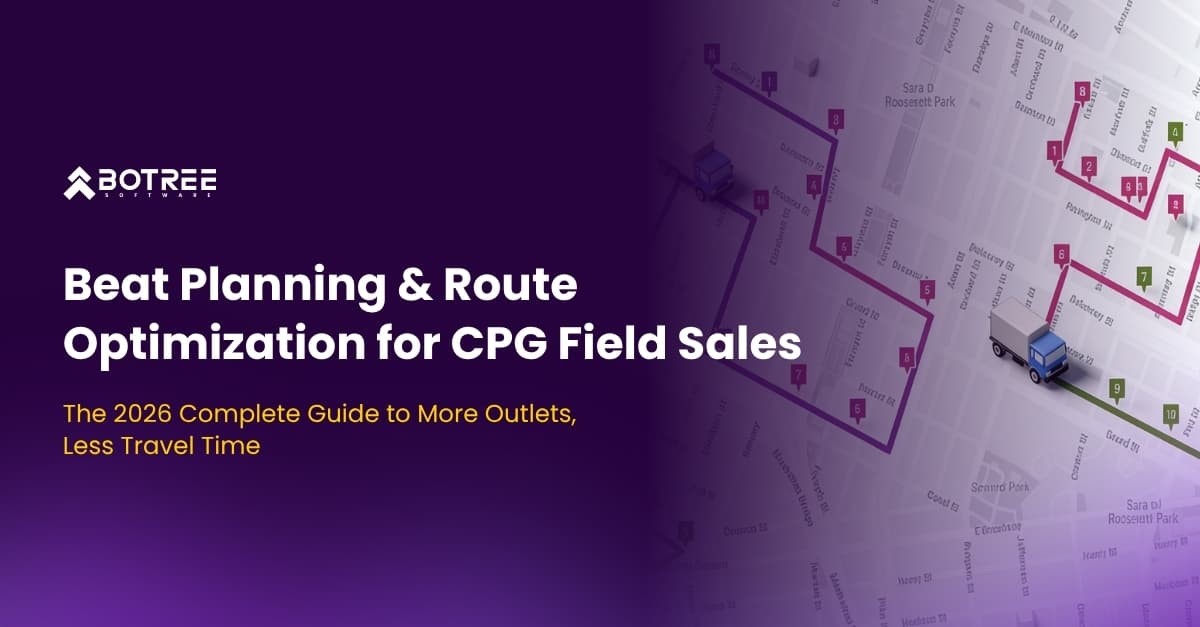
This is the complete guide. Beat planning and route optimization – what they are, why they matter, how they work together, and how to choose the software that delivers both. Every section answer one of two questions: how do your salesperson reach more outlets, and how do they spend less time getting there.
A beat planning is the structured process of deciding which outlets a field salesperson visits, how frequently, and within which territory expressed as a Planned
Journey Plan (PJP). It is a day-wise outlet schedule: Monday outlets, Tuesday outlets, Wednesday outlets, salesperson across the month.
The beat planning determines which salesperson owns which outlets, how often they visit each tier, and how territory workload is distributed across the field team. Done well, it ensures every high-value outlet gets face time every week and no territory is systematically underserved.
Most brands still run beat plans that were designed months ago and haven’t been meaningfully updated since. The failure modes are predictable:
Route optimization is the process of sequencing a salesperson’s daily outlet visits in the order that maximises productive selling time – factoring in outlet priority, geographic clustering, visit duration, traffic conditions, vehicle capacity, and real-time changes to the plan.
The critical distinction: route optimization is not about the shortest path. It is about the most productive path.
A route that visits 12 Tier C outlets before reaching the 3 Tier A accounts at the far end of the territory is an optimized route in terms of distance. It is a commercial failure in terms of priority. Real route optimization weights outlet importance into the sequence, not just geography.
Beat planning and route optimization are operational tools. But their impact is commercial. Here are five reasons why they are not logistics decisions they are business decisions.
1. Outlet coverage is a revenue driver
Every outlet your salesperson misses is a missed selling opportunity and a shelf your competitor can capture. Consistent, structured coverage builds stronger retailer relationships and improves visibility at the point of sale. Over time, brands with disciplined beat planning create a presence that competitors struggle to displace, while others are forced into reactive selling.
2. Travel time is a hidden cost
A significant portion of a salesperson’s day is spent in transit, yet it rarely shows up directly in financial salespersonorts. It impacts key metrics like productive calls, revenue per salesperson, and cost per visit. Route optimization reduces unnecessary travel, freeing up more time for selling without increasing team size.
3. Beat adherence drives campaign ROI
Product launches, trade schemes, and in-store activations depend on consistent execution. Without high beat adherence, even well-planned campaigns fail to reach the shelf. In many cases, poor ROI is not due to strategy or pricing, but because salesperson did not visit the outlets that required activation.
4. Workload imbalance affects performance
When territories are assigned purely by geography, workload becomes uneven. High-potential outlets get concentrated with a few salesperson, while others manage lower-value territories. Balanced beat planning based on outlet value and volume ensures better utilization and improves overall team performance.
5. Data without direction has no value
Field activity alone does not drive results. Visiting the wrong outlets or following inefficient routes produces data that reflects effort, not impact. Beat planning ensures the right outlets are targeted, while route optimization ensures they are covered effectively. Together, they turn field data into meaningful, actionable insights.
|
40%
Of salesperson’s day spent travelling without route optimization
|
44%
Rise in productive calls per day with AI routing
|
95%+
PJP adherence target with intelligent beat planning
|
25%
Outlet activation increase with optimized beat coverage
|
These two terms are used interchangeably across CPG and FMCG circles. They should not be. Beat planning and route optimization solve different problems, operate at different time horizons, and are owned by different people. Confusing one for the other produces the most expensive mistake in field sales management: solving the wrong problem with the right tool.
| Aspect | Beat Planning | Route Optimization |
|---|---|---|
| Definition | Planning which outlets, a sales salesperson should visit and how often | Determining the most efficient route to visit those outlets |
| Focus | What to visit and when | How to reach them efficiently |
| Objective | Ensure proper outlet coverage and visit frequency | Minimize travel time and maximize productivity |
| Approach | Based on outlet type, potential, and business priorities | Based on distance, traffic, geography, and travel constraints |
| Time Horizon | Medium to long-term (weekly/monthly plans) | Short-term (daily route planning) |
| Key Output | Beat plan or visit schedule | Optimized travel route for the day |
| Impact on Sales | Improves coverage, consistency, and outlet relationships | Increases productive selling time and reduces travel fatigue |
| Dependency | Strategic planning layer | Execution efficiency layer |
| Without It | Missed outlets, inconsistent coverage | Wasted time, fewer productive visits |
| Together | Ensures the right outlets are planned | Ensures they are reached efficiently within the day |
Good beat plan, no route optimization: The salesperson has the right outlets in their plan – correct tiering, correct frequency, balanced workload. But they’re building their own daily route from memory and habit. They start with the easy outlets, backtrack across the territory mid-morning, hit the priority accounts late when retailers are less receptive, and run out of time before completing the plan. Good strategy. Poor execution. Productivity stays flat.
Route optimization, bad beat plan: The salesperson is travelling efficiently – minimum distance, clean sequence, no backtracking. But the outlets in their plan are the wrong mix: too many low-value accounts, under salesperson of Tier A, no high-growth Tier B outlets getting the attention they need. Efficient travel to commercially insignificant destinations. Fuel saved. Revenue missed.
A beat planning that works in the field starts with the right data and the right logic not a spreadsheet divided by pin code. Here is the seven-step framework, built for ops managers and ASMs who need something that survives contact with reality.
Step 1: Map the outlet universe
Start with a complete and accurate list of all outlets by geography, channel, and performance tier. If your outlet data is outdated or incomplete, the entire beat plan becomes unreliable
.
Step 2: Classify outlets by value
Segment outlets into Tier A, B, and C based on revenue contribution, fill rate, and growth potential. This should be reviewed regularly using actual sales data, not treated as a one-time exercise.
Step 3: Define visit frequency by tier
Set clear visit frequencies for each tier. Adjust dynamically during campaigns, launches, or competitive activity without disrupting the core structure.
Step 4: Balance salesperson workload
Distribute outlets across salesperson based on workload and outlet mix, not just geography. Balanced allocation improves productivity and avoids overloading or underutilising teams.
Step 5: Build the PJP (Permanent Journey Plan)
Create a day-wise outlet plan with geographic clustering to reduce travel time. Prioritise high-value outlets during peak productivity hours.
Step 6: Add a flexibility buffer
Keep room in the plan for new outlets, urgent visits, and campaign priorities. Rigid plans fail quickly in dynamic market conditions.
Step 7: Review and refresh regularly
Track adherence weekly and update the beat plan monthly based on outlet performance. A plan must evolve with the market to stay effective.
Once the beat plan defines which outlets a salesperson owns and how often they visit each tier, route optimization takes over at the daily execution level. It answers one question the beat plan cannot: given today’s 22 outlets, in what order should the salesperson visit them and what changes when reality deviates from the plan?
| HOW ROUTE OPTIMIZATION WORKS – DAY IN THE FIELD | |
|---|---|
| 1. | Morning – Route generated: Before the salesperson leaves, the SFA app generates an optimized sequence for the day’s outlets. Tier A accounts are front-loaded. Geographic clusters are grouped. Travel time between stops is minimized. The salesperson opens the app and sees: outlet 1, directions, expected arrival, estimated visit duration. |
| 2. | Mid-morning – Outlet closed: The salesperson arrives at Outlet 7 – it’s closed. Without route optimization: the salesperson calls the manager, decides to skip it, and moves to the next outlet on their mental list, probably backtracking. With route optimization: the system detects the missed visit, identifies the nearest unvisited Tier B outlet due this week, and inserts it into the sequence. No time lost. |
| 3. | Midday – Urgent priority added: The RSM flags an account for an urgent visit – a competitor has placed a large display in a high-value outlet. With AI routing: the outlet is inserted into the salesperson’s afternoon sequence at the optimal position. With manual routing: the salesperson gets a call, adds it to their mental list, and hopes they have time. |
| 4. | End of day – Results: Without route optimization: 17 of 22 planned outlets visited, including 2 missed Tier A accounts. With route optimization: 22 of 22 planned outlets visited plus 1 opportunistic unplanned visit. Same salesperson, same working hours, different system. |
The market has two types of software calling itself beat planning and route optimization. The first is a field tracking tool that shows where salesperson went. The second is a platform that determines where salesperson should go and proves they got there. Here is how to tell them apart.
Most SFA tools track that a salesperson visited an outlet. Botree SFA determines which outlets the salesperson should visit, in what order, and at what frequency and then tracks whether they did. That is the distinction between a field monitoring tool and a field execution platform.
Beat planning and route optimization are not logistics features. They are the architecture of a productive field sales operation. Beat planning determines which outlets your salesperson own, how often they visit each tier, and whether your field team is deployed against the outlets that generate revenue or the outlets that are simply convenient to reach. Route optimization determines how much of the working day your salesperson spend selling versus driving between those outlets.
Together, they answer the two questions that determine FMCG and CPG field sales performance in 2026: are your salesperson reaching the right outlets, and are they spending enough time there to make a commercial difference?
The brands closing the gap between their outlet universe and their actual outlet coverage are not doing it with more headcount. They are doing it with smarter plans, AI-powered routes, and systems that close the execution loops every 24 hours.

Marketing Associate
Meet Christina Evangelin Ebinezer, our dynamic marketing associate at Botree Software. With a background in HR and marketing, and prior experience as a content writer, Christina brings a sharp eye for storytelling and a knack for crafting engaging blogs and marketing content. She’s passionate about turning ideas into words that drive impact. Outside of work, Christina finds joy behind the piano keys or the wheel—whether she’s playing a soulful tune or cruising down open roads.
What is a beat plan?
What is PJP in field sales?
What is the difference between beat planning and route optimization?
How does AI route optimization work?
What is PJP adherence?
How does route optimization reduce costs?
What is outlet coverage rate?


Stay updated with the latest trends and insights.