
Christina Evangelin Ebinezer
Marketing Associate



Your brand spent three months designing a perfect store programme. Planograms were signed
off. Must-sell SKU lists were distributed. POSM was printed, packed, and dispatched to every
distributor in the network.
Then the field team went out.
By Friday, walk into 10 random outlets in your top territory. How many reflect your planogram?
How many have the POSM up? How many have your hero SKU at eye level instead of buried on
the bottom shelf? In most FMCG networks without SFA built for retail execution, the answer is
fewer than half.
That gap between strategy and shelf reality is not a rep performance problem. It is a systems
problem. Without structured checklists, photo evidence, AI compliance scoring, and real-time
manager visibility, there is no mechanism to close the distance between what a brand plans and
what actually happens at the point of sale.
This guide is the complete playbook for retail execution in 2026 – what it means, and how SFA
software powers it.
Retail execution is the discipline of ensuring that every outlet in a brand’s distribution network
consistently and verifiably reflects the brand’s merchandising, stock, pricing, and promotional
standards at the outlet level, not the territory level.
The word ‘verifiably’ is doing a lot of work in that definition. Any brand can set execution
standards. Fewer can prove whether those standards are being met across 50,000 outlets every
week.
Being on the shelf is the minimum. Retail execution is about everything above that minimum:
| THE 5 PILLARS OF RETAIL EXECUTION | |
|---|---|
| 1. | SKU Availability: Are all must-sell and priority SKUs physically in stock at the outlet? No stockouts, no gaps in the range. |
| 2. | Shelf Placement: Are products placed at the right height, in the right category block, with the correct number of facings? Eye-level placement vs floor placement is not the same outcome. |
| 3. | Planogram Compliance: Is the exact shelf layout – product sequence, facings, adjacency – matching the brand’s planogram for that outlet type and channel? |
| 4. | POSM Visibility: Are promotional materials (danglers, shelf talkers, standees, end-cap displays) correctly placed, current, and undamaged? |
| 5. | Pricing Accuracy: Is the MRP and promo price correctly displayed? Are active scheme prices reflected at the shelf? |
Most FMCG brands have a retail execution strategy. Most have planograms. Most have POSM
budgets and must-sell lists. The gap is not in planning – it is in the mechanisms to verify and act
on execution. Here are the four failure modes that keep brands operating without real visibility.
A sales head can tell you what was planned for every outlet in their network. Ask them what
actually happened at shelf level last Tuesday across 500 outlets in Zone West – and the answer is
a DSR submitted by 40 salesperson, each one reflecting what the rep chose to write rather than
what was actually on the shelf. Managers know what was planned. Nobody knows what was
executed.
Without SFA, a field rep manually auditing a shelf spends 20–30 minutes per store – counting
SKUs, checking placements, noting POSM, filling forms. That data is then compiled and shared
upward. By the time a coverage gap or compliance failure reaches the RSM, the selling window
has already closed. An issue caught on Monday that surfaces in the MIS on Friday is not
actionable intelligence – it is historical documentation.
Promotional material is dispatched to distributors and assumed deployed. The marketing team
allocates budget based on distribution numbers. But without outlet-level proof of POSM
placement – a geo-tagged photo tied to a specific store visit – there is no way to confirm
whether the dangler is up, the standee is placed, or the end-cap display is occupied by your
brand or a competitor’s. Campaign ROI is measured on sales lift without ever verifying whether
the campaign physically showed up at the outlet.
Without structured checklists and mandatory photo evidence embedded in the SFA app,
execution data reflects what salesperson report, not what’s on the shelf. Salesperson under
time pressure skip audits, estimate counts, or mark compliance as achieved without verification.
This is not a motivation problem – it is a structural one. The system does not require evidence,
so evidence is not provided.
| THE RETAIL EXECUTION GAP AT A GLANCE | |
|---|---|
| Visibility Gap | Visibility Gap – managers know the plan, not the execution reality |
| Audit Speed Gap | Manual audits produce data that’s days old by the time it reaches decisions |
| POSM Gap | Campaign material dispatched but deployment unverified at outlet level |
| Data Integrity Gap | Execution scores reflect rep reports, not shelf reality |
A Perfect Store programme is a weighted compliance scoring system that tells a brand, per
outlet per visit, how closely that outlet reflects the brand’s execution standard across the five
pillars. It converts a strategy document into a number – one that can be tracked, benchmarked,
and acted on at rep, territory, and national level.
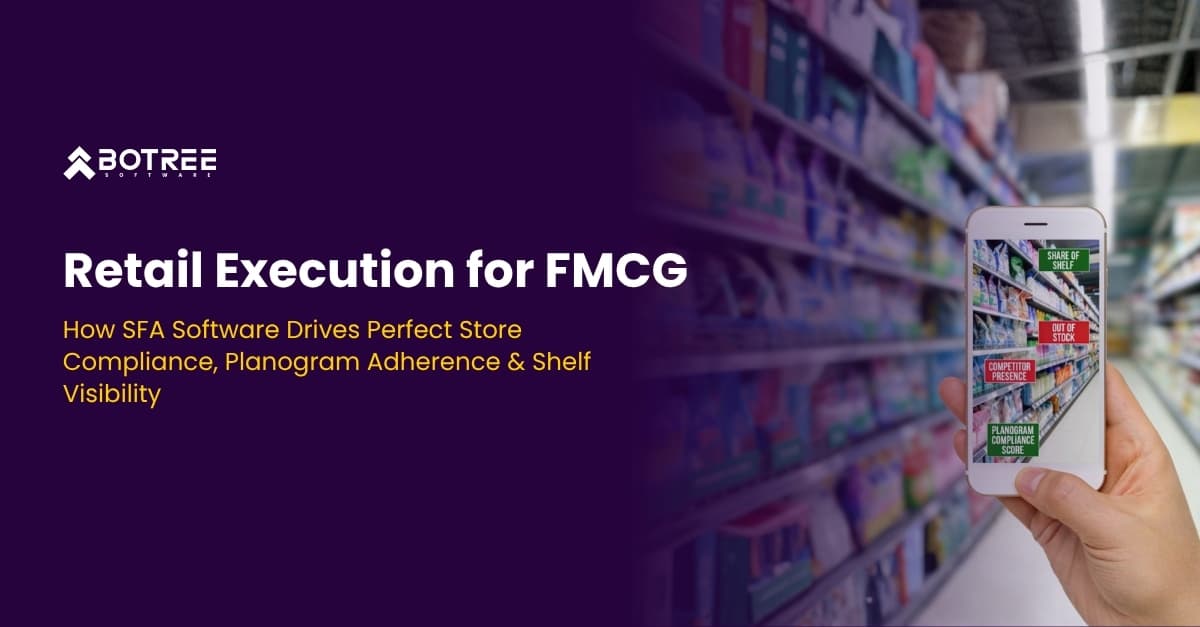
SFA standardizes retail execution through outlet-specific checklists, mandatory geo-tagged photo validation, and real-time visibility into field activities. Compliance gaps are identified instantly, while automated corrective actions ensure issues are addressed quickly during the next outlet visit.
Planogram compliance is the most under-measured dimension of retail execution. Most brands track whether their product is in stock. Far fewer track whether it is in the right position, at the right shelf level, with the right number of facings, in the correct brand block sequence.
The commercial difference is significant. A hero SKU at eye level with three facings in a
contiguous brand block outperforms the same product on a bottom shelf with one facing by a
margin that NielsenIQ research puts at 11–13% incremental category growth when planogram standards are correctly met. Availability without correct placement is incomplete execution.
Planogram compliance measures five specific dimensions:
SFA streamlines planogram execution by providing outlet-specific planograms, mandatory shelf
photo validation, and AI-powered compliance scoring in real time. Reps can instantly identify
and correct shelf deviations, while managers gain live visibility into compliance performance
and low-scoring outlets for faster corrective action.
Shelf visibility is the most immediately commercial of the three pillars. A shopper standing in
front of a shelf makes a purchase decision in seconds, based entirely on what they can see.
Whether your brand is part of that decision depends on three measurable conditions being true
at the same time.
AI-powered retail execution enables sales teams to track on-shelf availability, share of shelf, and
competitor visibility through real-time image recognition. Stockouts trigger instant replenishment actions, while mandatory POSM validation and live campaign visibility help brands improve execution consistency across outlets.
Retail execution strategies fail not because they are poorly designed but because there is no system reliable enough to carry them from the planning room to the shelf. Botree SFA is built specifically to close that gap.
Here’s why:
Every decision made in a brand’s planning cycle like product development, pricing, trade marketing, distribution investment – ultimately comes down to a single moment: a shopper standing in front of a shelf, deciding what to pick up.
Whether that moment goes in the brand’s favour depends on whether the product is there, placed correctly, priced right, and visible in a way that competes with the brands around it. That is retail execution. And in a network of tens of thousands of outlets, it cannot be managed by instinct, manual audits, or self-reported DSRs.
Software like Botree SFA built for retail execution with structured checklists, mandatory photo evidence, real-time manager dashboards, and gamified rep incentives is the mechanism that closes the gap between a brand’s perfect store strategy and what actually shows up on the shelf.

Marketing Associate
Meet Christina Evangelin Ebinezer, our dynamic marketing associate at Botree Software. With a background in HR and marketing, and prior experience as a content writer, Christina brings a sharp eye for storytelling and a knack for crafting engaging blogs and marketing content. She’s passionate about turning ideas into words that drive impact. Outside of work, Christina finds joy behind the piano keys or the wheel—whether she’s playing a soulful tune or cruising down open roads.
What is retail execution?
What is perfect store execution?
What is planogram compliance?
How does SFA software improve retail execution?
What is share of shelf?
What is POSM in retail execution?
What is on-shelf availability (OSA)?





Stay updated with the latest trends and insights.