
Christina Evangelin Ebinezer
Marketing Associate



Field sales continue to be the backbone of growth for FMCG, CPG, and FMCD businesses. Although technology and automation have completely changed the way of distribution, the importance of field sales cannot be ignored when it comes to establishing retailer relationships, ensuring product availability, expanding outlet coverage, and generating secondary sales.
Each visit to outlets allows to improve market execution whether you book an order, launch a new product, execute a trade scheme, increase shelf visibility, or find out about new retail opportunities. At the same time, organizing field sales of hundreds or thousands of outlets brings its challenges including inconsistent beat execution, poor visibility on field activities, manual reports, and missed sales opportunities.
An effective field sales strategy does not only mean making more visits to retailers but assisting sales representatives in prioritizing outlets, optimizing their work during each client interaction, and making smart business decisions based on data analysis.
This blog post will cover what field sales means, the importance of field sales for FMCG, CPG, and FMCD businesses, the main activities of efficient field sales teams, tips on how to optimize field sales, and how artificial intelligence changes field sales in 2026.
Field Sales is the process of conducting sales activities by meeting customers face-to-face for selling purposes, building customer relations, and market execution. In case of FMCG, CPG, and FMCD, field sales go beyond mere sales; they become the point that connects the brand to the distributor and retailer, guaranteeing availability and visibility of goods within the market.
Successful field sales strategy includes both sales execution and retail insights, enabling companies to optimize distribution, increase secondary sales, and develop strong retailer relationships.
Field sales teams are responsible for a wide range of activities, including:
An effective field sales approach is an important way for companies to increase their revenue through improved sales performance without necessarily having to expand the size of the sales force.
A successful field sales strategy is built on five core pillars that help FMCG, CPG, and FMCD businesses improve retail coverage, strengthen market execution, and drive sustainable revenue growth.
1. Market Coverage Design
Market coverage design is an integral part of an effective field sales strategy since it involves choosing proper outlets for the coverage, determining their appropriate visit frequency, and prioritizing potential retailers. Rather than offering equal coverage to all outlets, companies need to match their coverage with the potential of outlets, geographical location, and opportunities for sales.
2. Channel Prioritization
The execution approaches differ between various sales channels, and therefore, the companies’ revenues from them will vary. As a result, companies need to plan for field execution according to the performance of specific channels, the potential of individual retailers, and the market needs.
3. Sales Territory Planning
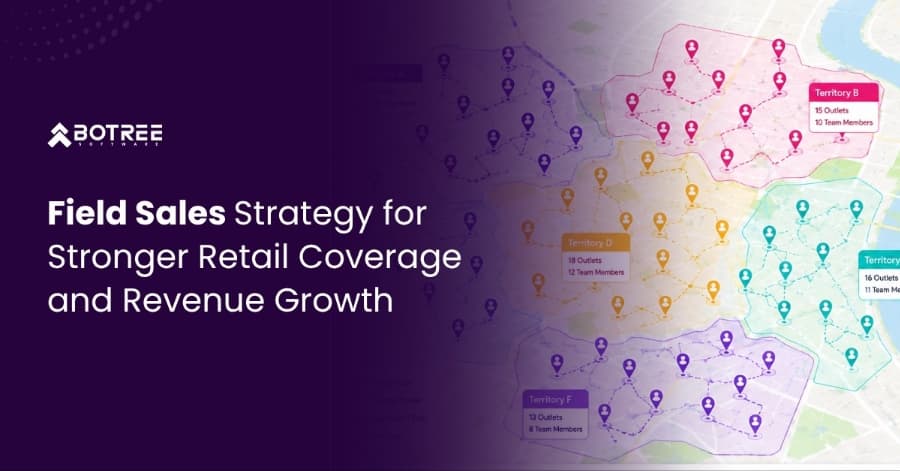
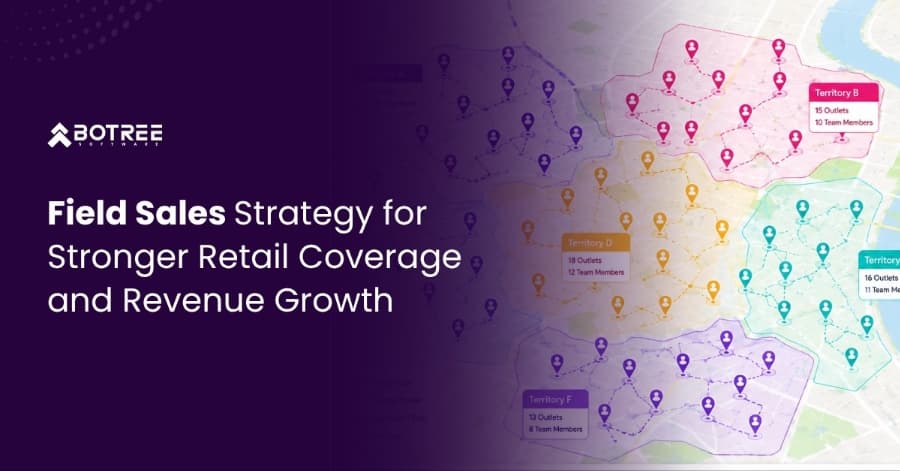
Balanced sales territory helps sales representatives cover more outlets without getting overloaded. The process of designing the sales territory includes such factors as the density of the outlets, travel time, visit frequency, and the potential of sales.
4. Standardized Field Execution
To achieve market success, companies need to provide a standardized execution at all the retailers. Standards should be applied when booking orders, range selling, communicating the trade scheme, product availability, merchandising, retail audits, and new outlet addition.
5. Performance Management
For there to be an effective field sales process, continuous performance monitoring and coaching is needed. This allows managers to monitor key indicators like outlet visits, beating compliance, quality call activity, supplementary selling, and target attainment.
Even well-planned field sales strategies can fail if execution is inconsistent. These are some of the most common challenges FMCG, CPG, and FMCD businesses face—and how to overcome them.
AI is helping FMCG, CPG, and FMCD companies in executing their field sales strategy better by converting their real-time data into recommendations. With the help of artificial intelligence, businesses can optimize outlet coverage, enhance market execution, and enhance sales productivity.
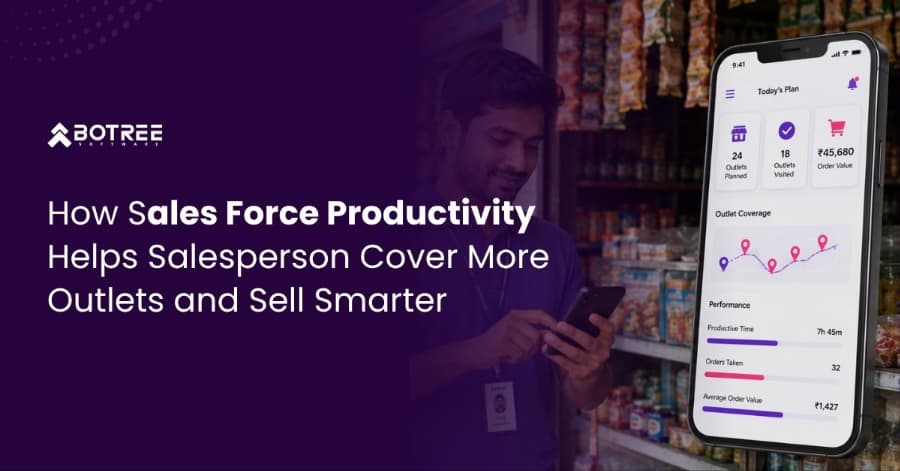
Botree’s AI-powered Route-to-Market platform helps FMCG, CPG, and FMCD businesses execute their field sales strategy by connecting field teams, distributors, retailers, and sales intelligence on a single platform. Botree SFA enables sales representatives to manage beat plans, capture orders, conduct retail audits, execute trade schemes, and monitor field activities in real time, while AI-powered Beat Planning helps prioritize high-potential outlets for better retail coverage and productivity. Product Recommender with Suggested Order Quantity (SOQ) recommends the right products and quantities based on purchase history, outlet potential, inventory levels, and active schemes, helping improve range selling and increase order value. Native DMS integration, including FlexiDMS, provides real-time visibility into secondary sales, distributor inventory, pricing, schemes, and claims while seamlessly connecting distributors using Tally or Busy.
Botree Van Sales supports ready-stock distribution with real-time route billing, inventory tracking, and collections, while the Botree Retailer App enables retailers to place orders anytime, improving between-visit engagement and generating valuable demand signals. Botree Insights and Sales Tracker consolidate field execution, outlet coverage, territory performance, secondary sales, and retail execution into real-time dashboards, enabling managers to optimize field sales performance, strengthen market execution, and drive sustainable revenue growth across the distribution network.
The effectiveness of a field sales approach is not determined by the number of salespeople out in the field but by the ability of these salespeople to capitalize on each outlet visit to drive business growth. The firms that are able to concentrate on the right geographic areas, target the right outlet prospects, execute with consistency, and make data-driven decisions will be better positioned for retail coverage expansion, building of strong relations with the retailers, generation of secondary sales, and sustained revenue growth. With the increasing complexity of distribution channels, businesses will need to rely on a combination of good execution with visibility and intelligence driven by AI technologies.

Marketing Associate
Meet Christina Evangelin Ebinezer, our dynamic marketing associate at Botree Software. With a background in HR and marketing, and prior experience as a content writer, Christina brings a sharp eye for storytelling and a knack for crafting engaging blogs and marketing content. She’s passionate about turning ideas into words that drive impact. Outside of work, Christina finds joy behind the piano keys or the wheel—whether she’s playing a soulful tune or cruising down open roads.
What is field selling?
What are the key responsibilities of a field sales representative?
What is the difference between field sales and inside sales?
What is field sales automation?
How does Sales Force Automation (SFA) improve field sales?
What is territory management in field sales?
Why is retailer relationship management important in field sales?
How does AI improve field sales?


Stay updated with the latest trends and insights.