
Christina Evangelin Ebinezer
Marketing Associate



The FMCG & CPG & CPG business sector in India works under one of the most fragmented distribution systems in the world. In India, products worth more than USD 110 billion are moved every year through over 13 million Kirana stores, distributors, super stockists, and wholesalers, out of which about 85 percent continue to be delivered via traditional general trade routes. For decades, the Distributor-Retailer connection within the network has still been the least efficient, least transparent, and prone to error-filled step in the entire process.
Manual order capturing, order partial fulfilment, scheme leaks, dispute claims, and slow secondary sales tracking have silently eaten away market share and margins for FMCG & CPG brands year after year. The silver lining is that contemporary Distributor-Retailer processes, enabled through technology and AI, offer a fresh perspective on how FMCG & CPG distribution can be done through smarter planning and selling of products.
In this blog post, we’ll see what makes Distributor-Retailer operations truly ‘modern,’ the ways in which it positively impacts FMCG & CPG distribution processes, a use-case of the process in action, and the KPIs that should matter once you have switched sides.
In the traditional distribution of FMCG & CPG products, there is a push-based approach. The manufacturer appoints the distributor, who hires the sales force, which visits 40-60 stores daily, takes manual orders, and reconciles its accounts at the end of the day. The products then move from the distributor to the retailer in 2-3 days, usually without fulfilling the order fully.
It works well where the market was slow, and the number of SKUs was minimal. In today’s environment of fast product launches, hyper-local competition, and quick commerce taking away business from general trade, this model has several flaws:
Despite the rise of modern trade, e-commerce, and quick commerce, traditional general trade still accounts for nearly 80% of India’s FMCG & CPG retail sales. Fixing the Distributor–Retailer link is, in effect, fixing the performance of 80% of your business.
The speed of modern FMCG & CPG supply chains cannot tolerate any disconnect between the processes involved. Any gap between the inventory management system used by distributors, the demand from retailers, and the field execution process can result in stock-outs, lost sales opportunities, and ineffective retail servicing.
By contrast, modern distributor-retailer processes can integrate all four of these factors into an interconnected ecosystem. Rather than react after the fact, FMCG & CPG brands can be proactive, responding quickly and improving execution efficiency.
However, manual ordering processes generate constant problems related to incorrect SKU choice, unavailability of scheme information, duplicity, and delays in billing. Such minor discrepancies become significant in the long run and start affecting retailer confidence, billing process, and sales productivity.
Advanced Sales Force Automation (SFA) solutions are replacing paper-based order registers by digital order capture with live SKU databases, pricing, scheme information, and real-time inventory availability. Representatives can now order accurately from the outlets as retailers experience quicker confirmations and fewer discrepancies in the fulfillment process.
Botree Sales Force Automation Software is an example of modern solutions that facilitate consistent order management within large distributor networks.
What Changes Operationally?
Most FMCG & CPG brands depend on primary data to assess their sales potential. However, primary billing fails to reveal what moves at the retail point of sale.
The Distributor Management System offers timely visibility of secondary sales data through the instantaneous capture of goods movement between the distributor and the retailer. This enables brands to have an accurate picture of high movers, outlet requirements, stock shortages, and regional sales trends.
This enables businesses to switch from reactive to proactive inventory management and logistics operations.
What Changes Operationally?
One of the biggest operational loopholes when it comes to FMCG & CPG products is trade schemes. These usually consist of manual calculations, late validation, and claims processing which leads to profit margin leakage and reconciliation issues.
The modern practice of distributor-retailer operations incorporates the use of schemes at the point of invoice processing. Claims are created automatically, thus eliminating manual intervention and enhancing visibility for distributors.
FMCG & CPG distribution management ecosystems can further help brands in assessing the performance of their schemes.
What Changes Operationally?
Inventory management becomes complicated when there is no correlation between the flow of inventory through the distributor’s channel and the consumer demand.
AI-based auto replenishment solutions examine the secondary sales flow, the performance of the outlets, and demand patterns to suggest optimized quantities for replenishment and restocking.
Current FMCG & CPG distribution automation systems rely on predictive analytics that help them detect problem stores even before sales start dropping.
What Changes Operationally?
The traditional approach of field sales tends to face difficulty in covering infrequent or distant retailers. Higher coverage generally leads to higher costs for the field operation.
Ordering through online retail portals, B2B e-commerce portals, and WhatsApp order placement enables retailers to order at any time, without being solely reliant on visits by the salespersons.
Thus, it is possible for FMCG & CPG brands to enhance their coverage, increase the frequency of orders, and enhance retailer engagement without raising sales costs substantially.
What Changes Operationally?
Many FMCG & CPG brands now combine self-service ordering with SFA platforms to create a hybrid distribution model that improves both retailer convenience and field productivity.
Modern FMCG & CPG distribution is no longer driven only by primary billing and distributor relationships. Brands now need real-time coordination across distributors, retailers, field teams, inventory, and retail execution to maintain market responsiveness at scale.
Here are six major ways connected distribution operations are improving FMCG & CPG performance in 2026.
Stock gaps would usually be detected when retailers start raising their concerns. At that point, the shelf space could have been occupied by competing brands.
Current distributor management software systems provide real-time, batch-based visibility of inventories within the distributor’s premises. The system monitors slow-moving items, ageing of stock, and secondary sales performance, enabling brands to reorder more quickly based on the actual retail sell-throughs.
The benefits include higher order fill rates, reduced stock-outs, and improved shelf presence at all retail outlets.
In conventional FMCG & CPG ordering cycles, numerous manual tasks need to be performed, such as submitting orders on paper, delayed invoicing, disconnected claims management, and delayed reconciliation process.
However, with modern systems of distributor-retailer relationships, everything becomes automated. The invoices are generated instantly, schemes are applied automatically at the time of billing, and claims are processed through well-defined processes.
This helps in reducing the cycle time from order to cash.
It is also worth noting that even today, most FMCG & CPG sales teams rely on fixed routes that involve visiting the same outlets repeatedly without considering their future sales potential or current sales performance.
However, advanced versions of SFA software leverage artificial intelligence algorithms to focus sales teams’ attention on outlets with higher retail potential, faster SKU turnover rates, and better execution opportunities.
In addition, route optimization techniques help minimize redundant trips while maximizing effective call ratios.
Don’t measure field productivity only through outlet coverage. Metrics like productive call ratio and lines sold per call reveal whether the beat is generating incremental sales.
Leakage in the FMCG & CPG supply chain still occurs frequently in the process of trade promotions. The scheme is sometimes incorrectly used, retailers miss out on some deals, and claims are always slow to reconcile.
Using modern-day DMS systems eliminates the problem by automating the scheme process at the time of invoicing. Pre-defined discounts, slabs, and free goods are set up in advance in the software, while claims automatically appear in the system with appropriate auditing.
Primary sales reveal the items that entered the pipeline. Secondary sales reveal the items that have been sold. The difference between these two represents where surplus stocks accumulate.
In today’s world of distribution and retail, the secondary sales movement can be captured in real time and aid demand planning.
These AI forecasting models will then help recognize the items that sell quickly and even suggest patterns of reordering.
Retailers work in time-bound environments that require speed and convenience in ordering processes.
The use of retailers’ applications and eB2B ordering systems enables retailers to explore the catalogues, see schemes, place orders, follow deliveries, and receive invoices without relying solely on the visits made by salespersons.
In this regard, this becomes an added advantage for FMCG & CPG brands to foster a good retailer relationship level.
The changes discussed above are not compartmentalised; they compound. Once the brand digitalises the connection between the distributor-retailer, the impact is seen immediately on the top line, bottom line, and balance sheet. This is how the above impacts are converted into business results:
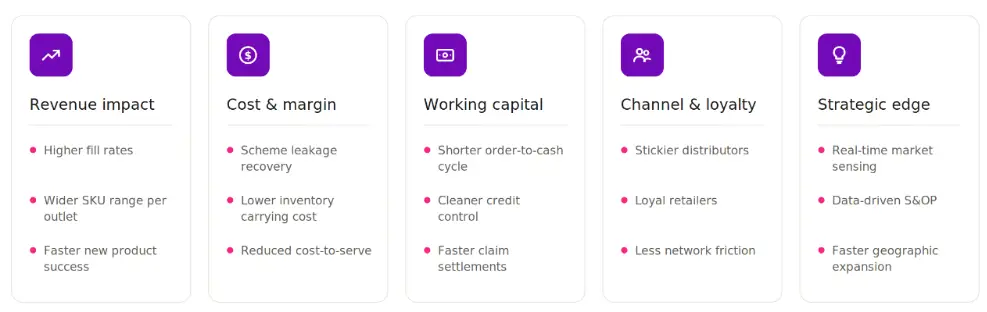
FMCG & CPG distribution today needs connectivity between distributors, retailers, field sales, inventory management, and retail execution. Lack of connectivity results in late replenishment, leakage of schemes, lack of visibility for secondary sales, and inconsistent retail execution.
The Botree DMS and Botree SFA solutions can help FMCG & CPG companies achieve connectivity between their distributor operations, field execution, and visibility in secondary sales.
Starting from AI outlet prioritization using Botree OutletPulse, managing schemes and programs in real time, achieving inventory visibility, enabling retailer self-service ordering, and retail execution visibility, Botree can help companies achieve better operational agility.
This enables FMCG & CPG brands to:
Current distributor-retailer operations are not only about better coordination of distributors and retailers. They affect such factors as fill rate performance, retailer retention, secondary sales transparency, trade spend effectiveness, and FMCG & CPG distribution performance.
With increased fragmentation of retail channels and changing customer demand patterns, current models of distribution that rely on delayed reporting and manual coordination become less effective at scale.
Connected DMS solutions, SFA, AI-driven demand forecasting, and retailer self-service platforms are allowing FMCG & CPG companies to implement smarter and faster distributor-retailer operations fueled by real-time market insights and execution effectiveness.
Brands that adopt smarter distributor-retailer operations today are likely to gain an edge in reducing operational leakage, increasing retailer execution effectiveness, and building route-to-market excellence tomorrow.

Marketing Associate
Meet Christina Evangelin Ebinezer, our dynamic marketing associate at Botree Software. With a background in HR and marketing, and prior experience as a content writer, Christina brings a sharp eye for storytelling and a knack for crafting engaging blogs and marketing content. She’s passionate about turning ideas into words that drive impact. Outside of work, Christina finds joy behind the piano keys or the wheel—whether she’s playing a soulful tune or cruising down open roads.
What are distributor–retailer operations in FMCG & CPG distribution management?
How does distributor management software improve secondary sales visibility?
How does sales force automation software improve retail execution and field productivity?
How is AI in FMCG & CPG distribution improving demand forecasting in FMCG & CPG?
What features should modern distribution automation and retail order management systems include?
Stay updated with the latest trends and insights.