
Christina Evangelin Ebinezer
Marketing Associate



There are several factors which have led to an increase in complexity within sales operations of FMCG & CPG firms over the past few years.
These include travelling field sales team who cover different territories, expanding distributor networks, trade spend, outlet execution, merchandising, van sales, and retailer’s engagements that incur expenses daily.
However, most organization are still handling their expenses manually using tools such as Excel sheets and emails for approvals and reconciliations.
This creates challenges with expense management because it becomes hard to track where the money is going, how much money is being spent, and whether there is a link between the spend and the sales performance.
The traditional approach to expense management has become inadequate in helping businesses improve their efficiency and control.
Today, expense management is not only the responsibility of the finance team.
In the modern business environment, expense management has become a tool for improving efficiency and effectiveness of sales operations by increasing visibility, improving compliance, and accelerating execution.
Organizations that automate expense reporting can significantly reduce processing costs and approval effort compared with manual processes. Aberdeen Group estimates automated expense reporting can reduce processing cost per report from approximately $58 to under $16.
In this guide, we’ll explore how expense management is evolving in FMCG and CPG and how technology is helping sales teams operate more efficiently.
Expense management in FMCG and CPG involves collecting, verifying, authorizing, and reimbursing the expenses incurred by the salesperson, distributors, and channel partners of the business as part of their activities, including travel costs, daily allowances, fuel costs, meetings with retailers, schemes, and trade promotions. Expense management solutions leverage SFA and DMS systems to automate these processes, reducing losses, expediting reimbursements, and increasing sales productivity.
Expense management for field sales in FMCG & CPG is distinct from regular office expense management because it:
Is conducted on a large scale: hundreds or even thousands of salesperson and distributors making claims daily
Common types of claims include travel, fuel, travel and daily allowances (TA/DA), food, entertainment of retailers, samples distribution, schemes, distributor claims, and trade promotions.
Expense inefficiencies do not usually present themselves as a visible issue. These inefficiencies build up over time through the approval process, reimbursement process, reporting, and execution until they start having an impact on sales performance and productivity.
For FMCG and CPG organization, who conduct their executions through a wide network of distributors and field forces, minor delays can have a significant business effect.
The following are some of the common expenses that come with inefficient expense management.
Where there is a delay in expense authorization and expense reimbursement, field sales team will be hesitant to submit their expenses and will cut back on activities that help in executing the plan.
This will affect market coverage and execution in the long run.
Many businesses still review expense data after execution is completed.
Without real-time visibility, leaders struggle to answer questions such as:
Instead of making decisions during execution, teams react after the opportunity has already passed.
Manual sales expense management procedures create inefficiencies within an organization since they require that members of the sales and finance departments divert their attention from high-value tasks to engage in documentation, approval, reconciliation, and troubleshooting. As the organization grows, administrative burden increases at a much faster rate than business value.
With an increase in the number of transactions, it becomes increasingly difficult to manage the process manually. There is a higher chance of double billing, delayed settlements, documentation errors, and inconsistent approvals. Ultimately, this impacts governance, leads to operational leakages, and weakens decision-making.
Cost management is frequently a multidisciplinary effort, with sales dealing with implementation, finance dealing with cost containment, and operations dealing with process compliance. Where there is no system integration, each group works with separate sets of information. In this case, decisions are slower, coordination is poor, and execution becomes less effective.
One of the biggest hidden costs is the inability to connect spend with outcomes.
Without integrated expense visibility, businesses struggle to determine:
Expense management becomes far more valuable when spending can be tied directly to execution performance.
If your expense reports are reviewed only after month end, you are managing historical spending not operational performance.
Expense management problems seldom originate with increasing costs.
For the majority of FMCGs and CPGs, they usually start to emerge within the company itself, through slow approval, delayed reimbursements, decreased transparency, and increased administration. Since this process occurs slowly, employees tend to adapt to these issues rather than identify them as problems with their processes.
Consequently, expense management becomes a problem only when it impacts the quality of the execution and sales results.
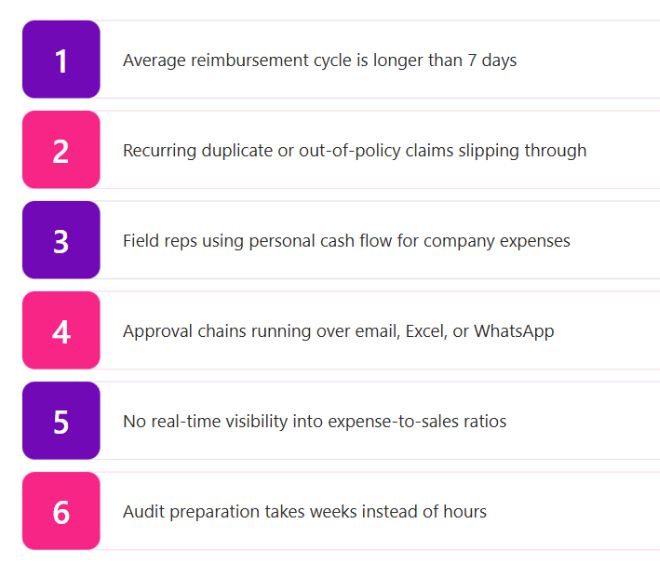
If one of the following scenarios rings a bell, you probably have an expense management gap in your sales operations.
Modern FMCG and CPG companies use a combination of Distribution Management Systems (DMS) and Sales Force Automation (SFA) platforms to manage two very different categories of business expenses — channel-side and field-side.
| Expense Category | Managed By | Examples |
|---|---|---|
| Channel & distribution expenses | DMS | Distributor claims, scheme payouts, logistics, damages |
| Field sales & Salesperson expenses | SFA | Travel, fuel, daily allowance (TA/DA), retailer meetings |
| Cross-functional financial flows | DMS + SFA + ERP integration | Reimbursements, payroll, audit, P&L visibility |
A Distributor Management System enables companies to automate distributor-driven processes such as logistics, warehousing, billing, and secondary selling. In terms of expenses, a DMS will cater to:
Through automation of these processes on one single platform, brands can have complete financial control across their distribution channels – eliminating weeks of manual claims processing and enabling rules-based expense management.
While DMS caters to channel-side expenses, Sales Force Automation platforms cater to field sales teams. The key expense management capabilities within an SFA system include:
Result? Minimal paperwork, fast approvals, less disputes, and greater accountability within the field force.
The actual savings come from integrating DMS and SFA and letting them communicate with each other, as well as with all your other enterprise systems.
The most forward-thinking FMCG/CPG companies integrate their DMS and SFA with:
Together, these create a connected expense management ecosystem that delivers:
Expense processes don’t fail due to a lack of discipline on the part of teams; they fail because the business model was made for a smaller company.
A system that worked well for controlling a couple of expense processes each week starts to become hard to maintain as sales teams increase, distributors multiply, and the cycles of action speed up.
This is when businesses start transitioning from manual expense management to connected and automated expense management.
| Area | Manual Expense Management | Automated Expense Management |
|---|---|---|
| Expense Capture | Expenses recorded after execution through spreadsheets or forms | Expenses captured in real time during execution |
| Approval Process | Multiple follow-ups and delayed approvals | Automated workflows with faster turnaround |
| Visibility | Limited visibility until reports are consolidated | Real-time monitoring across teams |
| Reporting Accuracy | Higher risk of manual errors and duplication | Standardized and consistent reporting |
| Reimbursement Cycle | Slower settlements and delayed processing | Faster reimbursement and settlement cycles |
| Compliance | Difficult to enforce policies consistently | Rules and approval controls built into workflows |
| Decision-Making | Decisions based on historical reporting | Decisions supported by live operational data |
| Scalability | Process complexity increases with growth | Designed to scale with operations |
In addition to being effective at controlling costs, proper expense management systems can speed up the sales process.
With real-time expense management, there is less time spent on approvals, reconciliations, and reporting, leaving more time for getting things done. This results in better responsiveness from field operations and quicker actions by companies in changing market situations.
Among the most significant operational advantages are:
Expense management gradually evolves from being a mere reporting activity to an operational strength that enables organizations to enhance execution capabilities, gain control, and make more informed investments within sales operations.
Improving expense management does not require replacing every existing process at once. The most successful initiatives usually start by simplifying current workflows, improving visibility, and gradually connecting systems across sales and finance operations.
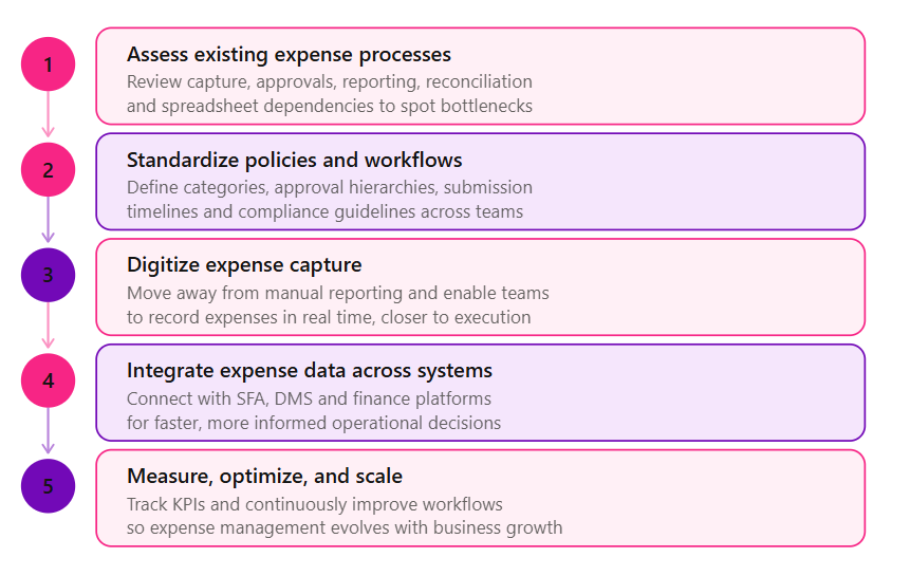
The goal of expense management is not to reduce spending, it is to ensure spending creates measurable business outcomes.
When there is a lack of connection between the processes of approving and making claims, seeking reimbursements, and executing activities, managing costs associated with the field and channel becomes challenging.
By integrating field and sales operations with expense management processes, Botree expense management allows FMCG and CPG companies to gain control and visibility into their expense management processes.
This helps businesses:
The result is a more connected approach to expense management—where expenses become easier to manage, faster to approve, and more aligned with sales performance.
Managing a large distributor ecosystem often increases operational complexity across schemes, claims, approvals, and sales execution.
To improve visibility and simplify operations across its distributor network, Jyothy Labs implemented Botree DMS.
The result:
While the initiative focused on distribution operations, the impact extended to faster workflows, improved operational visibility, and more efficient management of execution-related activities.
Expense management is not limited to just cost control or reimbursement processing anymore.
In terms of FMCG and CPG companies, expense management has taken an important seat within efforts towards developing faster, more connected, and efficient sales operations.
With the scaling of field execution, expansion of distribution channels, and increasing operational complexity, managing expenses manually becomes increasingly difficult, with the potential for delayed approvals, limited visibility, and poor workflows, resulting not just in additional work but reduced execution and decision quality.
Effective modern expense management enables companies to progress beyond mere reporting and achieve increased visibility of their spend, execution, and performance.
The objective isn’t necessarily to reduce spend.
It is to ensure that every spend made supports strong execution and informed decision-making.
Companies that approach expense management as an operational capability and not just a financial activity will have a clearer path to scaling up.

Marketing Associate
Meet Christina Evangelin Ebinezer, our dynamic marketing associate at Botree Software. With a background in HR and marketing, and prior experience as a content writer, Christina brings a sharp eye for storytelling and a knack for crafting engaging blogs and marketing content. She’s passionate about turning ideas into words that drive impact. Outside of work, Christina finds joy behind the piano keys or the wheel—whether she’s playing a soulful tune or cruising down open roads.
What is the difference between expense management and expense tracking in FMCG & CPG?
How does expense management software improve sales operations?
Why is field expense management important for FMCG sales teams?
How does Sales Force Automation (SFA) support expense reporting?
Can expense automation improve operational efficiency?
How do FMCG companies measure the success of expense management initiatives?

Stay updated with the latest trends and insights.