
Christina Evangelin Ebinezer
Marketing Associate



BThe modern FMCG and CPG supply chains are becoming increasingly complicated due to additional channels, increased SKU volumes, and demand variability.
However, many brands still struggle with the same problem: inventory is present in the supply chain; it just does not appear at the right locations.
While distributors have excess inventory, the sales points are short. Fast-moving SKUs disappear without warning, while excess inventory of slow-moving SKUs affects the working capital.
It is not the question of inventory availability anymore. The problem becomes one of inventory management. Regular practices based on manual replenishment and reporting are not coping with the challenges.
AI – powered inventory management is transforming distribution execution through real-time inventory visibility, demand forecasting, replenishment, and improved decision-making regarding inventory management.
In this guide, we will examine the process of evolution of stock management and how AI helps FMCG and CPG brands to improve their distribution processes.
Stock Management is the activity of managing your inventories by procuring, storing, controlling, and managing them throughout your entire distribution chain – be it the manufacturer’s warehouse, the distributor’s godown, or your shelf on the retailer’s store.
When done properly, it ensures your inventory reaches the appropriate locations on time, in the right quantities, and in perfect conditions.
When done wrongly, however, it leads to lost sales and reduced margins that slowly erode your brand’s market share.
Therefore, efficient inventory management system for FMCG does not only mean having a sound system; it means being able to keep your products relevant in the market and maintaining distributors’ trust and loyalty to your brand.
This is why modern stock management through artificial intelligence has become crucial for any high-performing FMCG and CPG business.
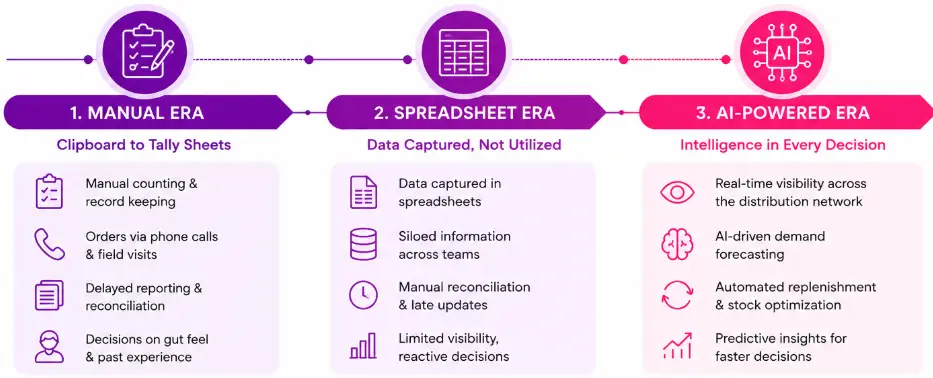
Until recently, stock management in FMCG was dependent upon manual methods of inventory counting, phone calls, and delayed reports. The decision-making process for inventory was made based on past experience and available information
This method functioned well when there were fewer SKUs and less complicated distribution channels.
However, as the number of sales channels increased, demand grew uncertain, and processes became increasingly complicated, conventional stock management failed to cope with the situation.
Currently, the most advanced FMCG/CPG companies are adopting artificial intelligence-based solutions for stock management to facilitate instant visibility and automated replenishment.
Here’s how stock management has evolved over time.
Adopting a modern stock inventory management system delivers advantages that compound across every layer of your distribution network.
Have instant knowledge about where your stock always resides – within warehouses, through distributors, and in the field. No need for daily reporting or having to chase down distributors to get your stock inventory.
Replenishment software solutions powered by artificial intelligence always keep track of your stock and initiate purchase order processes on their own once threshold levels are hit, preventing stockouts before they occur.
State-of-the-art forecasting techniques use historical sales trends, current sell-out speeds, seasonality factors, and promotion schedules to provide a picture of how much stock you need at specific points in time.
Fast-moving consumer goods typically have a finite shelf life. It’s therefore critical to have inventory management systems that keep track of batches and expiry dates of your stock throughout the entire network.
Having too much stock takes capital. By managing inventory more precisely, you can minimize stock quantities, which in turn helps reduce waste of working capital and improve the bottom line.
When fill rates go up, stockouts cease to be an issue, which goes unnoticed by distributors who will appreciate your reliability and place greater confidence in your stock.
FMCG and CPG distribution is not a simple two-step process. It is a multi-tier, high-velocity operation where products move from manufacturer to super stockist to distributor to retailer and any breakdown in stock visibility at any of these layers has consequences that ripple through the entire network.
Here’s what makes stock management uniquely challenging in this industry:
The FMCG brands may have several hundred SKUs under their banner when size, formats, flavours, and regional preferences are factored in. Each SKU has its demand curves, shelf-life cycle, and replenishment strategy.
The products under consideration are perishable as compared to industrial goods. If there is poor inventory control, the company faces not only dead stock but also liabilities and brand risk.
There can be data loss with each transfer in a complex network of distribution channels. Primary sales capture sales leaving the factory while secondary sales record actual sales from distributors’ stock. You cannot ignore either of them in decision-making.
Competitor activity, seasonal festivals, regional weather, etc. may trigger shifts in consumer demand. The brands that are slow to adapt to changing circumstances end up incurring losses.
Depending on the type of distribution, the inventory management differs. It means that general trade, modern trade, e-commerce, and institutional sales require varied service levels and replenishment strategies.
In this environment, the margin for error is thin and the cost of getting it wrong is high.
Despite knowing the stakes, many FMCG and CPG brands are still operating with significant gaps in their stock management capabilities. And those gaps are creating real, measurable operational risk.
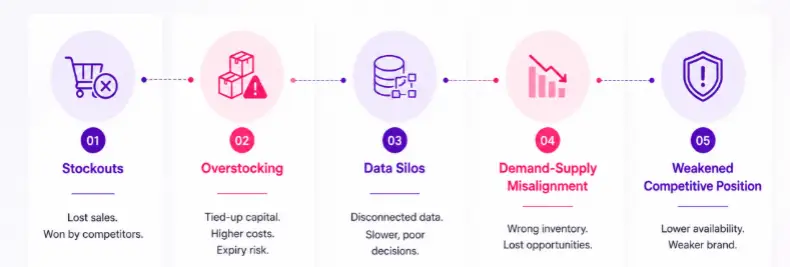
The fix isn’t working harder on the same broken systems. It’s replacing them with something built for the scale and complexity of modern FMCG distribution.
Botree DMS is an exclusive Distributor Management System designed specifically for the complexities involved in FMCG/CPG distribution.
With the help of Botree DMS, brands get full visibility and control over their entire supply chain visibility right from the movement of stocks at the manufacturer level to the secondary sales of products in the market through distributors to tertiary sell-out at retail shelves.
As against other generic tools for inventory management, Botree DMS is developed specially for handling the multi-level nature of FMCG/CPG business and provides a unified platform to bring together the manufacturer, super stockist, distributor, field sales, and retailer all on one place in real time.
No matter whether it is 50 distributors or 10,000+; Botree DMS helps in managing them efficiently.
How Botree DMS Solves Everyday Stock Management Challenges
Every feature in Botree DMS is built to solve a specific, real problem that FMCG and CPG brands face in day-to-day distribution.
Here is how Botree helps address some of the most common challenges in distribution.
| Everyday Challenge | Traditional Approach | How Botree Solves |
|---|---|---|
| Limited inventory visibility | Manual reports and delayed updates | Improves visibility across distributors and stock movement |
| Stockouts across priority outlets | Reactive replenishment | Supports faster replenishment decisions |
| Excess inventory and slow-moving stock | Static inventory planning | Improves inventory balancing and utilization |
| Forecasting based on historical trends | Manual forecasting | Uses demand signals to improve planning |
| Slow distributor coordination | Multiple disconnected systems | Creates a more connected execution environment |
| Delayed inventory action | Report-first workflows | Helps teams identify and act faster |
Being the world leader in precise nutrition for pets, Royal Canin encountered problems with inventory mismatches, manual mistakes in orders and data fragmentation within its multi-channel distribution process.
In an effort to streamline operations, Royal Canin utilized a connected distribution method using Botree DMS and created inventory consistency through integrating data among its distributors, ERP systems, own online shop, and veterinary partner management system.
Through such integration, stock reconciliation could be done in a much more efficient way than before.
The result was a more connected, real-time distribution chain that enabled:
The outcome was not simply improved inventory management.
It was stronger inventory execution across the distribution network.

Modern stock management helps FMCG and CPG businesses move from reactive inventory control to faster and more informed decision-making. By improving inventory visibility and reducing dependency on manual processes, teams can manage stock more efficiently across distributors, warehouses, and retail channels.
Key benefits include:
The impact of better stock management extends beyond inventory accuracy. With greater visibility and faster execution, businesses can improve service levels, respond better to changing demand, and maintain product availability across markets.
This helps businesses:
A stock management tool should go beyond just managing the inventory. The ideal stock management should help organizations achieve better visibility, respond to changes in demand, and enable distribution execution more efficiently.
These questions need to be answered when selecting a tool:
1.Is it geared towards FMCG & CPG Distribution?
Pick an inventory management tool that is geared towards multi-tier distribution, secondary sales visibility, and field execution rather than inventory management in general.
2.Does it offer real-time inventory visibility?
The stock management tool should provide real-time visibility into your inventory in warehouses, distributors, and the sales process.
3.Does it include artificial intelligence for inventory forecasting and replenishment?
Today’s stock management systems should help you predict the demand and replenish the inventory automatically.
4. Is it easy to connect it to other business processes?
The best stock management software integrates with ERPs, accounting, SFA, DMS, and analytics platforms to provide comprehensive visibility.
5. Is it scalable?
A stock management tool should accommodate SKU diversification, complex supply chains, and the growth of the organization without adding any extra work.
The ideal stock management tools do more than help companies monitor their inventories. They also help increase availability, execution, and efficiency of the distribution process.
Prioritize platforms that combine visibility, forecasting, and execution instead of standalone inventory tracking tools.
Stock management practices have developed from manual stock tracking into a connected process of making decisions.
With FMCG/CPG businesses growing ever more complicated, conventional practices based on lagging data gathering and isolated processes become more difficult to uphold. Poor visibility, reactive replenishment, and disconnected stock tracking don’t merely cause inventory problems but also have a negative impact on the efficiency of your business operations and availability of your products in the market.
Today’s stock management allows you to take your operations further by developing a distribution system that goes beyond simple stock monitoring and helps you achieve higher efficiency and connectivity in the supply chain. Thanks to improved visibility, better forecasts, and intelligent replenishment, you’ll manage to make the market available for your products.
The point of stock management isn’t simply stock maintenance anymore.
Your aim now becomes to develop a stock management strategy which will help you execute your business activities better, take better decisions, and grow sustainably.

Marketing Associate
Meet Christina Evangelin Ebinezer, our dynamic marketing associate at Botree Software. With a background in HR and marketing, and prior experience as a content writer, Christina brings a sharp eye for storytelling and a knack for crafting engaging blogs and marketing content. She’s passionate about turning ideas into words that drive impact. Outside of work, Christina finds joy behind the piano keys or the wheel—whether she’s playing a soulful tune or cruising down open roads.
What is stock management in FMCG and CPG?
How does stock inventory management improve inventory visibility?
What should businesses look for in stock management software?
How does an inventory management system support better replenishment planning?
How does AI improve inventory optimization and demand forecasting?
What is the difference between inventory tracking and inventory control?
Why is a Distribution Management System (DMS) important for stock management?
How can FMCG and CPG brands improve inventory planning?
Stay updated with the latest trends and insights.