
Christina Evangelin Ebinezer
Marketing Associate



Everything about the way in which consumer brands are selling and distributing their products is up for grabs right now. AI agents are managing the field sales force. Distribution players want live visibility. Modern Trade is booming, but General Trade digitizes stealthily. And consumers in cities as well as rural India insist on getting their products wherever, whenever, and however they please.
In other words, if you still run your sales and distribution operations according to the traditional rule book, you’re not only behind the times – you’re losing market share.
In this practical guide, I will take you step by step through the process of building a high-performing sales and distribution strategy – the combination of sound strategic thinking and smart AI execution. Be it sales management at a leading CPG enterprise or rapid FMCG growth, you’ll have a proven framework to implement this quarter.
The sales and distribution strategy is the combined effort involved in moving the company’s products from production to distribution centres to retail centres to the end consumer in a way that results in profitable income at each step along the way. This includes decisions on channels, distribution centre management, field selling tactics, pricing, trade promotions, and technologies used for these tasks.
Selling is the process of turning demand into money. Distribution is the process that enables products to be made available for conversion of demand. Treating selling and distribution separately is what is holding many businesses back. Successful firms in 2026 operate selling and distribution as an integrated process.
Difficulties in Sales and Distribution have outpaced conventional operations. FMCG, CPG, and OTC products continue to work on their execution systems as if there were lesser sales channels, slower sales cycles, and intermittent reporting. Today’s growth strategy revolves around being fast, clear, and good in execution.
Gaps, where they exist, occur not in manufacturing but between planning and execution.
Some of the common issues are:
There is usually a separation between sales, inventories, retail execution, and channel performance, which makes decision-making difficult.
This occurs due to the use of manual reports, reconciliations, and updates from distributors that delay decisions about marketing.
These processes are inflexible as far as changes in the marketplace and productivity are concerned.
Increased products and channels make the conventional methods for forecasting obsolete.
These delays affect the organization adversely, as stockouts and inefficiencies are created because of late signalling.
Some high performers have decided to take actions to create connected sales and distribution ecosystems.
An effective sales strategy ensures that a team of field reps becomes a reliable and efficient growth machine for a company. This is because it addresses the following questions: Who do we sell to? How often? What do we push? And how do we encourage proper behavior?
These are the 5 pillars of sales strategy
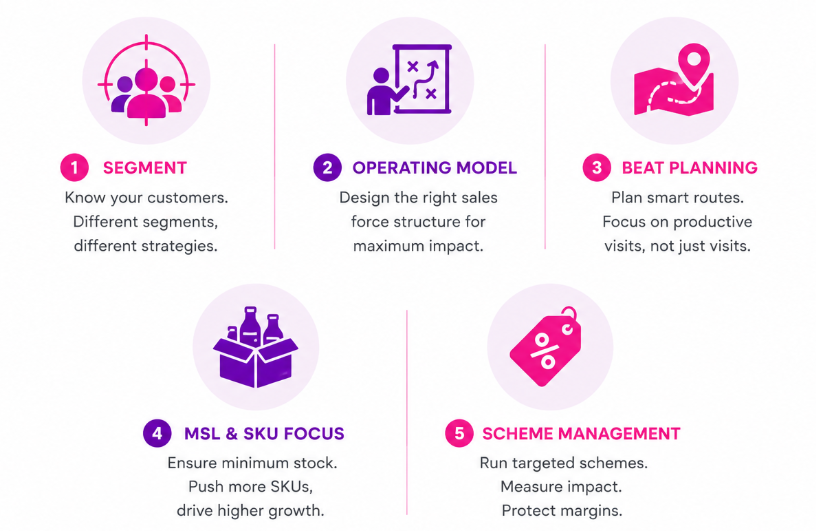
Breakdown of the customers, outlets, and markets according to relevant attributes such as geographic location, sales potential, distribution channel type, or purchase behaviours. Segmentation requires an individualized approach to sales and FMCG distribution management.
Develop the optimal model for sales and distribution management through proper definition of roles, territory planning, distributor accountabilities, and effective execution process design. This will boost productivity.
Development of efficient beat plans and routes for visits made to relevant outlets within a market. This entails visiting outlets as per the right frequency.
Optimization of the SKU mix and MSL. Effective push of key and high-performing SKUs will enhance stock availability and better sales results.
Management of trade schemes and promotional efforts aimed at maximizing sell-through and maintaining adequate profit margins.
These five together create the foundation for a stronger sales and distribution strategy-from deciding where to sell, how to execute, what to stock, and how to accelerate demand.
An effective distribution strategy ensures products reach the right outlets, through the right channels, at the right time – turning distribution into a scalable growth engine. It answers five critical questions: Where do we sell? How do products move? How do we track demand? How do we expand reach? And how do we strengthen distributor performance?
These are the 5 pillars of distribution strategy.
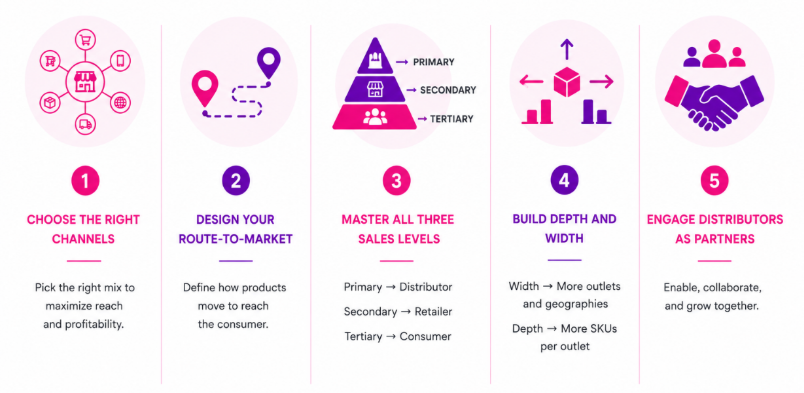
Pick the right channel mix considering consumer behavior, reach, and profitability. Combine General Trade, Modern Trade, E-commerce, Quick Commerce, D2C, and regional channels.
Describe the journey from manufacturing through distribution to retail and consumer delivery. A good route-to-market strategy takes into account territories, coverage strategies, service levels, and execution focus.
Create awareness at every point-of-sale journey:
Primary sales → Brand → Distributor
Secondary sales → Distributor → Retailer
Tertiary sales → Retailer → Consumer
The best decisions are made in synergy of all three.
Achieve greater reach both in terms of:
Breadth → Greater outlet and geographical presence
Depth → Increased selection and penetration of SKUs in outlets
Both are necessary for sustainable growth.
Move from transactional partnership to collaboration. Support distributors with visibility, claims processing, planning and aligned goals to improve their execution capabilities.
A high-performance distribution strategy is not about selling more products – it is about creating the right channel, coverage, execution, and partnership model to scale growth efficiently.
Effective sales and distribution strategies do much more than just get products into the hands of customers. They aid in improving brand performance in terms of execution, agility, and more predictable growth.
Where sales, distribution, field execution, and decisions work in tandem, the outcome transcends profitability.
In the end, successful sales and distribution strategies will ensure that your brand shifts from being reactive to being proactive in terms of decision making, availability, and results.
A superior sales and distribution approach cannot operate on islands and stale data. With growing numbers of channels and increased dynamism in execution, brands require an integrated technology stack that can integrate planning, execution, visibility, and decision-making.
This is what forms the backbone of modern sales and distribution operations.
SFA has emerged as the engine of modern field sales teams. It assists in planning beat plans, recording orders, tracking visits to outlets, improving execution quality, and increasing productivity.
Some other features of modern-day SFA include:
The result: better field productivity and faster market response.
A Distributor Management System DMS creates visibility across distributor operations and turns secondary sales into actionable intelligence.
It helps brands manage:
The result: faster decisions and stronger distributor collaboration.
AI technology is emerging as the key differentiation factor in terms of performance in sales and distribution.
AI not only makes predictions but also recommends courses of action based on those predictions.
Common AI use cases include:
The result: teams spend less time analyzing and more time executing.
Individual systems no longer create competitive advantage – connected systems do.
In a modern operating model:
The result: faster execution, better visibility, and decisions based on real-time information instead of delayed reports.
It is not just the use of technology that helps enhance the efficiency of sales and distribution. Rather, the correct combination can help brands deliver on all three fronts.
However, technology can only add value if the systems are interlinked – here is where Botree Software comes into play.
Botree integrates all the key aspects of modern sales and distribution into a single system, combining Sales Force Automation (SFA), Distributor Management System (DMS), Retail Execution, and Artificial Intelligence-based insight.
Field staff works more efficiently with real-time visibility. The distributors work with connected inventory and orders. The executives can access secondary sales insights and performance data quickly.
With capabilities such as beat planning, route optimization, order management, scheme execution, distributor collaboration, retail visibility, demand-led replenishment, and AI-powered recommendations, Botree helps brands move from fragmented operations to connected execution.
The result is a sales and distribution engine built for speed, visibility, and scalable growth in 2026.
“We wanted to provide one of the best applications to our distributors and salesmen, so we partnered with Botree for end-to-end services, which include DMS, Mobile DMS, SFA, Retailer app, and even our server management. The Botree team is quite helpful, sincere, hardworking, and they are always on their toes to provide support. We are happy with the Botree performance, and we believe that we’ve selected the right partner.”
Ajay Seth
Head – IT,Amul (GCMMF)
However, developing a successful strategy for sales and distribution in 2026 is no longer about reach. Growth will be defined by how well brands integrate the channels, distributors, field execution, inventory, and decision-making in a cohesive way.
The brands that have an edge in the current market are not just those who sell more – but execute more.
Through optimal channel strategy, better distributor partnership, smarter execution, decision-making powered by AI, and an integrated technology platform, organizations can drive availability, responsiveness, and scale.
For FMCG, CPG, and OTC brands, it is time to move from standalone sales and distribution practices to a holistic model that is focused on execution.
It is not a question of whether sales and distribution must evolve. It is a matter of when.

Marketing Associate
Meet Christina Evangelin Ebinezer, our dynamic marketing associate at Botree Software. With a background in HR and marketing, and prior experience as a content writer, Christina brings a sharp eye for storytelling and a knack for crafting engaging blogs and marketing content. She’s passionate about turning ideas into words that drive impact. Outside of work, Christina finds joy behind the piano keys or the wheel—whether she’s playing a soulful tune or cruising down open roads.
What is a sales and distribution strategy, and why is it important?
What is the difference between distribution strategy and route-to-market strategy?
How can brands improve sales and distribution performance?
How do AI in sales and distribution and distribution automation improve operations?
What technology supports modern sales and distribution management?


Stay updated with the latest trends and insights.