
Christina Evangelin Ebinezer
Marketing Associate



On average, an FMCG & CPG salesman visits anything from 40 to 60 stores daily. Yet, field execution processes in many companies are based on rigid routes and outlet visits, delayed reporting and manual oversight. The sales team may be performing well at visiting outlets regularly; however, the brand faces stockout issues, ineffective retail execution, low productive calls ratio, and lack of market response agility.
The challenge isn’t about field visitation anymore. It is all about field execution quality.
Field force automation tools have been built so far to ensure attendance, routing compliance, and order processing. However, modern FMCG & CPG business demands something much more intelligent – tools capable of directing the field force to relevant outlets, pinpointing field execution deficiencies in a timely manner, improving retail visibility, and empowering sales reps to make sound decisions.
That’s where the application of AI in field force automation for FMCG & CPG businesses becomes critical.
With the use of artificial intelligence technologies, retail analytics, real-time reporting, and field execution connectivity, today’s FMCG & CPG brands are becoming better.
AI-powered field force automation is the use of artificial intelligence, automation, and real-time field intelligence to improve how FMCG & CPG sales teams plan, execute, and manage field operations.
Field force automation and AI-driven field force automation are not synonymous concepts, although most software vendors refer to both as the same. The importance of this differentiation lies in the impact it has on the ability of the platform to deliver better business results or simply automate inefficiencies.
| Dimension | Standard Field Force Automation | AI-Powered Field Force Automation |
|---|---|---|
| Core Function | Digitizes field workflows | Improves the quality of field execution workflows |
| Beat Planning | Static, geography-based route assignment | Dynamic, AI-led outlet prioritization based on sales potential |
| Order Capture | Digital forms replacing paper orders | AI-led SKU recommendations and smarter order suggestions |
| Shelf Compliance | Photo uploads with manual audit reviews | Computer vision scores shelves against planograms in real time |
| Retail Execution | Activity tracking and reporting | Real-time execution intelligence and gap identification |
| Manager Visibility | Managers manually review dashboards | Proactive alerts and AI-led execution nudges |
| Outlet Prioritization | Uniform outlet coverage | Focus on high-growth and at-risk outlets |
| Route Optimization | Coverage-focused route planning | Productivity-focused route optimization |
| Decision-Making | Reactive execution management | Predictive field intelligence and faster interventions |
| Performance Impact | Sales reps complete tasks faster | Sales reps improve execution quality at every outlet visit |
Most FMCG & CPG brands using standard SFA solutions have already reaped the efficiencies: digital check-ins, location tagging, digital ordering, and daily reporting. What they haven’t reaped yet, however, is the value from improved execution – specifically, the gap between what a representative does in a customer visit and what a brand expects of them.
It is in this gap that AI shines.
AI-enabled FFA makes sense for any FMCG & CPG brand running a distributed field force operation – i.e., organisations that have 50 or more field representatives across several different territories selling a catalogue of several hundred products and managing multiple distributions and retail outlets.
The platforms usually support multiple personas, each of which has a unique experience on the platform: sales representatives use it for beat plans and product recommendations; merchandisers for shelf audits and compliance scores; van salesman for load planning and routing; managers for dashboards and alerts. While each persona uses the same data set, the workflow is tailored for their individual use case.
While traditional field force automation solutions can help digitize field execution activities, it leaves significant execution gaps for FMCG & CPG sales execution.
These solutions can tell the reps where to go. They cannot instruct the reps on what to do when they get there.
Three main execution gaps arise from this situation:
Sales reps tend to depend on their memory, previous ordering habits, and personal judgment while visiting the outlet. This results in missed cross-selling opportunities, poor SKU suggestions, poor merchandising audits, and limited visibility of retail execution.
Leading reps are naturally skilled at spotting good selling opportunities and retailers’ behaviors. Traditional field force automation can detect the reps’ performance gap. However, it cannot solve it.
Lagging reports mean stockouts, failed executions, and scheme leakages are noticed too late. The managers get visibility into such issues only after the operational failure impacts sales.
AI-based field force automation addresses these gaps by making available:
This helps both sales teams and managers make faster and more intelligent decisions in the market.
Field Force Automation (FFA) systems have moved beyond being merely reporting tools. They are increasingly becoming the link between field forces, retail execution, outlet insight, and sales visibility.
The most significant change lies in the fact that field execution is now being driven through real-time monitoring rather than retroactive management.
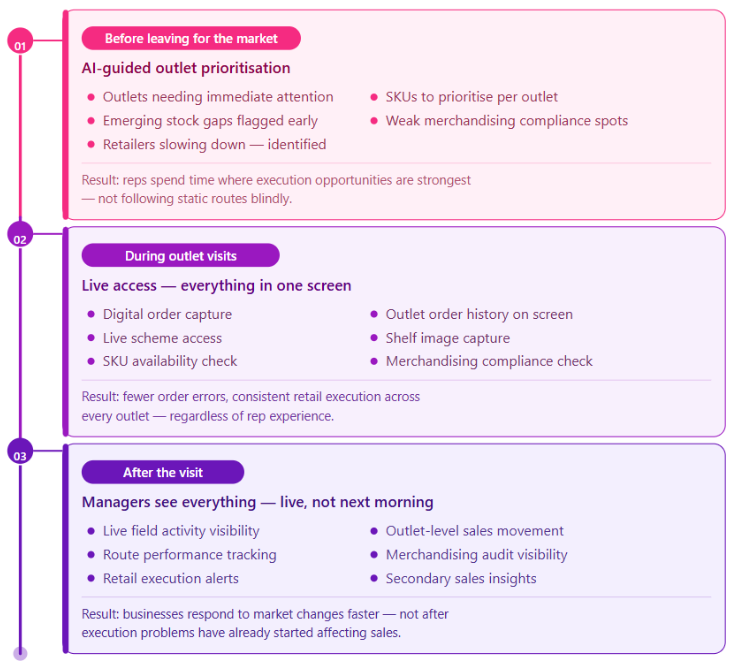
The effects of AI powered field force automation are much more than just digitizing the sales process. They affect execution effectiveness, productivity of outlets, speed of response in sales and FMCG & CPG growth performance in general.
As field operations grow increasingly connected and intelligent, FMCG & CPG companies find themselves more in control of how products travel, how retailers behave, and how fast field staff responds to changes on the ground.
Here are some of the major advantages modern FMCG & CPG businesses experience with AI-powered field force automation.
Traditional beat plans often lead to repetitive visits with low sales outcomes. AI-powered outlet prioritization ensures that field personnel spend more time visiting outlets with higher sales potential.
This strategy allows businesses to enhance field efficiency without recruiting additional sales representatives.
Real-time retail visibility allows brands to identify execution gaps faster across outlets and territories.
Managers can respond more quickly to:
This improves execution consistency across large FMCG & CPG retail networks.
Connected field force automation platforms improve visibility across distributors, field sales teams, retailers, and outlet performance.
This helps FMCG & CPG companies strengthen:
Modern route-to-market execution increasingly depends on real-time field intelligence instead of delayed reporting.
Digital order capture with live SKU visibility, pricing, and scheme information reduces billing errors and improves order accuracy.
Field teams can also identify upselling opportunities more effectively during outlet visits, helping improve:
Retailers are demanding faster service, better understanding of schemes, and easier ordering processes.
The adoption of AI for field force automation assists sales reps to meet retailer needs and ensure that servicing is consistent and reliable.
Such practices improve ties with the retailers and enhance their involvement with outlets over time.
AI-powered dashboards and live field visibility help managers identify execution issues much earlier than traditional reporting cycles.
Businesses can now make faster decisions around:
This improves operational responsiveness across rapidly changing FMCG markets.
A sales representative visiting 50 outlets daily may still underperform if productive calls remain low. High-performing FMCG & CPG teams increasingly focus on execution efficiency rather than visit counts alone.
Field execution for FMCG today is more than just tracking presence and capturing orders digitally. FMCG CPG brands require integrated platforms that include all aspects of outlet knowledge, retail execution, route optimization, and field visibility.
Botree Sales Force Automation Software can help brands optimize beat planning, order capture, retail execution, and field productivity using AI-integrated processes.
With the addition of Botree OutletPulse, businesses can leverage AI to enhance outlet prioritization and discover growth opportunities.
AI-enabled field force automation in its present form is already enabling FMCG & CPG companies to enhance their outlet prioritization, retail execution, route optimization, and field efficiency. However, the upcoming generation of this technology will take things even further by progressing from recommendation-based automation to agentic AI-driven execution.
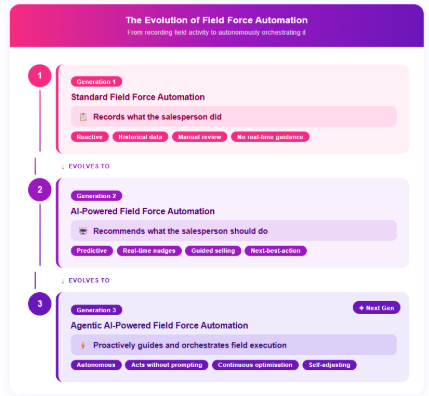
While traditional approaches require managers to evaluate dashboard reports or salespeople to verify task completion individually, the new approach involves the continuous evaluation of outlet performance, product movement, retailer reaction, and execution shortcomings in real-time and initiating proactive measures before they start impacting sales performance.
Rather than passively monitoring activity, the agentic AI system actually aids field execution by:
This fundamentally changes the role of the sales representative. Less time is spent on manual reporting, repetitive planning, and data interpretation. More time goes into retailer engagement, selling quality, and relationship building.
Modern AI ecosystems within Botree Sales Force Automation Software already support many of these capabilities through:
With Botree Distributor Management System and AI-driven retail execution technology, these systems are facilitating FMCG & CPG brands in adopting predictive and intelligent field execution models.
Not all the AI-driven field force automation platforms provide true execution intelligence. The majority of those solutions enhance their systems by adding reporting functionalities and dashboards behind an umbrella term such as “AI” while not offering any execution improvements whatsoever.
Thus, when analyzing such platforms, FMCG & CPG companies need to determine whether a certain solution can provide field guidance.
The following key capabilities need to be considered:
FMCG & CPG brands should also avoid platforms where:
The key to FMCG & CPG brand growth in the coming years will not be in expanding outlet presence or increasing field teams. It will be in the efficiency and intelligence that each brand brings to their field execution every day.
AI-enabled field automation technologies have been revolutionizing field execution by turning the process of tracking field execution into a truly real-time decision-making system involving intelligent beat planning, priority identification, retailer execution visibility, route optimization, and AI-driven recommendations.
It is no longer about digitizing the process of field execution. It is about making each outlet visit more productive for brands.
With the increasingly complex nature of FMCG & marketplaces, those brands still using traditional beat planning processes and lagging execution analytics will find it difficult to scale execution efficiency going forward. The brands that embrace intelligent field execution enabled by AI early will be well positioned to enhance productive call volume, build better retailer relationships, increase secondary sales responsiveness, and improve route-to-market performance for the next decade.

Marketing Associate
Meet Christina Evangelin Ebinezer, our dynamic marketing associate at Botree Software. With a background in HR and marketing, and prior experience as a content writer, Christina brings a sharp eye for storytelling and a knack for crafting engaging blogs and marketing content. She’s passionate about turning ideas into words that drive impact. Outside of work, Christina finds joy behind the piano keys or the wheel—whether she’s playing a soulful tune or cruising down open roads.
What is AI-powered field force automation in FMCG & CPG?
How does sales force automation software improve FMCG & CPG field execution?
Why is field sales management software important for FMCG & CPG companies?
How is AI in field sales improving retail execution?
What are the benefits of route optimization software in FMCG & CPG distribution?
How does retail execution software improve outlet-level visibility?
What features should modern field force management and sales productivity software include?

Stay updated with the latest trends and insights.