
Christina Evangelin Ebinezer
Marketing Associate



Getting a product onto the shelf is the first step in the journey towards sale in the FMCG and CPG retail industry. Once you go to your local grocery store and look around you will see that there are many brands that compete for the same shelf space.
Therefore, share of shelf is a crucial metric in the process because the share of space available determines the extent to which your brand will be seen by shoppers. Products placed higher up in the eye level and with better visibility on shelves have a higher chance of attracting attention and sales compared to brands with poor visibility.
However, with SKU numbers increasing and competition growing, share of shelf has gone beyond just another merchandising metric and become an important tool in measuring the success of a brand’s execution at the retail level. In this regard, share of shelf is an indication of how successful trade investments and in-store execution have been in terms of getting visibility on shelves.
In this article, we’ll discuss what share of shelf is, the importance of shelf space, the challenges of maintaining it, and possible solutions to improve visibility on shelves.
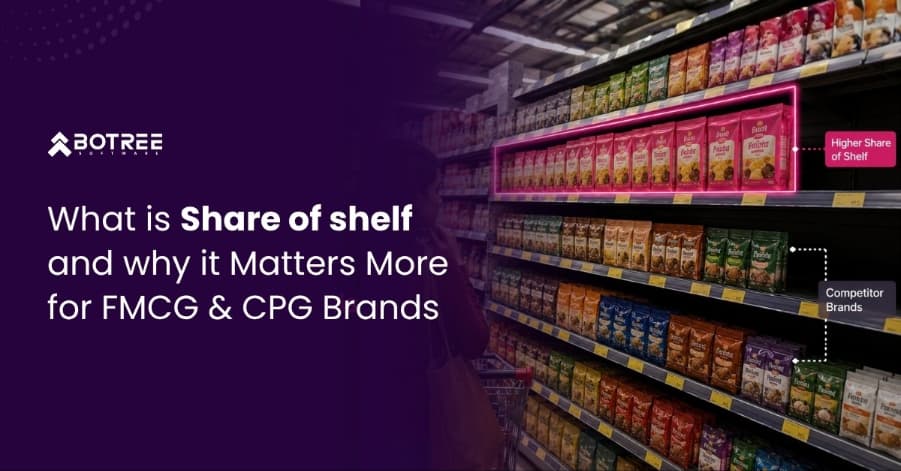
The term ‘share of shelf’ means the amount of shelf space used by a brand or product in each category or department in a store. The share of shelf is a measure of visibility, which takes into consideration the level of representation of a brand when it comes to decision time for consumers.
The formula is simple:
Share of Shelf = Brand Shelf Space ÷ Total Category Shelf Space × 100
For instance, if a particular type of beverage takes up 10 feet of shelf space and a particular brand is taking up 3 feet of that space, then the share of shelf for that brand is 30 percent.
Even though the share of shelf does not necessarily imply high sales, the fact is that the share of shelf helps determine consumer behavior.
Research from Vision Group’s 2026 retail execution study found that a brand that negotiated four eye-level facings through a trade agreement frequently finds only two facings when a salesperson visits – because resets didn’t fully execute, a store associate filled the gap, or an out-of-stock was never refaced. The gap between paid share and actual share is lost sales, accumulated daily.
Share of shelf has always been important, but competition for shelf space is stronger than ever. With more brands, more SKUs, and limited shelf space, maintaining visibility at the point of sale has become a key factor in driving sales and market share.
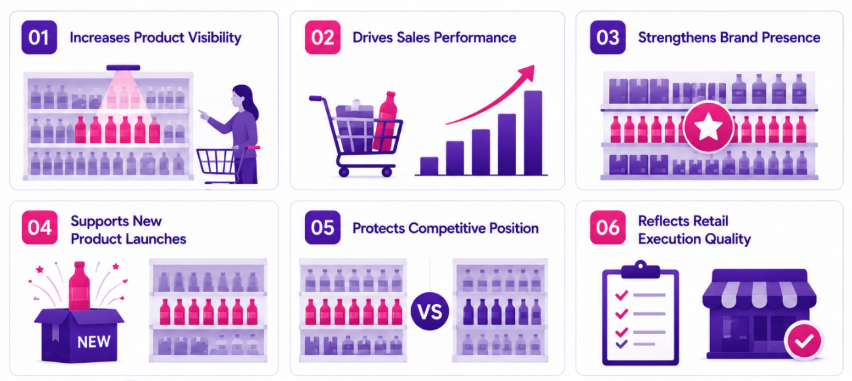
Products that have higher shelf visibility tend to be noticed and easily located by customers. Greater visibility leads to greater ease of discovery, which increases the probability of being included in purchasing considerations.
Most sales of Fast Moving Consumer Goods (FMCGs) are usually made on impulse at the point of purchase. Having higher shelf space increases the chances of increased attention by customers, resulting in improved sales performance.
Consistent shelf visibility reinforces brand awareness and helps establish a stronger presence within the category. Brands that maintain a healthy share of shelf are more likely to remain top-of-mind for shoppers.
In case of new product launches, shelf visibility becomes very important as it assists in generating awareness about the product and encourages trial as well as successful implementation.
Space on the shelf is limited, and every new facing that a brand gets is at the cost of losing it from somewhere else, which usually involves competition. It enables brands to defend themselves against competitive products and ensures visibility in the market.
Generally, share of shelf is the direct result of successful retail execution. If a product enjoys good availability, then its share of shelf can be improved through proper retail performance and execution.
Maintaining share of shelf requires consistent execution, product availability, retailer engagement, and ongoing monitoring across outlets. The following challenges make it difficult for FMCG and CPG brands to protect and grow their shelf presence.
Addressing these challenges requires a combination of strong retail execution, effective merchandising, and better visibility into what is happening at the shelf.
Computer vision-based shelf compliance deployments in FMCG have demonstrated share of shelf improvements of up to 15 percent within two quarters of implementation – simply because brands finally had visibility into where their share was eroding and could act on it in real time.
Improving share of shelf requires more than occasional shelf checks. Brands need a structured approach that combines retail execution, merchandising discipline, outlet prioritization, and continuous measurement.
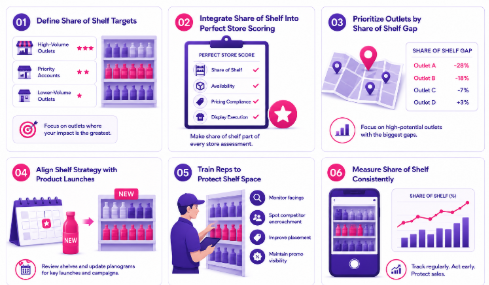
Not all retailers will have the same share of shelf target. Higher volume retailers will likely need a higher share of shelf than lower volume retailers. Identifying your share of shelf target based on type of retailer, category of goods, and overall market significance will enable you to optimize your resources towards areas that have the highest potential.
Your share of shelf should always be part of the perfect store score. When included in the metrics such as product availability, price compliance, and display execution, it makes it an integral part of the normal execution process.
The best opportunity for your brand lies in stores where your current share of shelf is far below your ideal target. Using both your sales opportunity and share of shelf figures, you can determine which stores are your priorities.
New products launch, seasonal promotions, and other special events are great moments to enhance share of shelf. Periodic evaluation of shelves and updating of planogram compliance will ensure that products get enough visibility during peak moments.
Salespersons are very instrumental in maintaining share of shelf for a brand. They should be trained on how to track facings, detect any intrusion by competitors, optimize shelf placement, and maintain shelf visibility.
Share of shelf needs to be monitored regularly and not just at specific times. The use of regular shelf audit and retail audit will ensure that brands discover any visibility problems in time.
By combining these strategies with strong retail execution and ongoing shelf visibility monitoring, brands can improve share of shelf, strengthen category presence, and drive better in-store performance.
AI Technology is helping FMCG and CPG brands move beyond manual shelf audits and periodic reporting. Modern retail execution platforms provide faster visibility, better measurement, and more actionable insights into share of shelf performance.

Share of shelf is no longer just a merchandising metric. It is a direct indicator of product visibility, retail execution quality, and competitive strength at the point of sale. In an environment where shelf space is limited and competition continues to grow, brands that actively measure and manage share of shelf are better positioned to protect visibility, improve product availability, and drive sales growth.
Achieving this requires more than periodic shelf audits. Brands need real-time visibility into shelf conditions, stronger field execution, and the ability to turn insights into action across thousands of outlets.
With solutions like Botree SFA, FMCG and CPG brands can automate shelf audits, monitor planogram compliance, track share of shelf performance, and gain real-time visibility into retail execution from a single platform.

Marketing Associate
Meet Christina Evangelin Ebinezer, our dynamic marketing associate at Botree Software. With a background in HR and marketing, and prior experience as a content writer, Christina brings a sharp eye for storytelling and a knack for crafting engaging blogs and marketing content. She’s passionate about turning ideas into words that drive impact. Outside of work, Christina finds joy behind the piano keys or the wheel—whether she’s playing a soulful tune or cruising down open roads.
What is share of shelf and why is it important?
How does retail merchandising improve share of shelf?
What is the role of planogram compliance in share of shelf management?
How do shelf audits and retail audits help improve share of shelf?
Why is product availability important for maintaining share of shelf?
How can technology improve share of shelf tracking and retail execution?



Stay updated with the latest trends and insights.