
Christina Evangelin Ebinezer
Marketing Associate



Step inside a kirana shop in Mumbai, a modern retail merchandising point in Bengaluru, or even a supermarket in Tier-2 India, and you will see the fight for the shelf is already on. The product battles out who gets the eye-level position, shelf space is limited, and the salesperson whose visit has come last always wins. In FMCG and CPG, merchandising is not some back-office activity. It’s a powerful lever brands must influence customers to buy.
But most brands are doing this blindly because salespeople cover 15 to 30 outlets per day and manually reporting doesn’t give an accurate picture of what happens at the shelf. Competitive products are pushed ahead. Promotional material vanishes without notice. Stock-outs are overlooked. And when the data arrives at the sales manager’s desk, a whole week is gone.
This blog we’ll explore the key challenges in retail merchandising, proven merchandising strategies, best practices for improving in-store execution, and how technology is transforming retail sales execution in FMCG and CPG distribution networks.
Retail merchandising is the process of ensuring the right product is available in the right store, at the right location on the shelf, at the right time, and in the right quantity to maximize sales and improve the shopper experience.
It covers everything from shelf placement and planogram compliance to stock availability, pricing visibility, POS material deployment, and promo execution. In short, retail merchandising is what happens between the distributor’s warehouse and the shopper’s hand.
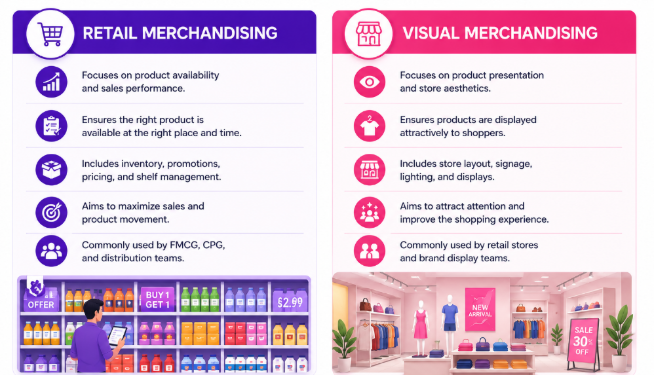
A common point of confusion: retail merchandising is often used interchangeably with FMCG visual merchandising. They are related but not the same.
Research shows that over 70% of FMCG purchase decisions are made at the point of sale. How a product is placed, whether it is in stock, and how prominently it is displayed directly determines whether it sells or whether the consumer picks a competitor SKU instead.
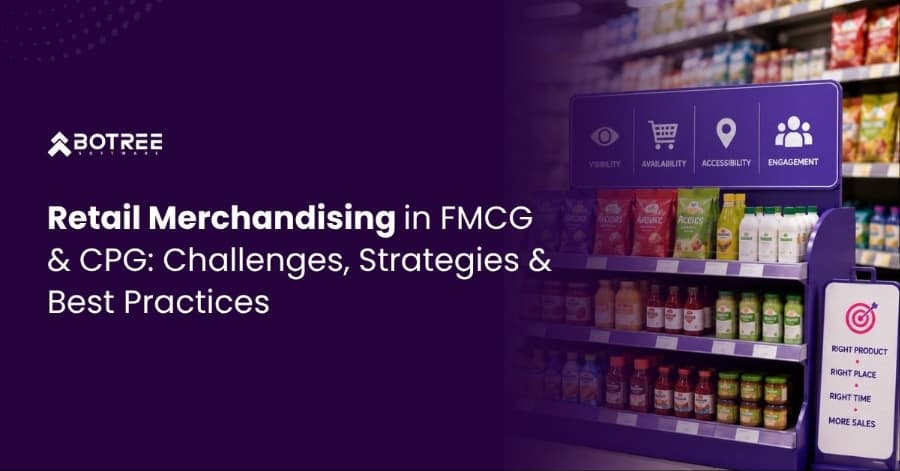
In highly competitive FMCG and CPG markets, retail merchandising plays a crucial role in influencing shopper decisions and driving sales performance. Effective merchandising ensures products are not only available but also visible, accessible, and appealing to consumers at the point of purchase.
Products that can be found easily will most likely be bought. Placement of products strategically, putting them at eye level, and merchandising products effectively will make the products visible on shelves.
Most buying decisions are usually done within stores. Positioning the products in highly trafficked areas such as end-caps and around the point of sale will encourage more impulse buying of the products.
Merchandising and consistent product placement across all retail shops will increase recognition of the brand. The consistent presentation and availability of the products will lead to brand recognition.
Product visibility, placement, and availability in retail spaces will ensure that the products get off the shelves quickly. Poor merchandising will result in poor sales and poor stock turnover.
Retailers stand to benefit greatly from good merchandising because of their increased sales. Consistent merchandising will help foster stronger relationships between the brands and the retailers.
Merchandising in retail stores enables the maintenance of standardization across all the stores, thus making sure that the merchandise is available, visible, and properly merchandised.
While retail merchandising plays a critical role in improving shelf visibility, product availability, and retail execution, executing it consistently across thousands of outlets is far from easy. FMCG and CPG brands often face several operational and execution-related challenges that limit the effectiveness of their merchandising efforts.
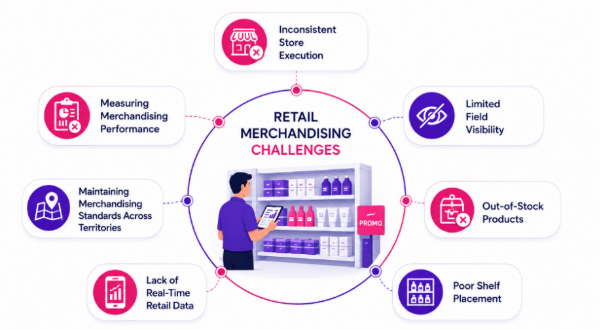
With salesperson working in several stores within a day, the time available for each outlet can be limited. While the merchandising criteria may be developed in-house, it may not be consistently implemented throughout each of the outlets. The quality of product placement, display, and promotion will depend on how an individual salesperson manages the outlet.
While some companies can use real-time technology to monitor the activities of their field personnel, others continue to rely on outdated manual reports or daily updates provided by the field. Therefore, they lose valuable time waiting for information to reach management in order to take action.
For obvious reasons, it is impossible to sell something that is not available for purchase. Even when there is sufficient supply of a certain product in the warehouse, a lack of proper replenishment plan, outlet-level visibility, and timely detection of changes in customer demand can cause out-of-stock situation, especially in competitive categories.
Shelf space is considered among the most important assets in any retail business. Unfortunately, this does not guarantee that all products are getting enough visibility. Some retailers would consider products that bring higher profit, have better connections, or enjoy better promotional opportunities. In such cases, lack of merchandising efforts results in poor product placement.
Any efficient merchandise decision requires relevant information about current processes. But even in the age of digital technologies, many brands continue using outdated methods to gather information and make merchandising decisions. Lack of real-time retail data makes it impossible to monitor shelf visibility, share of shelf, and other metrics.
Different territories require different approaches to merchandising. For example, strategies that work for modern trade could be useless in a general trade environment. Although it is important to have certain merchandising standards and territory management, it is not easy to implement them consistently.
Many companies invest heavily in retail merchandising but struggle to measure its impact. Metrics such as share of shelf, product availability, planogram compliance, and display execution are often tracked inconsistently, making it difficult to evaluate merchandising performance and identify improvement opportunities.
Map your outlet universe by execution risk – high-value outlets with low compliance frequency should be your first priority for structured merchandising visits. Not all outlets deserve the same attention, and not all territories have the same execution gaps.
Improving retail merchandising requires a combination of clear standards, consistent execution, and real-time visibility. The following best practices can help FMCG and CPG brands improve shelf performance and retail execution.
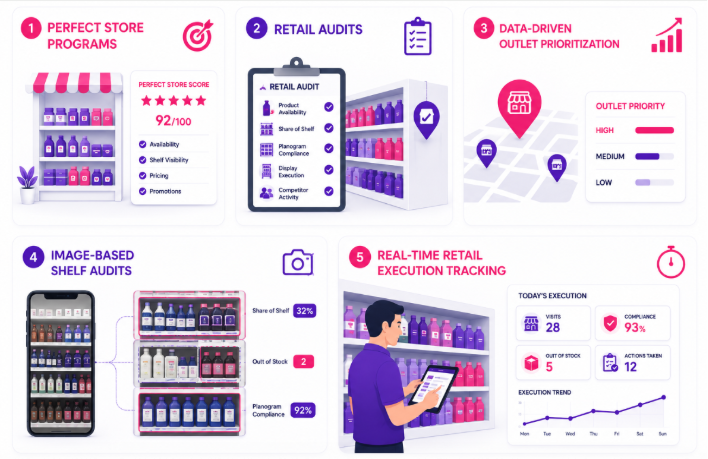
Define what an ideal outlet should look like based on product availability, shelf visibility, pricing, and promotional compliance. Use a scoring mechanism to measure performance and track improvement over time.
Conduct regular retail audits to assess product availability, share of shelf, planogram compliance, display execution, and competitor activity. Audit data helps identify execution gaps and corrective actions.
Prioritize outlets based on sales potential, outlet importance, and market opportunity. This ensures merchandising resources are focused on stores that deliver the highest impact.
Use image recognition technology to analyse shelf conditions, measure share of shelf, identify out-of-stocks, and monitor planogram compliance. This improves audit accuracy while reducing manual effort.
Track merchandising activities in real time to gain visibility into store-level execution, compliance issues, and product availability. Faster insights enable faster corrective action.
When supported by the right processes and technology, these strategies help brands improve shelf visibility, strengthen retail execution, and deliver a more consistent shopper experience across the retail network.
Brands that implement structured retail audit programs consistently report 15 to 25 percent improvement in planogram compliance within the first six months – simply because field teams know they are being measured. What gets measured, gets done.
Strategy without execution discipline rarely delivers results. These best practices separate brands that consistently win at the shelf from those that only win on paper:
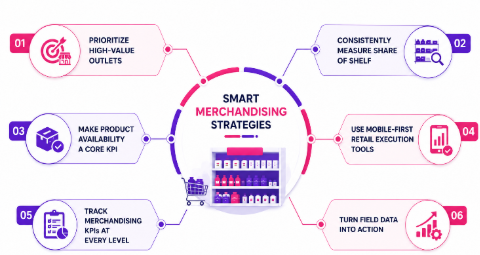
All outlets are not equally worth investing in. Prioritize your efforts related to field visits, premium shelving arrangements, product display and POS material deployment toward those outlets that have the greatest contribution to your sales and growth.
It is important to measure the share of shelf consistently because generally there is a gradual decline in share of shelf before it starts affecting the sales of products. This can be done through regular outlet visits and measuring the shelf.
Availability of product needs to be tracked regularly; it should be evaluated periodically. By doing so, it would be easier for brands to identify out-of-stock situations.
The limitations imposed by manual reporting processes result in decreased visibility and decision-making abilities. With mobile retail execution tools, field representatives will be able to collect relevant data, perform retail audits, and submit any reports on issues concerning compliance at the point-of-sale level immediately.
It is important that indicators such as share of shelf, planogram compliance, product availability, retail audit scores, and Perfect Store scores be monitored for territories, regions, and field staff to increase accountability and execution efficiency.
Gathering data is just the beginning. To maximize its value, field insights can be used to improve shelf visibility, fix compliance problems, lower out-of-stock rates, and enhance retail execution overall.
Run a quarterly planogram reset aligned to your promotional calendar. New launches, seasonal SKUs, and trade promotions all require shelf reconfiguration. A planned reset cycle prevents shelf layouts from drifting into non-compliance between active campaigns.
The tools available for retail merchandising have changed significantly over the last two years. AI is not a future aspiration – it is already being deployed by leading FMCG brands to solve execution problems that manual processes could never address at scale.
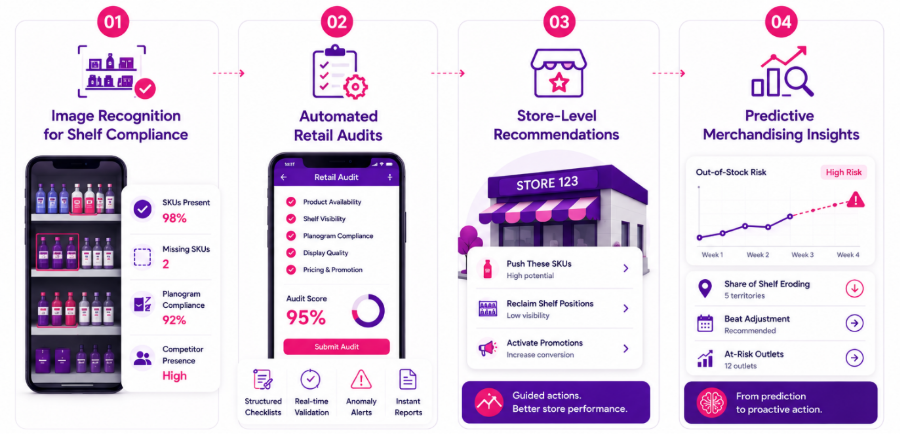
The technology also helps to perform shelf compliance analysis based on visual information. Image recognition powered by artificial intelligence can analyze product availability, calculate share of shelf, evaluate planogram compliance, and identify the presence of competitors on store shelves automatically.
In addition, AI makes it possible to automate the process of retail audits via validating gathered data and identifying compliance issues and also providing automatic generation of audit reports.
With the help of AI, brands are also able to analyse sales data, assess performance of each outlet, and even develop merchandising trends that will guide field teams when visiting each store.
AI makes it possible to predict shelf compliance issues such as out-of-stocks, declining share of shelf, and even coverage gaps.
Retail merchandising is very important in assisting FMCG and CPG brands in making their products more visible, increasing their shelf presence and sales on the spot. With increasing pressure to occupy shelf space, brands require better visibility, uniformity and control of their retail operations throughout their outlet networks.
Using well-defined merchandising standards, audit protocols, data and analysis driven decision making and execution monitoring will help the organization increase their product availability, ensure shelf share and provide an efficient in-store experience.
Brands can leverage tools like Botree SFA to efficiently carry out their retail merchandising activities and conduct retail audits.

Marketing Associate
Meet Christina Evangelin Ebinezer, our dynamic marketing associate at Botree Software. With a background in HR and marketing, and prior experience as a content writer, Christina brings a sharp eye for storytelling and a knack for crafting engaging blogs and marketing content. She’s passionate about turning ideas into words that drive impact. Outside of work, Christina finds joy behind the piano keys or the wheel—whether she’s playing a soulful tune or cruising down open roads.
What is retail merchandising?
How does retail merchandising improve retail execution?
Why is share of shelf important in retail merchandising?
What is planogram compliance and why does it matter?
How do retail audits help improve merchandising performance?
How can technology improve in-store execution and retail merchandising?


Stay updated with the latest trends and insights.