
Christina Evangelin Ebinezer
Marketing Associate



Placing goods in the retail store is not everything. Ultimately, it is the actions inside the store that will impact purchasing decisions. Out-of-stock, bad product placement, absence on shelves, wrong prices – all of those may make even the best marketing campaign hard to turn into sales.
That is why Perfect Store Execution has become a necessary retail execution strategy for FMCG, CPG, and FMCD brands. It enables companies to make sure that each location complies with merchandising standards in terms of product availability, shelf presence, assortment, pricing, promotions, and so on. Instead of conducting audits of retail stores periodically, today’s leading brands leverage technology to provide perfect execution across thousands of retail locations.
In this blog, we will discuss what is Perfect Store Execution, why is it important, how to create a good Perfect Store strategy, and how AI can help you increase shelf presence and compliance.
Perfect Store Execution is a retail execution process that enables brands to ensure that all retail outlets meet certain merchandising criteria. The idea behind it is simple – the right products should be made accessible to the consumers in an accurate manner through display, pricing and the right promotions for the purpose of delivering the optimum shopping experience.
While the concept of Perfect Store does not involve only checking the presence of products on shelves, it includes many components of the in-store execution such as product availability, shelf presence, adherence to the planograms, assortment of the products, accuracy of pricing, promotions and share of the shelf space.
In case of FMCG, CPG and FMCD brands, Perfect Store Execution ensures consistency in every retail outlet, whether it is a small neighbourhood Kirana store, a supermarket, a pharmacy, consumer durable dealers or a modern retail chain.
Perfect Store Execution is more than a merchandising initiative – it is a growth strategy that directly influences sales performance, retailer satisfaction, and customer experience. Brands that consistently execute well at the shelf are more likely to improve product visibility, reduce lost sales, and build stronger retailer relationships.
Every Perfect Store strategy is built on six measurable pillars. While the importance of each pillar varies by category, channel, and outlet type, together they define whether a store is executing the brand’s retail standards consistently and effectively.
| Pillar | What It Means | Business Impact |
|---|---|---|
| Availability | The right SKUs are in stock and available for purchase whenever customers visit the outlet. Even the best merchandising cannot generate sales if products are unavailable. | Reduces stockouts, improves product availability, and prevents lost sales. |
| Visibility | Products are placed in prominent shelf locations with the right number of facings and free from competitor obstruction, making them easy for shoppers to find. | Improves shelf visibility, attracts shopper attention, and increases purchase conversion. |
| Assortment | Each outlet stocks the right mix of products based on its format, customer profile, and demand instead of carrying the same SKU range everywhere. | Improves product availability, increases sales opportunities, and reduces slow-moving inventory. |
| Pricing | Products display the correct retail price, promotional offers, and price tags that match current trade schemes. | Builds shopper confidence, reduces pricing errors, and improves promotion effectiveness. |
| Promotion | Trade promotions, POSM, displays, and secondary placements are executed correctly and maintained throughout the campaign period | Increases promotion compliance, improves campaign ROI, and strengthens brand visibility. |
| Planogram | Products are displayed according to the agreed shelf layout, sequence, and number of facings to maximize shelf presence. | Protects share of shelf, improves planogram compliance, and delivers a consistent shopping experience. |
A Perfect Store is achieved when all six pillars work together. Businesses that continuously measure and improve these standards create stronger retail execution, better shopper experiences, and higher secondary sales across every outlet.
Even brands with well-defined Perfect Store standards face execution gaps that affect shelf visibility, product availability, and sales performance. The key is identifying these issues early and using technology to correct them before they impact revenue.
Products often go out of stock because replenishment depends on periodic field visits rather than real-time demand.
Solution: Leverage DMS connection and use secondary sales data for monitoring the stock level and initiating replenishment prior to any stockout.
Products may be wrongly positioned, get fewer facings or even lose shelf space compared to competitors unnoticed by brands.
Solution: Empower the field staff with digital planograms, photography and visual validation.
Merchandising standards are executed inconsistently across markets by different territories/field force teams.
Solution: Harmonize the merchandising standards through SFA using visual materials specific to each outlet.
These audits lead to a delay in visibility into execution problems, resulting in a corrective measure that is too late to be useful for current campaigns.
Solution: Move from manual retail audits to retail audit processes via mobile that offer real-time reporting and compliance dashboards.
Most managers depend on reports instead of using live execution data to identify and solve execution problems.
Solution: Real-time dashboards, geo-verified store visits, automated alerts and analytics at an outlet level will help monitor Perfect Store compliance.
The lack of Key Performance Indicators makes it hard for businesses to benchmark execution levels among various outlets, territories, and field force members.
Solution: Performance measurement using Perfect Store Score, which weighs Availability, Visibility, Assortment, Pricing, Promotions, and Planogram compliance.
The objective of a “Perfect Store” strategy is not simply to articulate store standards; it should also help field sales teams apply these standards consistently in all locations. The most effective brands develop strategies that are realistic, quantifiable, and technology-driven, which allows for identical performance irrespective of the geography or nature of the store.
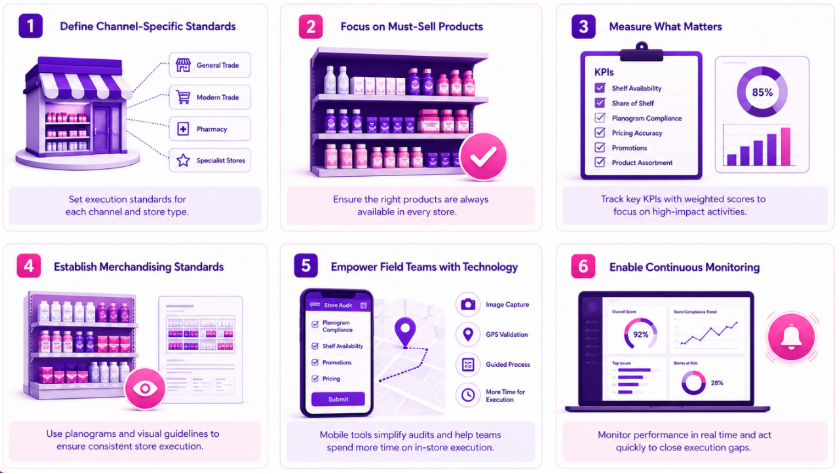
Every store doesn’t need to follow the Perfect Store standard. Categorize the stores based on the channel, the size of the outlet, or the potential of the store and set specific standards of execution for each category of the store. It will keep expectations grounded but ensure the highest levels of execution in General Trade, Modern Trade, pharmacy, and specialist stores.
Determine those products that are always supposed to be present in all categories of stores. Don’t sell all your products in every outlet but rather determine the right assortment of products in every store.
Measurement of Perfect Store Execution is done through Key Performance Indicators (KPIs) such as shelf availability, share of shelf, planogram, pricing accuracy, promotions and product assortments. The process of assigning weighted scores will help businesses prioritize activities that make a commercial impact.
Provide field teams with visual merchandising standards, planogram references, and outlet-specific execution guidelines. Clear standards reduce subjectivity, improve consistency, and make retail audits more accurate.
Mobile SFA applications make the task of doing retail audit easier with guided processes, image capturing capabilities, GPS validation, etc. This would allow the representatives to spend less time on reporting and more time executing in-store activities.
Execution of a Perfect Store has to be a continuous process instead of a periodic one. Continuous monitoring helps the management identify gaps in execution and take remedial steps immediately before it affects sales or campaign execution.
Perfect Store Execution is often viewed as a field operations or merchandising activity. It has a direct impact on sales, profitability, and market share. Every execution gap at the shelf translates into missed revenue, lower promotion effectiveness, or lost customer opportunities.
The most successful FMCG, CPG, and FMCD brands no longer treat Perfect Store Execution as a merchandising scorecard – they use it as a strategic growth lever that directly improves revenue, retailer performance, and competitive advantage.
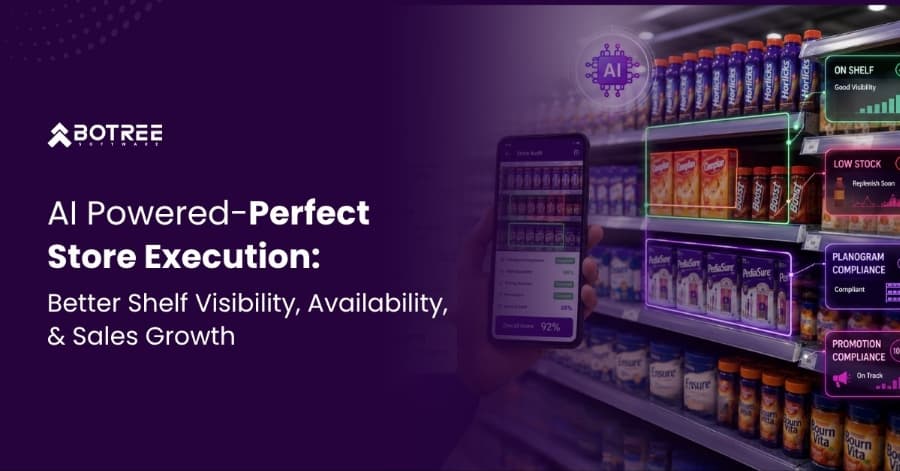
AI is transforming Perfect Store Execution by replacing manual audits and subjective assessments with real-time, data-driven insights. Instead of identifying execution gaps after store visits, AI helps brands detect, prioritize, and resolve issues while field teams are still at the outlet.
Botree AI-powered route-to-market platform enables FMCG, CPG, and FMCD brands to implement Perfect Store plans consistently in the field through its field sales, distributors, and business team collaboration on a unified platform. Using Botree SFA solution, field teams can perform perfect store audits, upload shelf images, price checks, availability check of products, and compliance against the preset Perfect Store standards with every store visit. Identification of missing SKUs, facings, and detection of competitor’s entry on shelves are done using AI image recognition technology, which makes shelf audit quick and efficient.
Botree Product Recommender with SOQ uses logic to recommend optimal product and quantity of products for every outlet on the basis of purchase history, secondary sales, current inventory, and demand trends to help field teams optimize assortments and minimize stockouts. Integration of Botree DMS solution makes available real-time distributor inventories and secondary sales data that help make timely replenishment decisions to avoid out-of-stock situations. At the same time, these provide managers complete visibility into the execution of Perfect Stores in terms of field execution, shelf compliance, secondary sales, and performance of outlets.
Perfect Store Execution is where strategy meets the shelf. Perfect Store Execution is how you ensure your products are available, visible, properly priced, and merchandised in every retail outlet to turn your distribution into sales. As retail competition gets tough, small deviations from execution like product out-of-stocks, lack of product visibility on shelf or promotions missed may result in lost sales and market share.
Brands which beat their rivals in sales are not always the ones which have largest distribution. They are the ones which do great execution at every outlet everyday. With the help of Perfect Store Execution process standardization along with AI-based retail audit solutions and field operations, companies can turn their Perfect Store Execution efforts into a consistent driver for sales growth.

Marketing Associate
Meet Christina Evangelin Ebinezer, our dynamic marketing associate at Botree Software. With a background in HR and marketing, and prior experience as a content writer, Christina brings a sharp eye for storytelling and a knack for crafting engaging blogs and marketing content. She’s passionate about turning ideas into words that drive impact. Outside of work, Christina finds joy behind the piano keys or the wheel—whether she’s playing a soulful tune or cruising down open roads.
What is a Perfect Store score, and how is it measured?
What is the difference between Perfect Store Execution and retail execution?
How does Perfect Store Execution improve share of shelf?
Why is planogram compliance important for retail execution?
What KPIs should businesses track for Perfect Store Execution?
What features should businesses look for in Perfect Store software?




Stay updated with the latest trends and insights.