
Christina Evangelin Ebinezer
Marketing Associate



For many years, the key to FMCG growth was the development of the distribution network. More distributors, more retailers, more products available to consumers – that was the strategy.
It still works, but the reality of the FMCG distribution network has changed dramatically.
Today’s brands sell their products via multiple distribution channels such as general trade, modern trade, e-commerce, quick commerce, direct-to-retail, etc. Product lines have expanded, retailer demands are growing, and there’s always a fierce competition out there. Although demand is essential for success, it’s not enough to ensure sustainable growth any longer. Increasing efficiency throughout the supply chain is critical for FMCG
Nowadays, it is not about creating demand. It is about getting the right products to the right locations on time.
In this environment, minor inefficiencies in the distribution network could easily lead to out-of-stock situations, surplus of inventory, missed business opportunities, and slow revenue growth.
In this article, you will learn about the most significant FMCG distribution network issues, their implications, and approaches to creating an efficient route-to-market operations strategy.
The FMCG distribution network refers to the structure or channel used to distribute FMCG products from manufacturers to end-users via distributors, wholesalers, retailers, and other sales channels. The distribution network helps in bridging the gap between production and consumption.
Traditionally, the FMCG distribution network consisted of:
Manufacturers > Distributors > Retailers > Consumers
Nevertheless, the present-day FMCG distribution channels are much more complicated than they used to be. Besides conventional distribution channels, companies today also cater to consumers via various other channels such as:
The main goal behind any FMCG distribution network remains straightforward – getting the correct product to the correct place on time and in sufficient quantities.
Distribution network failures do not always announce themselves with an obvious crisis. More often, they erode revenue quietly through availability gaps, invisible demand pockets, and execution inconsistency that accumulates into a meaningful growth gap over time. Here is the mechanism:
What makes these challenges particularly difficult is that they rarely occur in isolation. A coverage gap affects availability, poor availability impacts sales, and weaker sales reduce retailer confidence. Over time, these issues compound and slow revenue growth.
Run a quarterly coverage audit that maps your active outlet universe against your serviceable outlet potential by territory. The gap between the two is your unaddressed revenue opportunity and it is almost always larger than the sales team expects.
As FMCG distribution networks grow, maintaining visibility, availability, and execution becomes increasingly difficult. The following challenges consistently limit growth across distribution-led businesses.
There are many brands out there that continue to sell products in only a small portion of their target potential outlets. Limited coverage, inefficiencies in territory management and issues related to last mile delivery can lead to large portions of uncovered demand, especially in rural or semi-urban locations.
Sales data from the primary channel reflect all the sales data reported by distributors and do not represent actual secondary sales information. Therefore, a lack of visibility into secondary sales can affect demand planning and forecasting.
Stock surplus in some areas and insufficient inventories in other areas are a consequence of poor planning and forecasting in line with market demands, which leads to inefficiencies in operations and increases costs.
Distributors are a central element in the FMCG product distribution network, and as such, any issues relating to working capital, including claims, stock surpluses and delayed payments, can impact their operations.
Distribution efforts depend largely on field execution. Poor route adherence missed visits and ineffective order capture can cause inconsistencies in performance from territory to territory.
The more distribution tiers a product pass through – be it distributors, sub-wholesalers, wholesalers, and retailers – the harder it can be to keep track of its movements and ensure visibility. Many factors contribute to this issue, including fragmented systems, manual handling, and poor integration.
Rural markets offer significant growth opportunities, but they require a different distribution model. Brands that expand without the right infrastructure, coverage strategy, and technology often struggle to achieve profitable growth.
What makes these challenges particularly difficult is that they are interconnected. A coverage gap affects availability, poor availability impacts sales, and weaker sales reduce distributor confidence. Over time, these issues compound and slow revenue growth.
There is no single solution to distribution network complexity. The strongest FMCG distribution networks are built by improving visibility, strengthening execution, and making better decisions across every layer of the route-to-market operation.
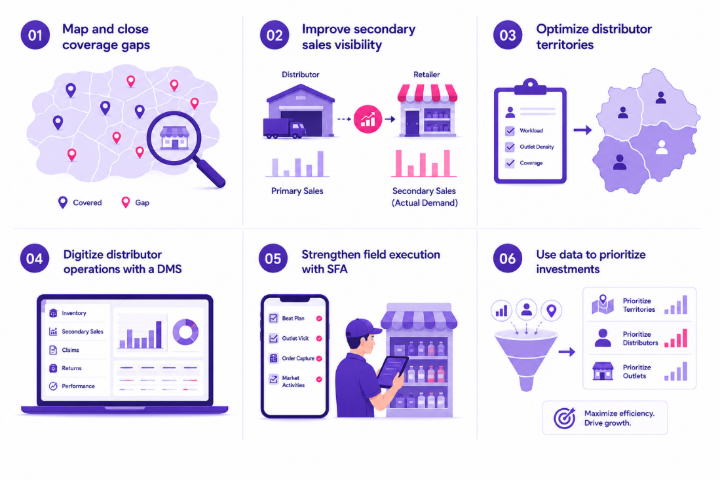 Map and close coverage gaps: Create an exhaustive view of your outlet universe and benchmark it against existing coverage. Spotting unserved segments, overlooked outlets, and territorial coverage gaps can help your brand grow its geographic footprint.
The FMCG distribution network of 2026 looks very different from the one that existed a decade ago. New channels, changing consumer behavior, and increasing operational complexity are forcing brands to rethink how they manage distribution.
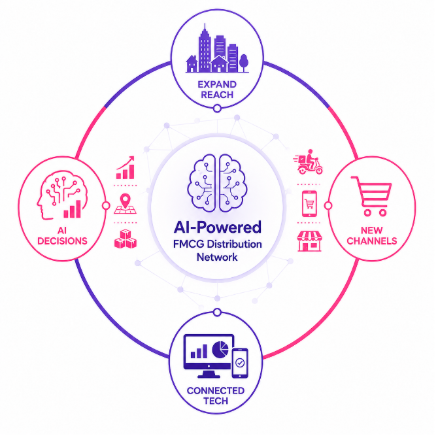
The future of FMCG distribution will be defined by visibility, agility, intelligence, and execution. Brands that build a connected, AI-enabled, and data-driven distribution network today will be better positioned to capture growth opportunities tomorrow.
Botree DMS and SFA platforms are built for the operational realities of FMCG distribution, helping brands improve visibility, strengthen execution, and drive greater distribution efficiency.
By connecting distributors, field teams, retailers, and data within a unified ecosystem, Botree helps FMCG brands build more visible, agile, and future-ready distribution networks.
An effective FMCG distribution network cannot be determined simply by the number of distributors and retail outlets served. Rather, an effective distribution network can only be described as one that responds well to market demand, maintains product availability and consistently executes in all channels.
In this evolving world of distribution, brands require greater visibility of secondary sales, stock movements, distributor activities and channel executions. Brands that fail to adopt a connected approach will find themselves unable to cope with evolving market demands.
The future of FMCG distribution will rely on connectivity through intelligence. Investing in the right business practices, technology and distribution networks will make your brands much more efficient, profitable and competitive in the coming years.
Through Botree Software, we empower brands to achieve real-time visibility and superior channel execution within their distribution network.

Marketing Associate
Meet Christina Evangelin Ebinezer, our dynamic marketing associate at Botree Software. With a background in HR and marketing, and prior experience as a content writer, Christina brings a sharp eye for storytelling and a knack for crafting engaging blogs and marketing content. She’s passionate about turning ideas into words that drive impact. Outside of work, Christina finds joy behind the piano keys or the wheel—whether she’s playing a soulful tune or cruising down open roads.
What is an FMCG distribution network?
What are the biggest challenges in FMCG distribution?
Why is secondary sales visibility important?
How does a Distributor Management System (DMS) improve distribution performance?
How does Sales Force Automation (SFA) support FMCG distribution?
How can AI improve distribution management and distribution efficiency?

Stay updated with the latest trends and insights.