
Christina Evangelin Ebinezer
Marketing Associate



Every sales return that passes through your distribution channel incurs a cost that often fails to be reflected in one simple figure. The cost of goods themselves. The cost of their transportation back to your warehouse. The cost of writing off expired or irreparable stock. And then, finally, there’s the less tangible cost – a distributor whose finances are tied up with returns, an inefficient salesperson who sells unnecessary stock and the misdirected signal they give.
Sales Returns in FMCG and CPG distribution are not merely a logistical or financial problem. Rather, they act as a signal to show that somewhere upstream of the return process something is failing. A mistake in order fulfilment, poor inventory management, bad schemes design or secondary sales oversight. Those brands who view returns as a symptom of a larger problem and work on eliminating the underlying issues always enjoy improved returns, distributor health, forecasting and realisation.
This blog post explains how high sales returns affect modern FMCG distribution, the total cost of such returns and how to effectively reduce them with Distribution Management System.
Sales return in respect of fast-moving consumer goods (FMCG) or consumer packaged goods (CPG) involves sending goods that have already been accounted for in terms of invoicing and despatching them backwards in the distribution network, starting from the retailer to the distributor, or from the distributor back to the organization. This leads to accounting for revenue reversal, issuing a credit note/debit note, and the physical movement of the products back to the organization.
In India’s FMCG distribution ecosystem, expiry and excess stock returns together account for the majority of B2B sales return volume. Both are largely preventable with the right inventory visibility and demand-driven ordering discipline.
Returns are not just a business procedure. Too many returns can hurt profits and make managing inventory difficult. Returns have a lot of importance since they help companies understand why things went wrong so that the company can fix its problems.
Proper handling of sales returns can significantly help in safeguarding profitability. Organizations can minimize losses in revenues, optimize margins, and effectively utilize inventory throughout the distribution process.
The process of sales returns has impacts on different levels within the logistics operation. Proper management of sales returns will minimize unnecessary movements of goods throughout the entire logistics process.
Returns will have an impact on how inventory is planned and replenished in the organization. Efficient sales returns management will assist organizations in ensuring that their inventory levels are accurately managed.
Efficient sales returns will be helpful in improving the relations between manufacturers and distributors. Fast settlements, proper policies, and effective sales returns management will lead to enhanced distributor relationships.
Elimination of avoidable sales returns will provide employees with sufficient time to focus on other activities rather than spending time handling return-related issues.
Most sales return problems are not random – they are predictable outcomes of specific process and system failures. Here are the root causes that consistently drive high return rates in FMCG and CPG distribution:
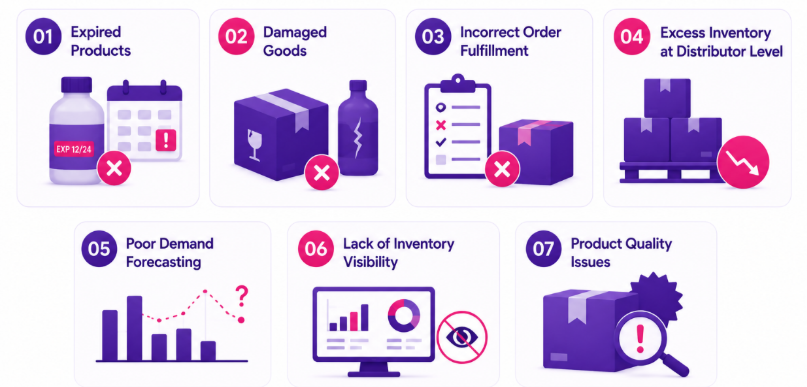
One of the costliest reasons for return of goods is expiration. This happens mainly when the inventory moves from the warehouse through the supply chain more quickly than it can be sold or if first-in-first-out (FIFO) strategy is not implemented. There is no way a brand will detect the problem until its goods have expired because there is no tracking of batches and their expiry dates.
Physical damage to goods during transit or handling is a frequent reason for sales returns. With distribution chains that span over several logistic players, even minor mishandling could result in many returns.
Incorrect SKUs, quantities, pricing, or batch information often lead to avoidable returns. Manual order-taking processes increase the risk of fulfillment errors, creating additional work for distributors and affecting customer satisfaction.
As inventory is loaded into the channel without regard for demand, the problem of excess inventory starts arising from the distributor’s side. Ineffective products are stored until they become obsolete because of their expiry date, poor packaging, or low customer demand.
Incorrect predictions regarding consumer demand and preferences might lead to the purchase of the wrong goods and excessive inventory at distributors. At one point, there will be excess stocks available on some markets and shortage on others, which will lead to higher returns.
Without access to real-time inventory data at the distributor’s end, companies find it hard to detect expired goods or slow movers. Products might already be on their way back to brands by the time an issue was discovered.
Less likely compared to the other reasons listed, but still worth mentioning is product quality, which could have been affected negatively by packaging, seals, or any inconsistencies within the goods.
Reducing sales returns requires action at multiple points in the distribution chain, from forecasting and inventory planning to return processing and distributor visibility. The following 8 strategies can help brands reduce return volumes while improving overall FMCG distribution efficiency.
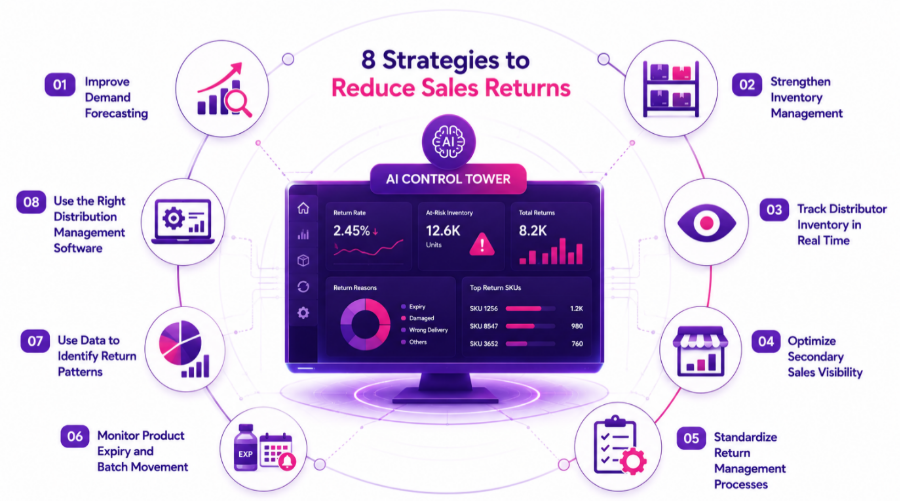
Another great way of cutting down returns is to improve demand forecasting. Brands must consider not only primary sales and secondary sales visibility in order to be able to determine the real market demand and avoid overproduction, which often leads to excessive inventories and expiry of products.
In terms of inventory management, a brand should aim at preventing its stock from turning into a risk factor for returns. FIFO, monitoring of stock ageing, and maintaining appropriate levels of stock are some measures that may help.
Real-time visibility in distributors’ stocks helps brands find out which of their products are selling slowly, which stocks might age soon and be returned to them and take any preventive actions by redistributing inventory or organizing promotional activities to sell the product off.
Secondary sales visibility provides insight into what is actually selling in the market. By monitoring outlet-level offtake, brands can identify slow-moving SKUs, detect inventory build-up, and align supply more closely with demand. This helps reduce excess stock and improve inventory utilization across the channel.
The return management process needs to be standardized in order to keep track of returns efficiently and effectively. The process involves a standardized return workflow, reason codes for returns, and automation of the approvals process.
Products can be tracked based on batches and expiration dates, making it possible for companies to identify any product that may have expired or is close to expiring. Monitoring will provide the opportunity to get rid of the product via promotions, secondary sales, or other marketing strategies before returns are made.
Return data can be used for understanding how the distribution process is performing. By analyzing the reasons and the frequency of returns, brands can identify trends and take action accordingly.
In order to manage the processes of inventory, distributor operations, secondary sales, and returns effectively and efficiently, brands should consider using a modern DMS that allows them to track inventory, monitor stock aging, and handle returns easily.
Botree RTM platforms help brands reduce sales returns by improving inventory visibility, strengthening return management, and enabling better distribution decisions.
By connecting inventory, distributor operations, and field sales data, Botree helps brands reduce returns and improve distribution efficiency.
Sometimes, sales returns occur because there are issues within the distribution process, such as wrong forecasts and excess stock, insufficient information on the distributors’ stock, and sales outside of authorized channels. Unaddressed, sales returns can affect profits, harm distributor relations, and reduce distribution effectiveness in general.
To prevent sales returns, companies need to develop proactive strategies aimed at improved forecasting, inventory control, visibility, and return processes. Companies that find the cause for sales returns and tackle them proactively are likely to enhance their business results and channel operations.
By developing appropriate procedures and using advanced software solutions, companies will be able to transform sales returns into a useful tool for learning about the distribution network.

Marketing Associate
Meet Christina Evangelin Ebinezer, our dynamic marketing associate at Botree Software. With a background in HR and marketing, and prior experience as a content writer, Christina brings a sharp eye for storytelling and a knack for crafting engaging blogs and marketing content. She’s passionate about turning ideas into words that drive impact. Outside of work, Christina finds joy behind the piano keys or the wheel—whether she’s playing a soulful tune or cruising down open roads.
What is a sales return?
How can sales return management improve distribution efficiency?
What causes high product returns in FMCG distribution?
Why is distributor inventory visibility important for reducing sales returns?
How does secondary sales visibility help reduce sales returns?
How can technology improve return management processes and reverse logistics?
Stay updated with the latest trends and insights.