
Christina Evangelin Ebinezer
Marketing Associate



For almost all FMCG, FMCD, CPG, and consumer goods brands, distributors form an integral part of product distribution to the market. Nevertheless, where the brands always have enough visibility into the processes carried out by the distributors, they usually lack enough visibility into the customers consuming their products.
Here, the brands are likely to know the products being sold by their distributors, but they cannot get to know who is consuming their products, frequency of consumption, their favourite products, and what drives their repeat purchases. Hence, there exists a divide between distribution execution and consumer demand.
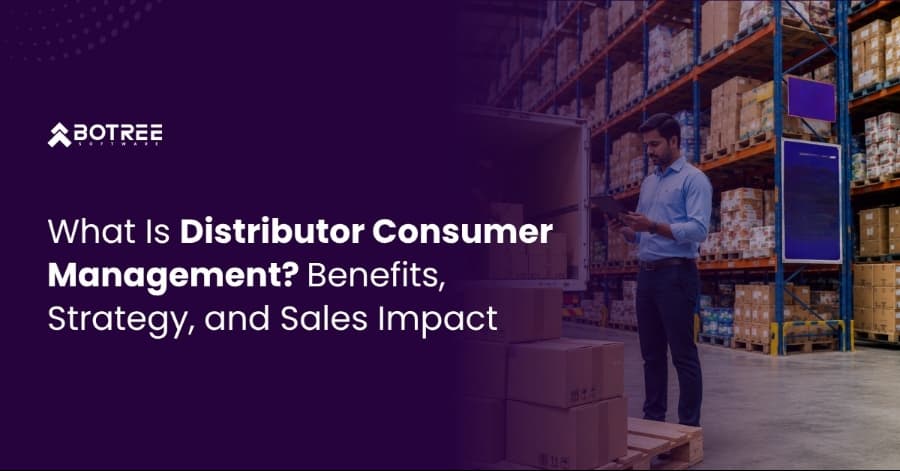
The Distributor Consumer Management (DCM) bridges the gap by bringing distributors, retailers, brands, and consumers together in an integrated ecosystem. Through DCM, brands can get consumer data, comprehend buying behaviours, build loyalty, enhance consumer engagement, and take more informed sales & distribution decisions
In this blog, you will learn about the Distributor Consumer Management, how it works, benefits, and more importantly, why you need it.
Distributor Consumer Management (DCM) refers to the management of consumer involvement, loyalty, purchase behavior, and demand insights through the distributor and retail network of the brand.
This allows the brands to gather and analyze consumer insights even when they keep selling through their distribution channel. Through DCM, brands can get an insight into who buys their product, the frequency of their purchases, and reasons for repeat purchases.
In simple terms, Distributor Consumer Management helps brands answer three important questions:
Rather than treating distribution and consumer engagement as separate activities, DCM brings them together into a single framework.
The FMCG & CPG supply chain in India is one of the most complicated worldwide. It takes multiple layers for the product to reach its consumers. In an environment with millions of outlets and fragmented supply chains, coupled with fast-changing consumer demands, achieving visibility and control over the entire supply chain becomes extremely hard.
In this context, not only does growth depend on the product itself but also the effective distribution of that product in the market. That is when Distributor Consumer Management comes into play.
Without Distributor Consumer Management, the brand will have a very limited perspective about what is happening after the sales. The secondary sales, retailers’ stocks, consumer demand, and market consumption patterns remain separate from each other. DCM connects the operations of distributors and consumers for better sales and inventory decisions.
Promotion plans, investments, incentives for retailers, and pricing activities should be executed consistently within the channel. The Distributor Consumer Management system enables better tracking and management of trade execution activities, minimizing leakage and ensuring compliance throughout the distribution network.
Consumer needs and demands can change rapidly. By using the Distributor Consumer Management system, companies can get quicker insights into changes in consumer needs and demands and take necessary measures before it negatively affects sales performance.
A well-built distributor consumer management system brings together several functional modules that individually address specific gaps and collectively give brands end-to-end channel control.
Strategies related to trade promotions, investment plans, incentive plans for distributors and retailers, and price policies should be consistently executed across the channel. Distributor Consumer Management gives the brand better control over these processes and helps prevent their leakage.
Consumers’ preferences, demand fluctuations, and changes in inventory might occur quickly. Distributor Consumer Management offers faster market signals and helps identify any shifts in demand, stock risks, or execution problems and take necessary measures before it affects sales performance.
Helps distribute orders, process them and track the progress of order execution while giving the brand an insight into sales performance across the channel.
Gathers information about the sales made by distributors to retailers and helps the brand to identify demand trends and make more informed decisions using secondary sales data.
Gives visibility into stock levels within the entire distribution channel and helps minimize stock outs and replenishment in time.
Allows executing and monitoring trade promotion schemes and incentive programs while ensuring consistent execution across distributors and retailers.
Provides assistance for retailer communication, online orders, schemes, and self-service, making it easier to establish relationships and generate orders from retailers.
Combines sales, inventories, distributors, retailers, and consumers’ information into dashboards for effective decision-making.
Even the most well-designed Distributor Consumer Management initiatives face challenges during implementation. Identifying and addressing these challenges early is critical to achieving long-term success.
Some distributors prefer to use manual methods and will resist the uptake of technology. To facilitate adoption, there is a need for brands to link data compliance, scheme eligibility, incentives, and operational benefits to the platform.
Brands find it hard to determine real demand without secondary sales visibility. Integrating distributor systems or using data capture solutions can enhance visibility without impacting distributor operations.
Discounts and incentives provided to channel partners through manual trade promotion will not always be captured. Through automated schemes and claim validation, leakage can be minimized.
SFA, DMS, ERP, and analytics will operate independent of each other when making decisions and creating reports. Integration of platforms provides a central repository of information for the entire distribution network.
Rural and semi-urban markets operate under low connectivity and poor distributor networks. This is solved by offline-capable mobile applications for data capture and execution.
Implementing a distributor consumer management system delivers outcomes across sales performance, operational efficiency, and channel relationships simultaneously.
Brands gain access to real-time information on sales, inventory, retailer performance, and consumer demand, enabling better decision-making across the value chain.
Better inventory visibility helps brands identify supply gaps early and ensure products remain available where consumer demand exists.
Distributor Consumer Management helps brands monitor scheme utilization, evaluate promotion performance, and improve the return on trade investments.
Faster communication, transparent processes, and improved operational efficiency help build stronger partnerships across the channel.
Automating order management, claims processing, reporting, and inventory tracking reduces manual effort and improves execution speed.
With access to real-time insights, brands can optimize territory planning, inventory allocation, demand forecasting, and channel investments more effectively.
Having the right technology is necessary but not sufficient. The brands that get the most from distributor consumer management are those that build a clear strategy around it. These are the pillars of a DCM strategy that delivers.
An efficient Distributor Consumer Management framework can be only as good as its distributor channel. While brands need to assess potential distributors based on their market reach and financial capabilities, it is equally important to ensure their technological adaptability, information sharing, and visibility.
To have Distributor Consumer Management in place, you need to know about more than primary sales. Collecting secondary sales data allows companies to understand demand trends and manage sales and inventories in a smarter way.
Manually handling trade schemes and incentive management usually results in mistakes, lags, and losses. Automating trade promotions, discounts, incentives, and claims validation helps increase compliance and improve visibility in the scheme performance.
The salesforce needs to be able to view stock availability, order status, and scheme information when visiting retail outlets. Linking field execution with distributor activities ensures agility, stock availability, and high service level from the retailer.
Distributor Consumer Management provides insights on various aspects including sales, stock, retailers, and consumers. Brands who utilize the data in making territory decisions, assortment decisions, and resource allocation will be more ready to grow.
Constantly monitoring distributor KPIs like secondary sales growth, service level, stock condition, claim turn-around, and scheme adherence helps in identifying areas of improvement before impacting business performance.
AI is moving distributor consumer management from reactive to predictive – changing not just how fast brands respond to market signals but whether they see them before the competition does.
As AI capabilities continue to evolve, Distributor Consumer Management is becoming more predictive, data-driven, and responsive, helping brands improve sales performance, channel efficiency, and decision-making at scale.
Botree enables FMCG and CPG brands to boost their Distributor Consumer Management capability with the help of integrating distributor operations, secondary sales visibility, retailer engagement, and field execution in a single route-to-market solution. With the help of Botree DMS, brands get visibility in order management, inventory management, scheme management, claims management, and distributor performance, whereas FlexiDMS ensures visibility and tracking of secondary sales and inventory management from the accounts management system like Tally and Busy without interrupting the process of distributors. For multi-companies distributors operating in small cities and emerging marketplaces, MyDMS is a solution which helps brands in getting better visibility and management capability. With the combination of Botree SFA, field representatives can track distributor inventory management, current schemes running and purchase record of outlet. In addition to it, Botree Insights makes brands decision-making easier through Artificial Intelligence-based analytics in secondary sales, distributor performance, territory management and scheme performance.
Distributor Consumer Management is not merely a means to manage your distributors anymore—it is an approach to bring visibility, control, and intelligence into the whole route-to-market ecosystem.
With growing complexity in distribution networks and volatile demand, companies can no longer rely on primary sales data and periodic reviews when making crucial business decisions; they require timely information on secondary sales, stock movement, retailer performance, scheme efficiency, and market demand.
Proper implementation of the Distributor Consumer Management approach enables brands to better ensure product availability, build up channel relationships, invest trade dollars efficiently, and make decisions based on facts faster. What is more important, it bridges between market signals and activities of the sales, distribution, and logistics teams.
What distinguishes successful brands of the current FMCG and CPG markets is not only their wide network of distributors but also the ability to act quicker based on insights from the market environment.

Marketing Associate
Meet Christina Evangelin Ebinezer, our dynamic marketing associate at Botree Software. With a background in HR and marketing, and prior experience as a content writer, Christina brings a sharp eye for storytelling and a knack for crafting engaging blogs and marketing content. She’s passionate about turning ideas into words that drive impact. Outside of work, Christina finds joy behind the piano keys or the wheel—whether she’s playing a soulful tune or cruising down open roads.
What is Distributor Consumer Management?
How does Distributor Consumer Management improve secondary sales?
What is the difference between Distributor Consumer Management and Distributor Management?
Why is Secondary Sales Visibility important in Distributor Consumer Management?
How does Distributor Consumer Management support Demand Forecasting?
How do Trade Promotion Management and Scheme Management benefit from DCM?
Can Distributor Consumer Management improve Retailer Engagement?
How does AI improve Distributor Consumer Management?
What should brands look for in a Distributor Consumer Management Software?
How does Distributor Consumer Management impact sales growth?
Stay updated with the latest trends and insights.