
Priyanka Allu
Senior Specialist - Content Marketing



In today’s hyper-competitive market, agility and efficiency are no longer optional — they’re essential for survival. With the emergence of e-commerce, modern trade, and direct-to-consumer (DTC) channels, distribution models have become increasingly complex and data fragmentation has become a massive challenge. To stay ahead, FMCG and CPG companies must optimize their operations and reduce inefficiencies. Seamless coordination is not just an advantage — it’s a necessity.
Yet, many companies still rely on disconnected systems — where Sales Force Automation (SFA) and Distributor Management System (DMS) platforms operate in isolation. While both systems deliver value independently, integration unlocks their full potential.
“A DMS ensures your inventory is under control, but without sales visibility, you miss the market pulse. On the other hand, SFA improves sales productivity but lacks back-end inventory insights.”
Let’s break down the hidden costs and explore how integrating SFA and DMS can become a strategic enabler for sustainable growth for your business.
Vasu T S, FMCG Sales Leader, shares his views on the importance of integrated DMS & SFA systems. With over 35 years of experience working with renowned FMCG companies including Glaxo, Danone, Mars Wrigley, and Perfetti Van Melle, Vasu highlights the key achievements, strategies and tips to boost sales growth.
The role of SFA is to bring discipline to the field, ensuring your sales teams follow structured beats, log outlet visits, and capture market data. It enhances market coverage and provides valuable insights — but it has limitations.
“SFA shows what’s booked, not what’s delivered. Without DMS integration, canceled or unsold stock remains hidden, leading to inaccurate insights and lost revenue.”
Also read: The Complete Guide to Sales Force Automation (SFA)
DMS offers granular visibility into inventory movements, tracks distributor-level inventory, billing, and order fulfillment. It’s the nerve center of distribution, yet it lacks the real-time field intelligence that SFA delivers.
“A DMS ensures your inventory is under control, but without sales visibility, you miss the market pulse. On the other hand, SFA improves sales productivity but lacks back-end inventory insights.”
If you are a FMCG player and you are into large distribution, raw materials or packing materials must be well managed at the inventory level. For this, you need a clear, nationwide view of your finished goods inventory — something only possible with proper SFA and DMS integration.
Without integration, businesses lack a real-time, end-to-end view of sales and inventory, resulting in operational blind spots and challenges such as;
Without SFA and DMS integration, you lack a unified view of distributor-level inventory versus the orders placed by sales teams. Many organizations still rely on field sales team to manually report stock levels —since salesmen typically visit distributors only once or twice a month, this creates substantial information gaps.
In fast-moving categories, these visibility gaps mean:
For instance, take the case of a beverage brand during summer. Without stock visibility, salesmen would book orders for a fast-moving SKU that has already been sold out at multiple distributor points. By the time products are restocked, the brand may miss the prime selling window resulting in lost revenue and dissatisfied retailers.
Also read: How DMS Revolutionizes Inventory Management for FMCG Distributors
To avoid stockouts, companies often overstock — leading to expired products and wasted capital, especially in categories with short shelf lives.
Impact?
“Consumers don’t check expiry dates; they check freshness. In food categories, freshness impacts taste, texture, and the overall brand experience. With SFA-DMS integration, you can monitor stock by SKU and manufacturing date at each distributor level, reducing dead stock and ensuring products stay fresh.”
Without real-time data from distributors, production planning is a guessing game. Manufacturers rely on outdated reports, leading to overproduction of slow-moving SKUs or underproduction of on-demand products. This misalignment disrupts the supply chain, affecting raw material procurement, fleet management, and logistics efficiency.
“Knowing your finished goods inventory across the country helps production planning, raw material procurement, and even fleet management for transportation. Accurate distributor-level data enables just-in-time production, optimizing raw material use and reducing logistics costs.”
DMS offers granular visibility into inventory movements, tracks distributor-level inventory, billing, and order fulfillment. When integrated with SFA, you can accurately track the orders placed vs billed and ensure transparency. This transparency not only improves retailer satisfaction but also enables you to accurately gauge market demands and make strategic decisions.
Thanks to cloud technology, even companies with thousands of distributors can access near-real-time data. As soon as a distributor bills a product, stock depletion reflects in the system, giving companies an up-to-date view of inventory.
Integrated systems allow marketing teams to align campaigns with on-ground stock availability.
With integrated data, you can hyper-localize launches, focusing on high-inventory regions while avoiding areas with low stock. For instance, if inventory is low in a certain region, campaigns can be paused or shifted to avoid wasted ad spends and maximize ROI.
Historical sales data, combined with current inventory insights, enhances demand forecasting. This means you can produce what consumers actually want, reducing both stockouts and excess inventory.
SFA-DMS integration isn’t just beneficial for manufacturers — it also empowers distributors and retailers, creating a healthier ecosystem.
“Better-managed inventories boost distributor profitability and ensure retailers consistently have fast-moving SKUs on hand.”
Post-integration, you must track key performance indicators (KPIs) to measure the tangible benefits:
Use the data to continuously refine strategies and maintain a competitive edge.
By breaking down data silos and creating a connected ecosystem, you can unlock untapped efficiencies, deliver better customer experiences, and thrive in a competitive market.
The Path to Integration: It’s Not All or Nothing
“Digital transformation has changed the entire landscape of FMCG. However, the field norms and sales fundamentals have not changed for over 50-60 years. The main role of SFA is in instilling discipline in the field and not beyond that. This is not enough in today’s competitive market. The investment in DMS isn’t a cost; it’s a profit enabler. The returns come not in small percentages but in exponential gains across the value chain.”
Also read: How to Choose the Right DMS for your Business?
Beyond short-term efficiencies, integration fortifies the entire distribution network. It strengthens distributor relationships, enhances retailer satisfaction, and builds a foundation for scalable growth.
If you are hesitant about investment, starting small is a viable strategy. Even partial integration delivers substantial returns, making the business case for full-scale adoption stronger.
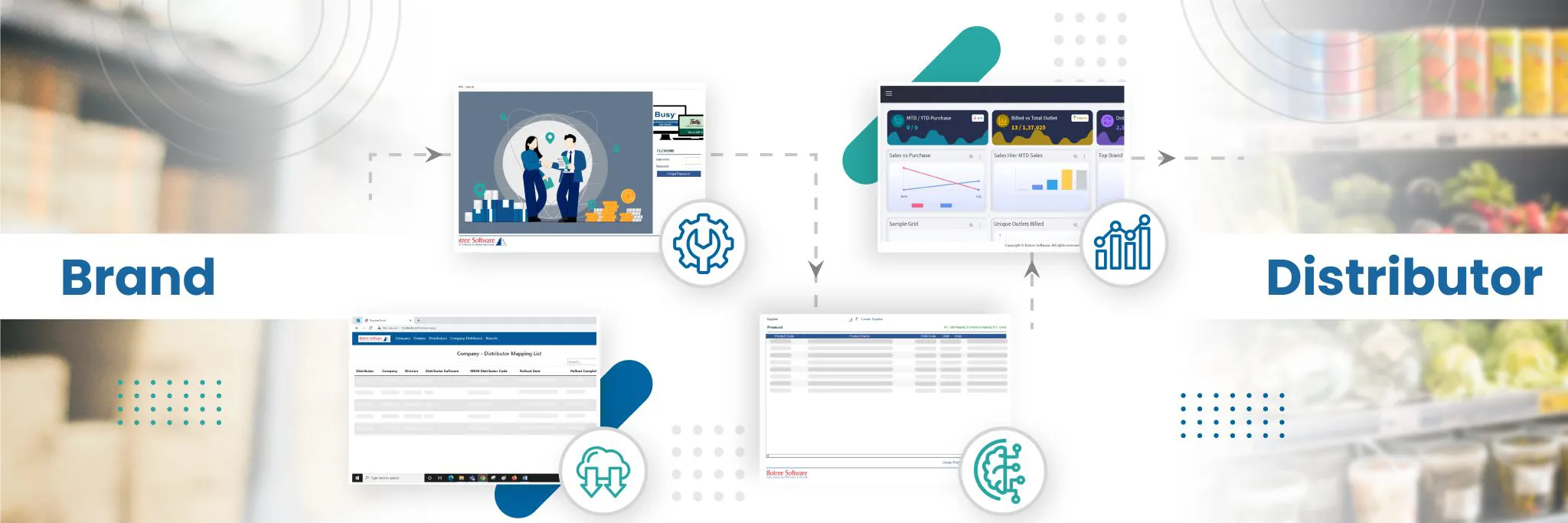
For example, Botree FlexiDMS offers a flexible model that seamlessly captures secondary and inventory data from the distributor’s accounting software without hassles. Using this convenience, you can start by capturing the data of the top 20% of distributors or highest-revenue regions who account for over 60-70% of your business.
This allows in driving business or a new product launch success through data-backed strategic decisions. This is called the 80/20 rule, or Pareto Principle in FMCG, that allows you to focus on key areas, maximize efficiency and profitability.

Senior Specialist - Content Marketing
Meet Priyanka Allu, our in-house content marketing specialist. With a background in literature and communications, Priyanka brings in her expertise in crafting compelling brand narratives and engaging content across various marketing channels. Outside of work, you can find her quickly escaping from the mundane city life by the beach or mountains, spending quality time with loved ones.


Stay updated with the latest trends and insights.